


The equity markets are undergoing one of the largest revolutions of their lifetime, and Alphabet is front and center. Investing in a company like Alphabet has historically meant exposure to multiple relatively predictable, profitable businesses, with positive cash flow generation every quarter for more than 15 years. That has changed as of Q2 2026; the company now has cash outflows and is expected to spend significant capital over the coming years. Right now, the expected ROI is largely unknown from an investor perspective, since few companies have managed to implement AI and extract value from it. Competition at the top is immense, not only in AI; Alphabet’s other core businesses are also under high pressure.
Despite that, Alphabet is one of the best-positioned businesses in the world to benefit from and push AI into the next era.
Company profile
Theme: Full-stack AI, Direction: Buy
Symbol: GOOGL, Exchange: NASDAQ
Sector: Communication Services, Industry: Internet Content & Information
Fair intrinsic value: $345 (0%), as of September 18, 2026
Note: equity risk premiums and the risk-free rate are elevated at the time of valuation, heavily pressuring fair intrinsic value and upside.
Market capitalization: $4 275 285 million
Pricing data: P/S 9.59x, P/E 17.51x
TYPEFCAPITAL.COM
Consider following me on X and YouTube.
This article is for informational purposes only and does not constitute investment advice or an offer to buy or sell securities.
A diversified business
Google has been one of the AI winners in 2026, the basket of stocks that have accounted for a majority of S&P 500 returns in 2026. The S&P 500 index excluding AI-related stocks ($SPXXAI) returned less than half of the 11% gains of the overall S&P 500 in 2026, which is also about what GOOGL 0.00%↑ stock has returned year-to-date.
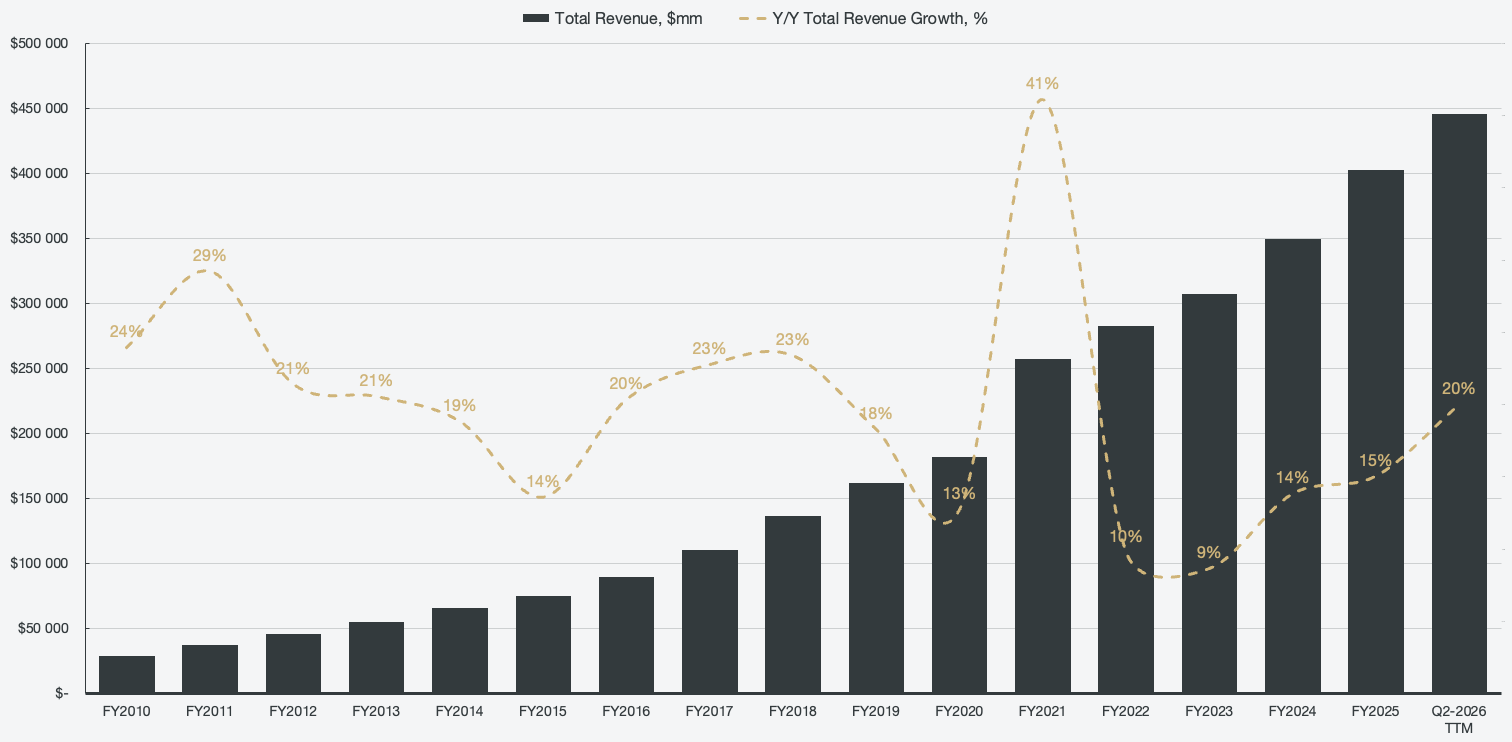
Revenue growth has steadily been accelerating after the COVID boom and subsequent bust, largely driven by Google Cloud. However, there are a myriad of different lines of business.
Figure 1: Revenue and revenue growth
Alphabet’s advertising segment has been the core driver of the business, both historically and currently. In essence, it is a two-sided marketplace where advertisers pay to reach people, and Google, along with its partner sites and apps, supply the consumer. Through Google Ads, advertisers buy placements by choosing a goal, campaign type, targeting, creatives, budget, and bid strategy. Goals can range from building awareness to driving sales, leads, or app installs. Alphabet gets paid based on clicks (CPC), impressions (CPM), video views, or sales conversions.
Publishers owning websites, apps, and even YouTube creators sell their leftover space. On sites and apps, they sell space using AdSense, AdMob, and Google Ad Manager. Google then runs an auction, bills advertisers, and distributes a portion of the revenue to the publisher. As an example, Content sites keep roughly 68% of AdSense ad revenue, and YouTube creators keep ~55% of revenue generated from ads shown in videos.
Figure 2: Segmented advertising revenue
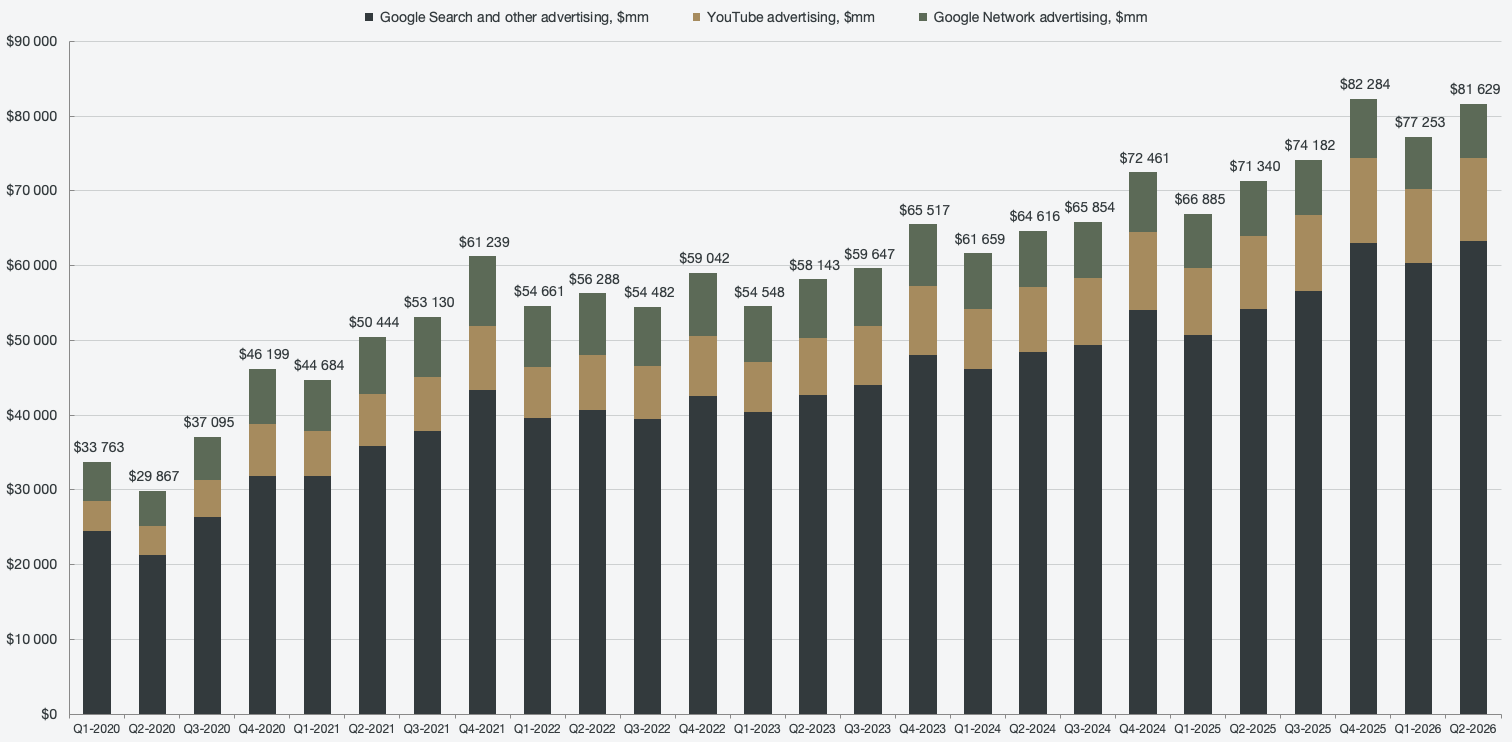
Advertising revenue is seasonal because businesses typically set budgets at a point in the fiscal year and distribute them across quarters, with a heavy lean toward the holiday season in Q4. As it has been the backbone of Alphabet’s whole business for as long as anyone can remember, most bear arguments target this segment. There is a fear that AI will disrupt search, which accounts for ~80% of total advertising revenue. The argument is that conversational AI will drive consumers away from querying the web.
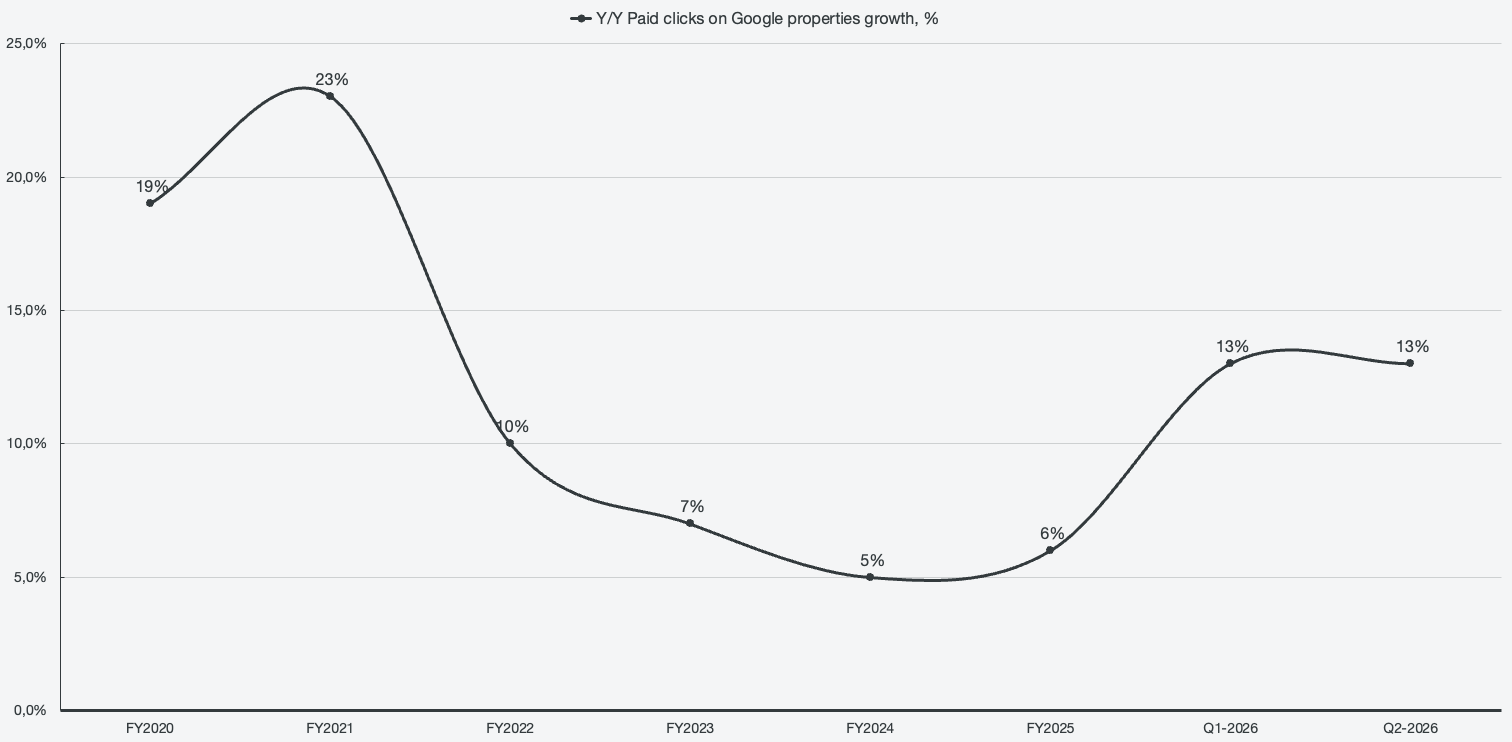
If AI were eating away at search queries, Alphabet would need to defend its revenue through pricing. Fewer queries would need to be monetized even harder, since the segment has steadily grown despite the launch of ChatGPT and similar AI interfaces years back. The data shows otherwise: growth in paid clicks across Google’s properties had been decelerating, but is now showing the strongest growth since 2021. Volume is driving segment growth rather than pricing.
Figure 3: Google property paid clicks growth
Google’s own AI overview and AI Mode seem to be expanding the monetizable events. However, Alphabet is notably inconsistent in reporting AI-related figures, making it hard to gauge a general trend. AI Mode passed one billion MAUs globally in Q2 2026, which is up from over a hundred million MAUs in the U.S. and India a year prior. Unfortunately, while the increase sounds impressive at face value, the numbers aren't comparable, as the latter excludes a large swathe of users. In addition, the most common queries AI interfaces handle aren't the most monetizable, since they are conversational rather than directly actionable.
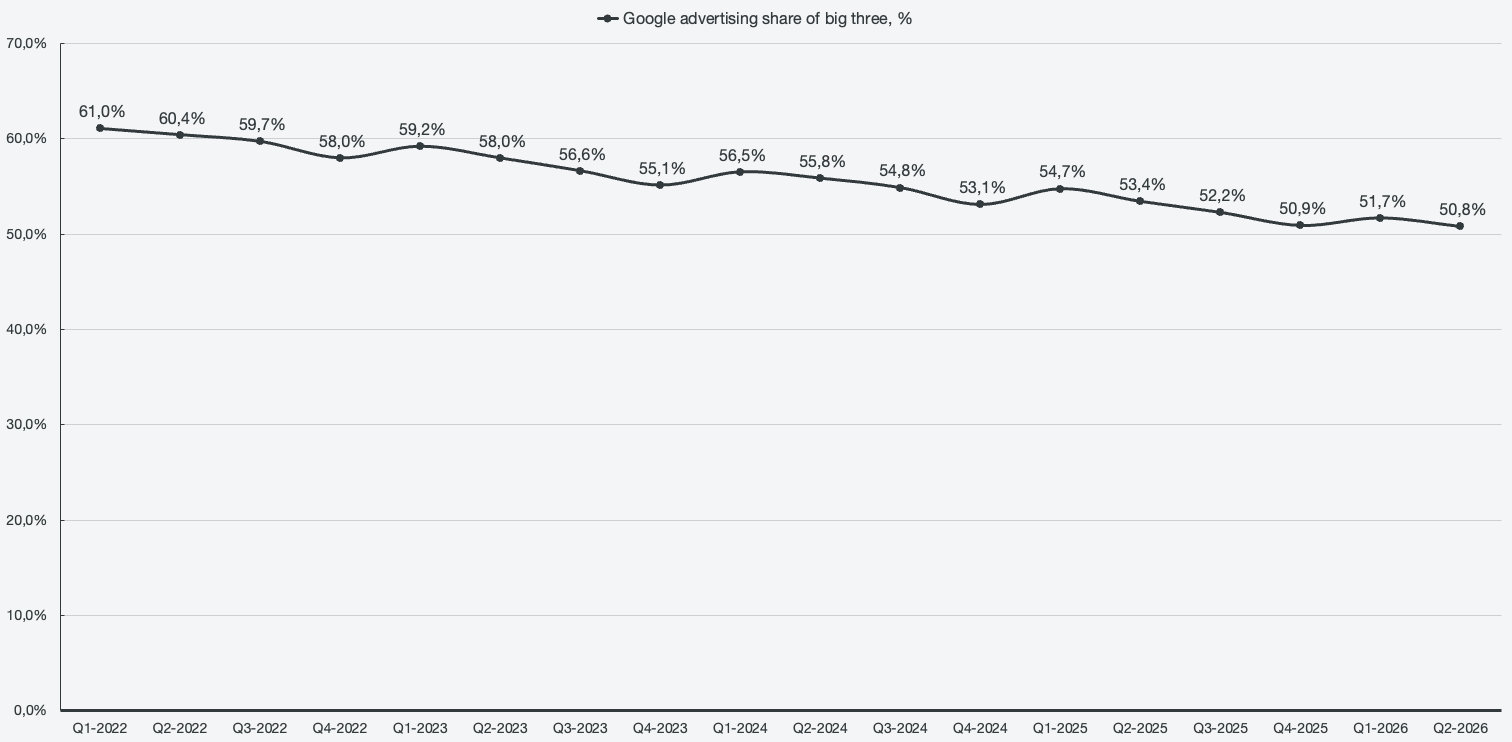
The advertising revenue market as a whole is set to accelerate, with projected global advertising revenue growth of 9% Y/Y in 2026 (up from 8% in 2025), per GroupM/WPP Media. In 2025, Google gained implied market share in the global advertising market compared to 2024, with a 27.3% implied market share versus 26.5% the prior year. However, among the big three global advertising players, Google is consistently losing market share. The composition of the big three is Amazon, Meta, and Google.
Figure 4: Google advertising market share of big three (Amazon, Meta, Google)
Alphabet stock is subject to volatility as the search business faces constant regulatory scrutiny. For example, Alphabet has arrangements with Apple to make Google the default search engine for its browsers, accounting for a large share of mobile queries. In addition, antitrust has targeted Google repeatedly, with a Google Chrome browser divestiture being on the table as recently as Q4 2025, and a recent case that closed just a few days ago relating to its ad tech.
Google owns the dominant tools on both sides of the market, meaning both advertisers and publishers. In the middle, the ad exchange (AdX) platform is used for auctions. Because of Google’s dominance, it was reported that Google took an outsized cut of every advertising dollar, starving digital publishers and news organizations of revenue. A coalition of states and the U.S. Department of Justice accused Google of illegally monopolizing the digital advertising technology market, asking for a ruling that would force Google to divest and sell off its AdX exchange. Judge Brinkema deemed a forced sale too disruptive, and the court instead opted for behavioral remedies.
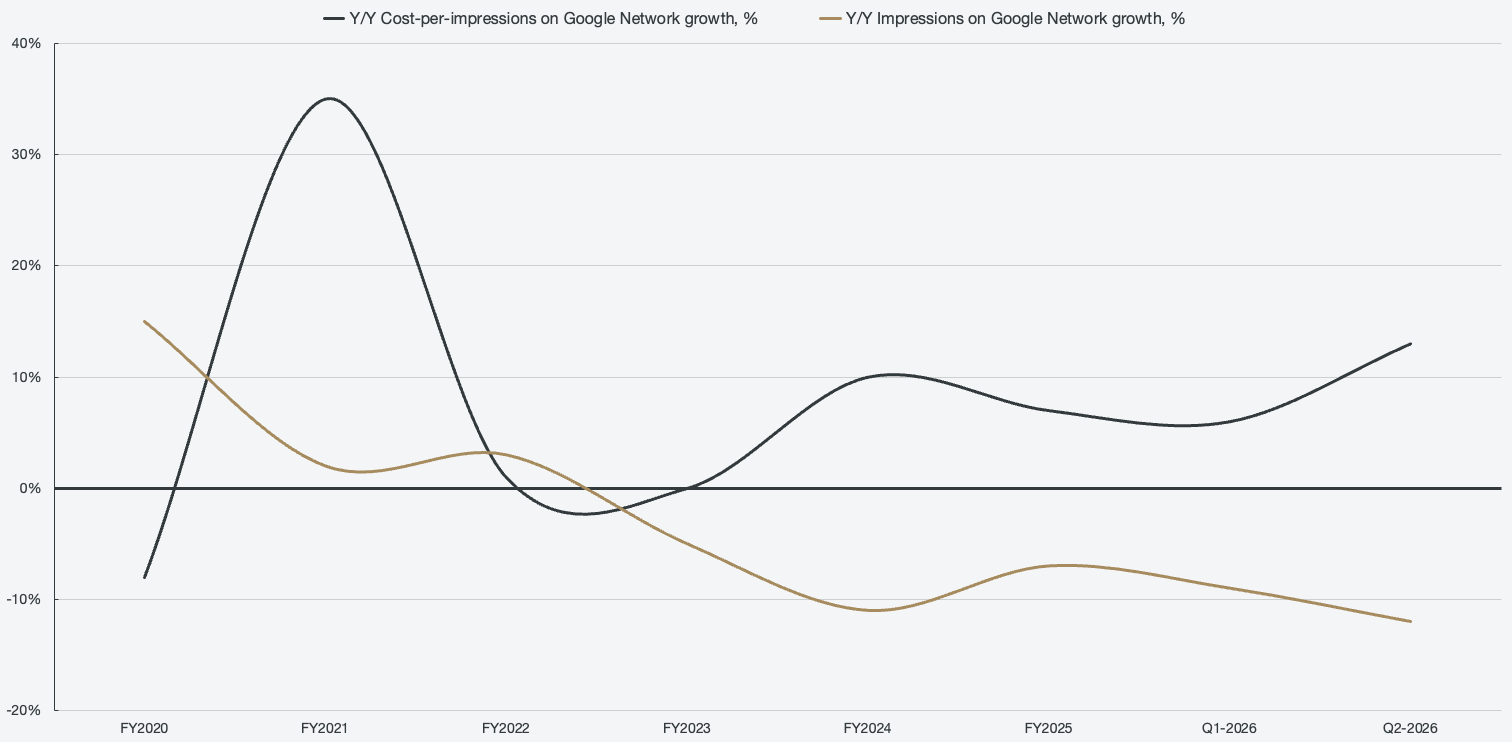
Google's network advertising segment has declined since 2022, with low single-digit revenue loss each period. Network impressions fell 12% Y/Y in Q2 2026, and cost per impression increased by 13%. That is the opposite dynamic as witnessed on Google properties. The network is not a core engine, but still accounts for ~$30-32 billion every year for the past 5 years, about ~10% of total advertising revenue.
Figure 5: Google network cost-per-impression growth and impressions growth
Search queries and page loads trigger real-time auctions that finish in milliseconds. Google doesn’t choose a winner based on the highest bid. Instead, Google computes an Ad Rank from the eligible ads based on factors that include the bid, the quality of the ad and its landing page, how competitive the auction is, the search context, which includes the user’s device, location, and time, as well as the expected lift from extensions like call buttons, prices, and site links. Google generates a quality score from expected click-through rates, ad relevance, and landing page experience, then uses it in the auction. A more relevant and useful ad can outrank a higher bidder and usually pays less per click. The price isn't an advertiser’s full max bid; instead, it tends to pay just slightly above the second-place advertiser.
Campaign types include tightly controlled Search ads with specific parameters set and AI-driven campaigns that spread the advertiser’s budget across Search, YouTube, Gmail, Maps, and other platforms, letting Google choose placements and bids.
Advertising flywheel summary
Free products like Google Search, YouTube, Android, Maps, and Gmail attract users.
The user’s habits and queries, watch history, and location create a signal that helps the advertising platform match ads to users and specific moments.
Better matching makes ads more useful and, in turn, more tolerable to users, which increases the payout for advertisers.
Advertisers’ money funds the free products.
While the backbone of the business remains advertising, the excitement in the markets is surrounding the AI narrative, and for good reason. Growth of the segment has accelerated significantly in recent periods, recording 82% Y/Y growth in Q2 2026.
