It's almost here: the most hyped and largest IPO of all time, along with SpaceX. Anthropic has built the fastest-growing enterprise business of all time, but its IPO price is still a stretch, given the challenges ahead.
Most of Anthropic’s revenue is consumption-based, meaning the business charges for the compute customers use. In an AI buildout where compute is becoming more efficient, most frontier models are equivalent, and customers are becoming capital-aware, sustaining its impressive growth for many more periods will be a tall order.
Company profile
Theme: Frontier AI (SI), Direction: Sell
Symbol: ANT, Exchange: NASDAQ
Sector: Information Technology, Industry: Software, AI models and platforms
Fair intrinsic value: $999 360 million, as of November 2, 2026
Market capitalization: $1 750 000 million (expected mid-point)
Pricing data: P/S 18.1x (2026E), P/E N/A
TYPEFCAPITAL.COM
Consider following me on X and YouTube.
This article is for informational purposes only and does not constitute investment advice or an offer to buy or sell securities.
The company was founded in 2021 by seven researchers who had just left OpenAI, and it had little of a product for the first two years. Claude, Anthropic’s large-language model (LLM), was competitive, but not differentiated. The real commercial inflection point came when Claude Code launched as a research preview in 2025. Claude went from typing out answers to questions to becoming an agent that can plan, write, test, and commit code, and developers ate it up. Later, agentic use was introduced across a wide range of tasks and integrations with Claude Cowork. Anthropic was among the first to scale both types of AI use, and it benefited from first-mover advantage. Revenue increased from $386 million in 2024 to $4.6 billion in 2025. In the first half of 2026 alone, Anthropic has recorded $16.3 billion in revenue.
The most valued frontier lab
Anthropic develops the Claude family of AI models, which to date consists of four classes: Mythos, Opus, Sonnet, and Haiku, each positioned to deliver an efficient compute-to-cost-and-speed ratio. I listed the models in order from highest to lowest capability, slowest to fastest speed, and highest to lowest relative cost. In essence, Mythos is intended for frontier tasks, and Haiku for high-volume, simple tasks.
Mythos: Highest capability, slowest speed, highest relative cost
Opus: Very high capability, moderate speed, high relative cost
Sonnet: High capability, fast speed, medium relative cost
Haiku: Good capability, fastest speed, lowest relative cost
Customers can access the models in three ways: through the Claude Platform, an agentic development environment using the same building blocks Anthropic uses internally; through first-party applications downloaded to a desktop or used on the web; or through major hyperscaler clouds (AWS, Google, and Azure). A subscription provides a weekly and hourly usage allotment, and beyond the allotment, customers can pay for usage metered in tokens.
Anthropic’s approach to models focused on coding capabilities first, as each iteration would contribute to its successor, speeding up development. In September 2026, Claude wrote more than 90% of contributions to Anthropic’s codebase, and code volume per engineer was over 45 times the 2024 average. Anthropic also took a different approach from competitors like OpenAI and Alphabet, which targeted consumers. Instead, Anthropic built its research priorities and product roadmaps with enterprises in mind, which explains why 74% of its H1-26 revenue came from customers paying at least $100,000 per year.
Unparalleled growth
On the AI frontier, it is all about revenue and not much else. Profits and efficiency are believed to follow naturally, so all attention is directed toward acquiring compute and serving it. And growth is exactly what Anthropic has been exhibiting, and among listed companies, Anthropic is the fastest-scaling company to ever exist.
Several key events over the past few quarters explain the explosive growth. In November 2025, Claude Opus 4.5 was released. The model was more capable than Opus 4.1 and also cheaper per task, which opened up new use cases. Work previously deemed too expensive to hand off to Claude became worth delegating, and usage rose with the price drop. In addition to Claude Code, Cowork launched in January 2026, using agents that spent tokens far faster than chats. It was also the start of several enterprise-level apps and integrations, including Claude for Financial Services, Financial Advisors, Healthcare, Life Sciences, Legal, Education, and Government. Each app had data connectors, skills, and compliance controls pre-loaded for easy deployment. The launch of multiple industry-specific apps also caused large parts of the market to sell off amid fears of AI disruption.
We expect our revenue growth rate to decline over time, and it may decline significantly and more rapidly than we anticipate as our revenue base increases and as the market matures.
Anthropic S-1, Management’s Discussion and Analysis
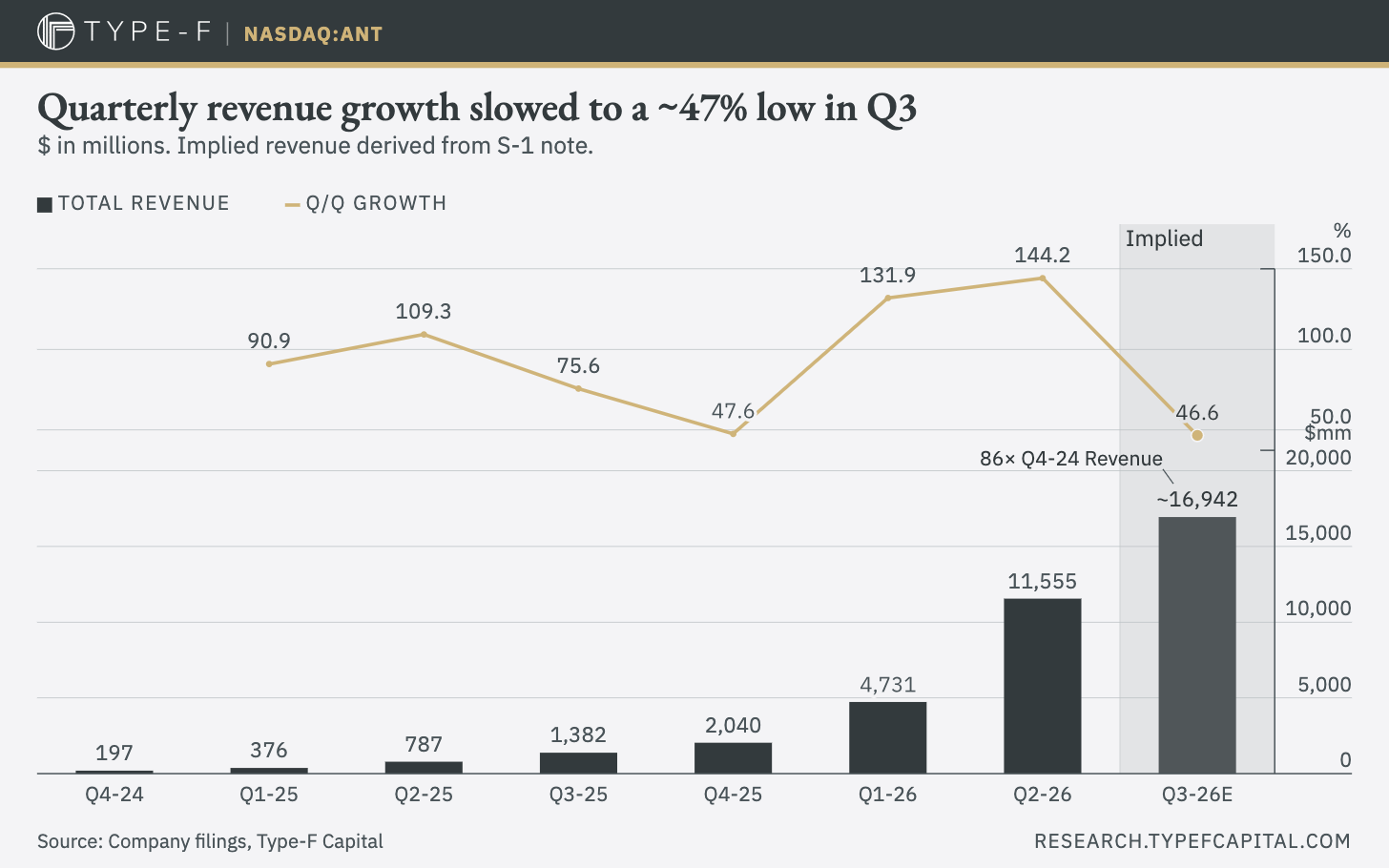
Revenue grew exponentially into 2026, with over 100% Q/Q revenue growth in both disclosed 2026 quarters. However, growth is starting to slow down, and the S-1 filing warns that growth may decline faster than expected. We don’t have exact Q3 2026 figures, but the S-1 notes that Q3 2026 was 86 times Q4 2024 revenue of $197 million, which would mean ~$17 billion in revenue and 47% Q/Q growth, down from 144%.
Anthropic disaggregates revenue into two segments: subscription-based and consumption-based. Consumption-based revenue, what Anthropic calls pay-for-intelligence, comes from customers paying for the tokens their applications and agents consume, based on the selected model. In H1 2026, consumption-based revenue accounted for 80% of total revenue. Subscription-based revenue comprises various Claude subscriptions for individuals, as well as team and enterprise plans. Both subscription types can overlap, as a user who exhausts their allotted compute can pay on a consumption basis until their quota resets.
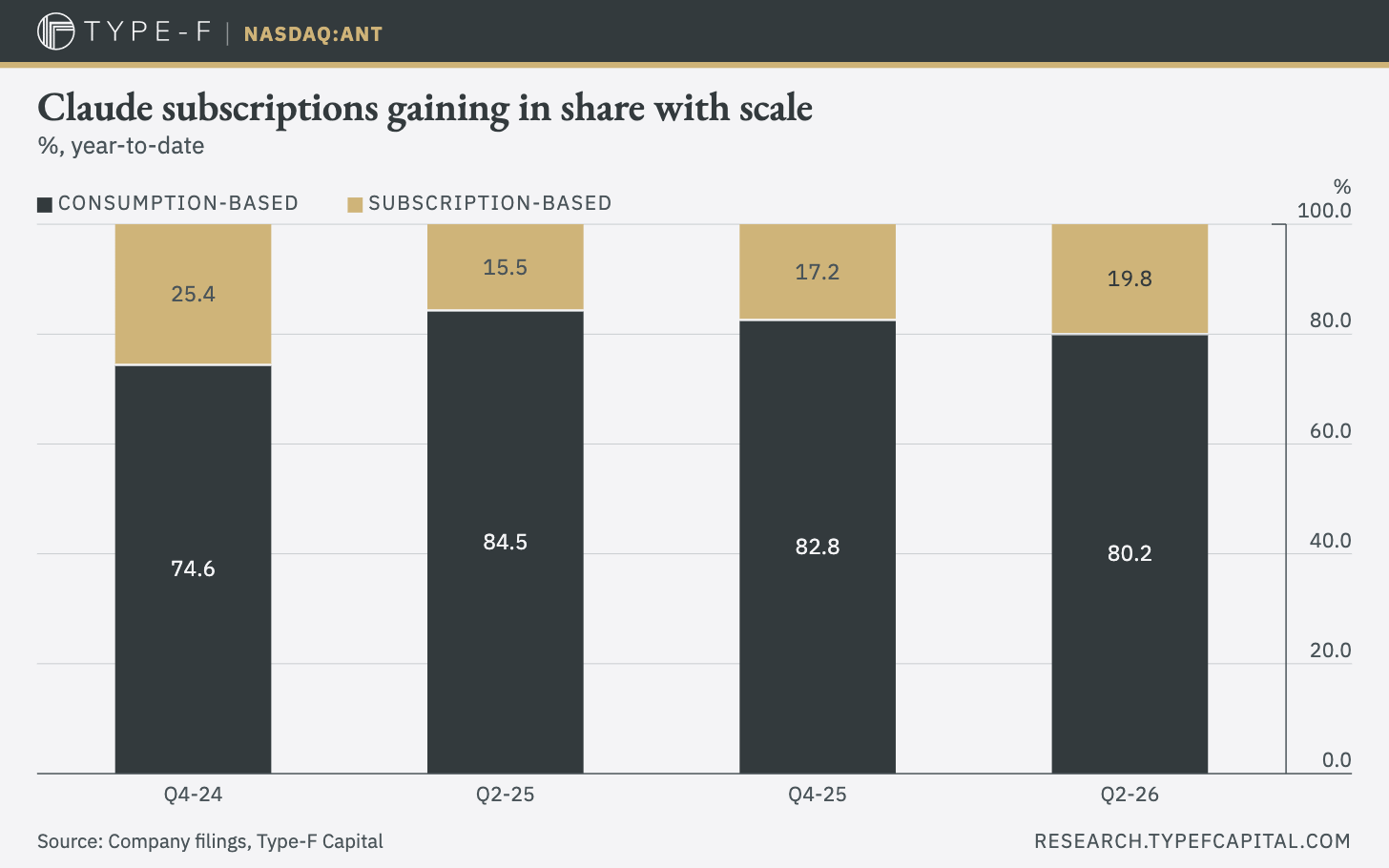
In general, investors want to see subscription-based revenue increase in share, as it is generally stickier. However, in AI, switching costs are low, and subscriptions don’t provide the traditional safety net and backbone investors might expect. On the consumer side, it is easy to migrate to whichever company has the most capable model at any given time, and that changes frequently. Within enterprises, it is a bit stickier if a workflow is built around a specific model, but I believe enterprises are becoming more cautious about tying their business to one model.
For Anthropic specifically, enterprise adoption has skyrocketed with the launch of industry-specific applications throughout 2026. In Q4 2025, there were ~1,500 customers that had spent $100,000 or more over the trailing twelve months. That figure quadrupled to 6,000 by Q2 2026, then doubled again by Q3 2026 to 11,900.
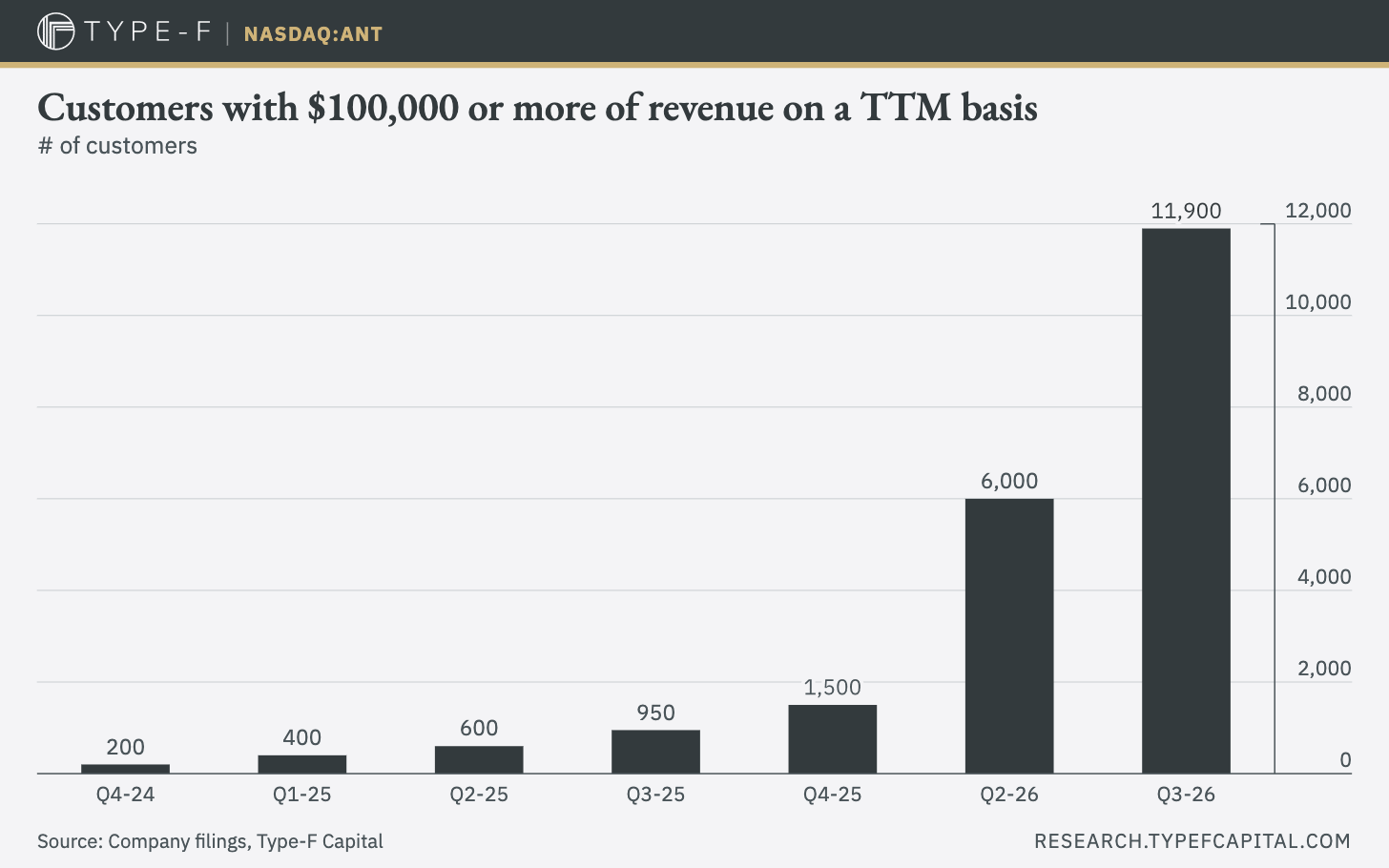
Of the 11,900 paying over $100,000 on a TTM basis, 1,900 pay over $1 million per year, and about 250 customers pay over $10 million. Per Anthropic, over 50% of the Fortune 500 companies are paying customers of at least $100,000 per year, and over 30% of the Global 2000.
By looking at past growth, we can see how Anthropic’s revenue engine has changed. From 2024 to 2025, revenue from customers paying at least $100,000 or more rose from $220 million to $3.5 billion, while the number of such customers increased 7.5x and revenue per customer roughly doubled from $1.1 million to $2.3 million. On a log basis, 3/4 of that growth came from more large customers, and 1/4 from more spend per customer. In 2026, the balance has shifted toward more spending. In Q3 2026, net revenue retention was roughly 900%, which means customers that have been with Anthropic for over a year are spending about 9 times as much in Q3 2026 as they were in Q3 2025.
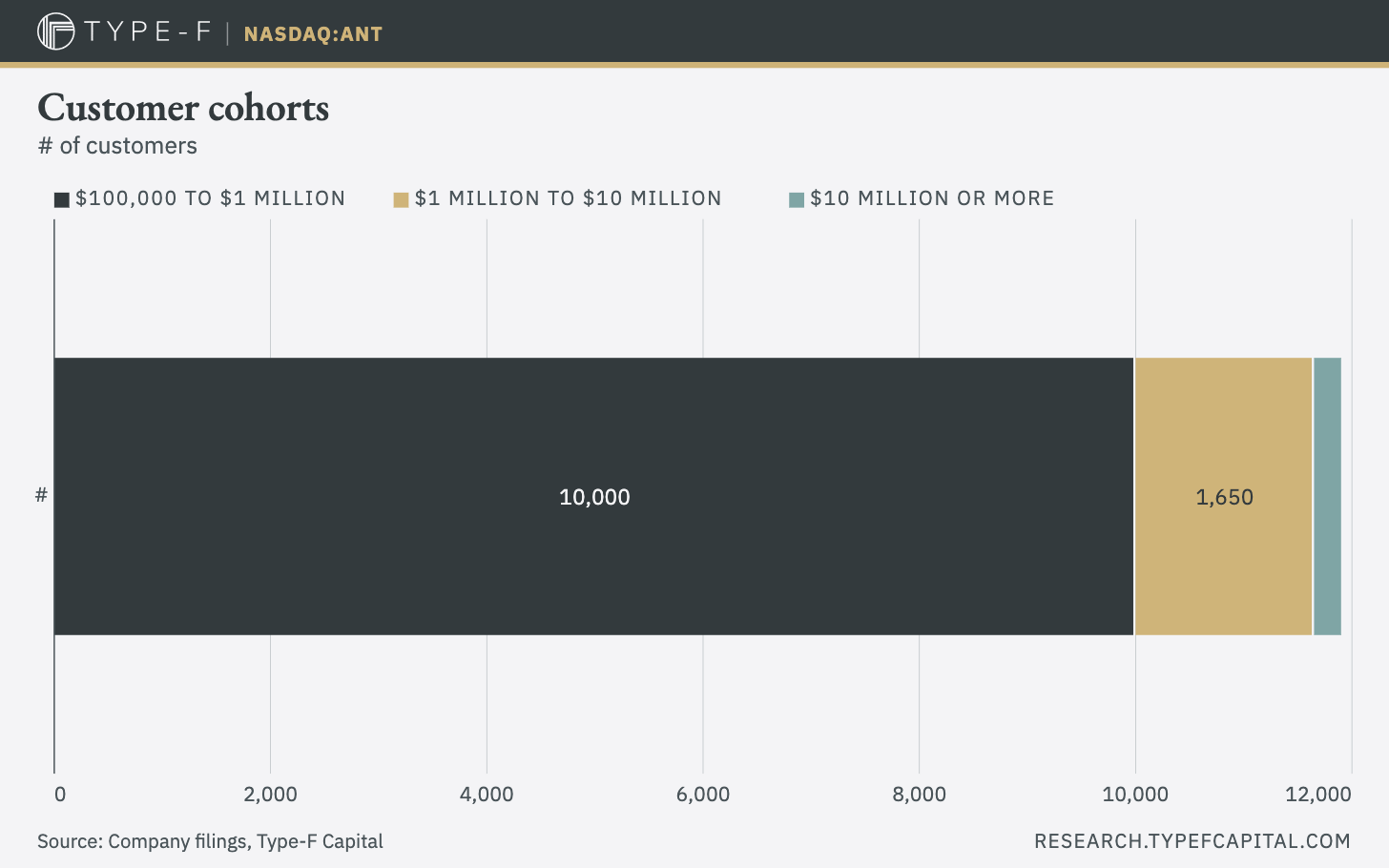
Anthropic’s customer concentration is falling, but remains a big threat considering the volatility of the AI industry. The top five customers accounted for 36% of revenue in Q1 2026, and dropped to 21% by Q3 2026. The two largest customers accounted for 20% in the first half of 2026. Meanwhile, ~40 million customers paid less than $100,000 over the TTM, leaving plenty of room to keep scaling. Future growth is more about increasing usage per customer than raw customer count, which poses its own threats as models get increasingly efficient and commoditized.
Consumption
At 83% of total revenue in 2025 and 80% of revenue in H1 2026, it accounts for nearly all of the revenue expansion reflected in the 900% NRR figure. Management sees consumption as the core driver moving forward:
We expect consumption-based revenue to continue to represent the substantial majority of total revenue for the foreseeable future.
Anthropic S-1, Management’s Discussion and Analysis
Consumption’s growth is both very fast and very fragile at the same time. Typically, it starts out as self-service: an engineer might try Claude Code, then the team adopts it, and the bill keeps growing with usage before procurement is involved. Anthropic has a direct sales and AI team of forward-deployed engineers who build out custom solutions for customers, which then get adopted enterprise-wide. A growing number of enterprises sign annual or multi-year contracts with a minimum spending stipulated in exchange for a set price list, which is how remaining performance obligations can increase. In Q4 2025, it was $2.1 billion, and by Q2 2026, RPO was up to $10.8 billion, which is still only ~0.55 times trailing revenue. When a new model ships, most customers move their workloads to the latest model, and the spending expands into new use cases with each release, per the S-1 filing.
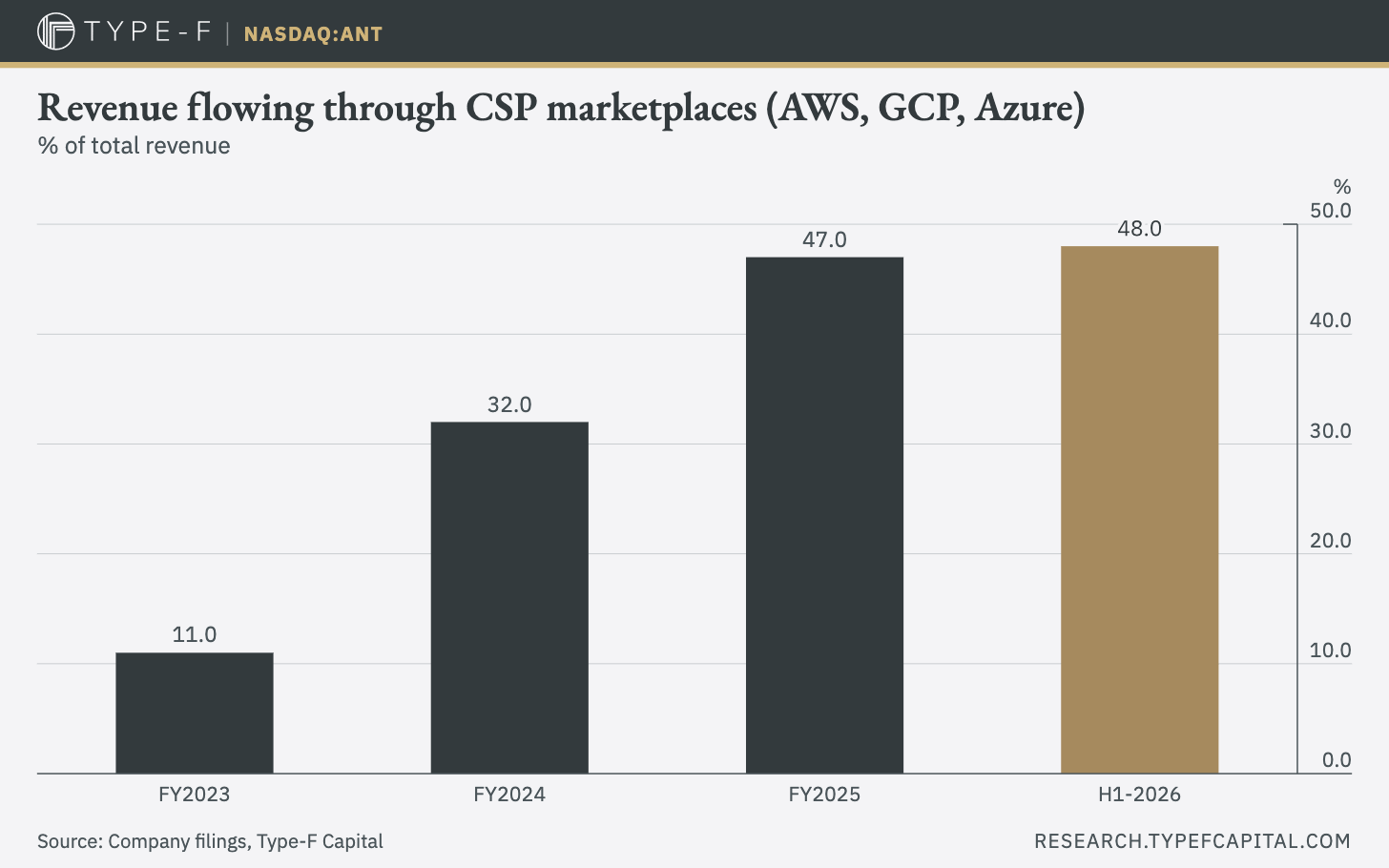
In the first half of 2026, 48% of revenue came from cloud marketplaces on AWS, GCP, and Azure, where Anthropic pays each provider a fee.