The stock has had a rough year, with its share price down over 50%, but that repricing might be just what I needed to get interested in this business. AppLovin has a large market share, very strong margins, low reinvestment needs, and a competitive positioning to capture future growth.
However, it doesn’t have a moat; does it need one to be an attractive investment at these prices?
Company profile
Theme: AI advertising, Direction: Buy
Symbol: APP, Exchange: NASDAQ
Sector: Communication Services, Industry: Advertising Agencies
Fair intrinsic value: $390 (+26.53%), as of September 29, 2026
Market capitalization: $103 886 million
Pricing data: P/S 15.2x, P/E 23.6x
TYPEFCAPITAL.COM
Consider following me on X and YouTube.
This article is for informational purposes only and does not constitute investment advice or an offer to buy or sell securities.
Dominance without a moat
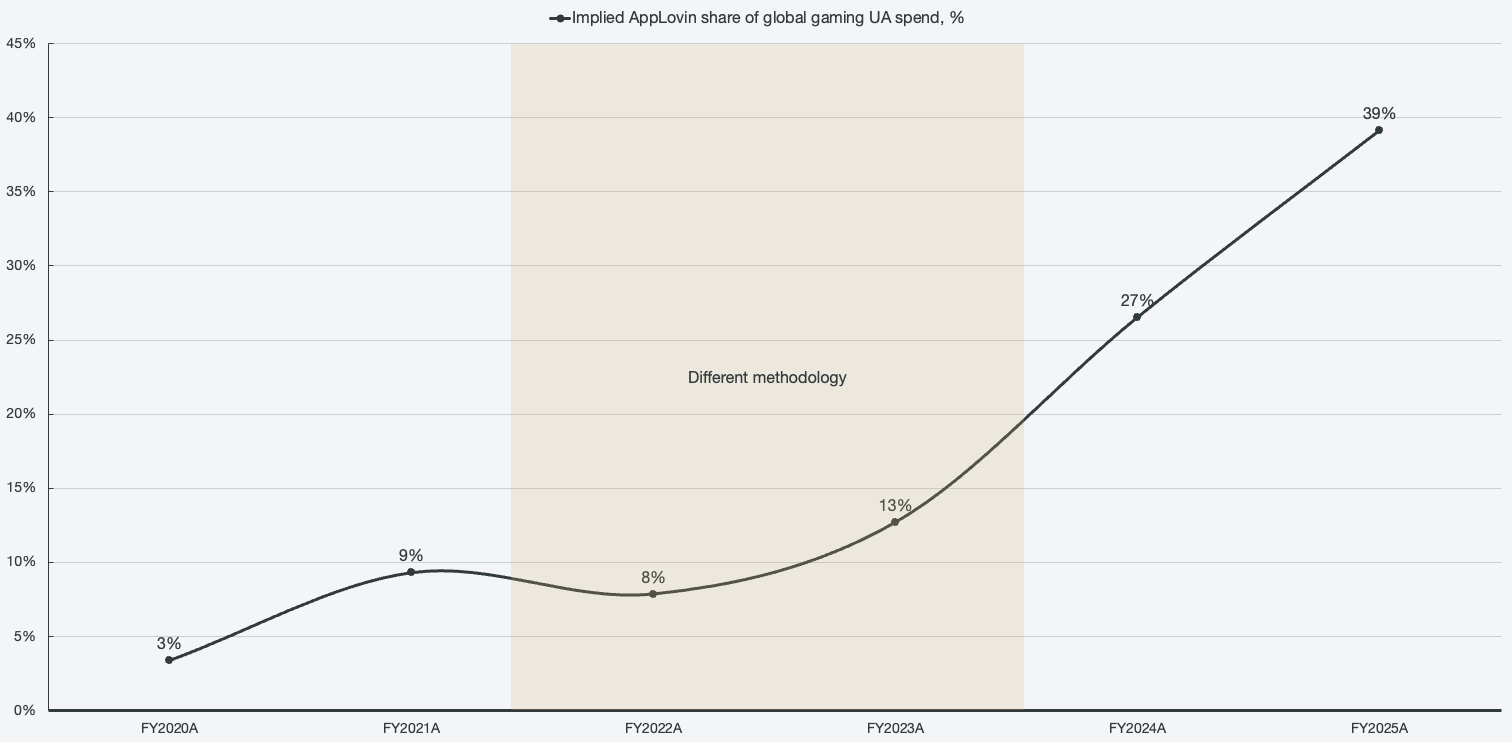
AppLovin has an implied 40% share of measured global gaming user acquisition spend in 2025 (AppsFlyer). But what does the company do, and how much growth is there left in the market for AppLovin to target?
The company sits on both sides of the mobile game advertising auction, similar to what Google GOOGL 0.00%↑ does with its Ad-tech stack, where it runs the exchange while also bidding on the buy side. MAX, which is AppLovin’s mediation platform, is where game studios decide which ad network fills each ad slot through auctions. Axon is on the other end, a machine-learning ad engine that is also the most successful bidder in the auction. In essence, AppLovin operates the auction house and also serves as the most successful bidder.
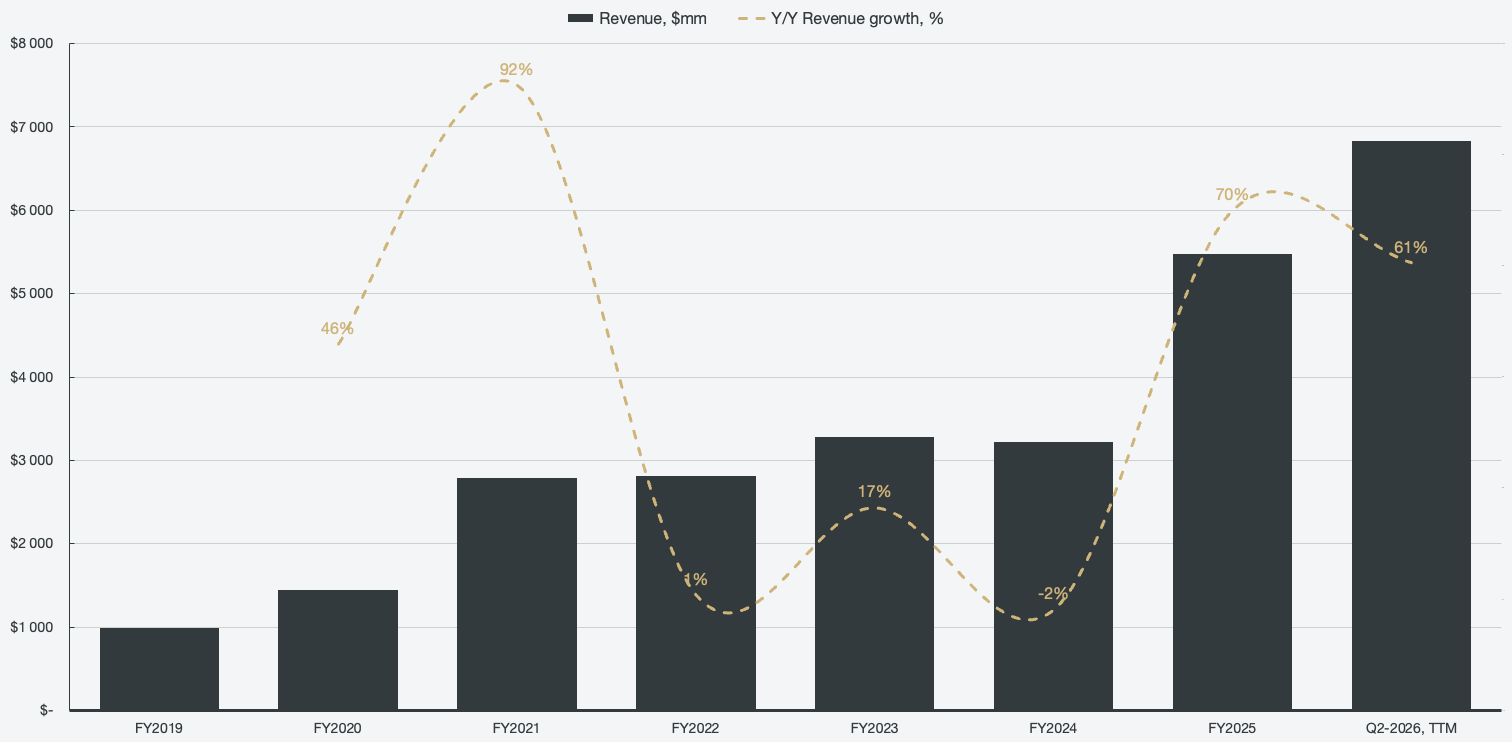
Figure 1: Revenue and revenue growth
The main business is essentially three components. Axon Ads Manager is the demand-side engine where advertisers set a return-on-ad-spend (ROAS) goal. Axon then bids for users predicted to convert. AXON AI is the company’s proprietary model that scores whether a user will convert (install, pay, or buy what is being advertised) in microseconds, and then prices the bid. MAX, the supply-side mediation, runs a unified real-time auction across over 20 networks inside publisher apps. It currently has over a billion daily active users, most of whom are in casual games. These three components work together to match performance advertisers to mobile inventory with the goal of the advertiser’s value exceeding its ad cost.
In short, advertisers invest capital toward a ROAS target. AXON prices the impressions based on predicted conversion value, and then pays the publisher on a CPM-like basis, with AppLovin keeping the spread. The auction has several flywheels, and it is tied to what differentiates AppLovin.
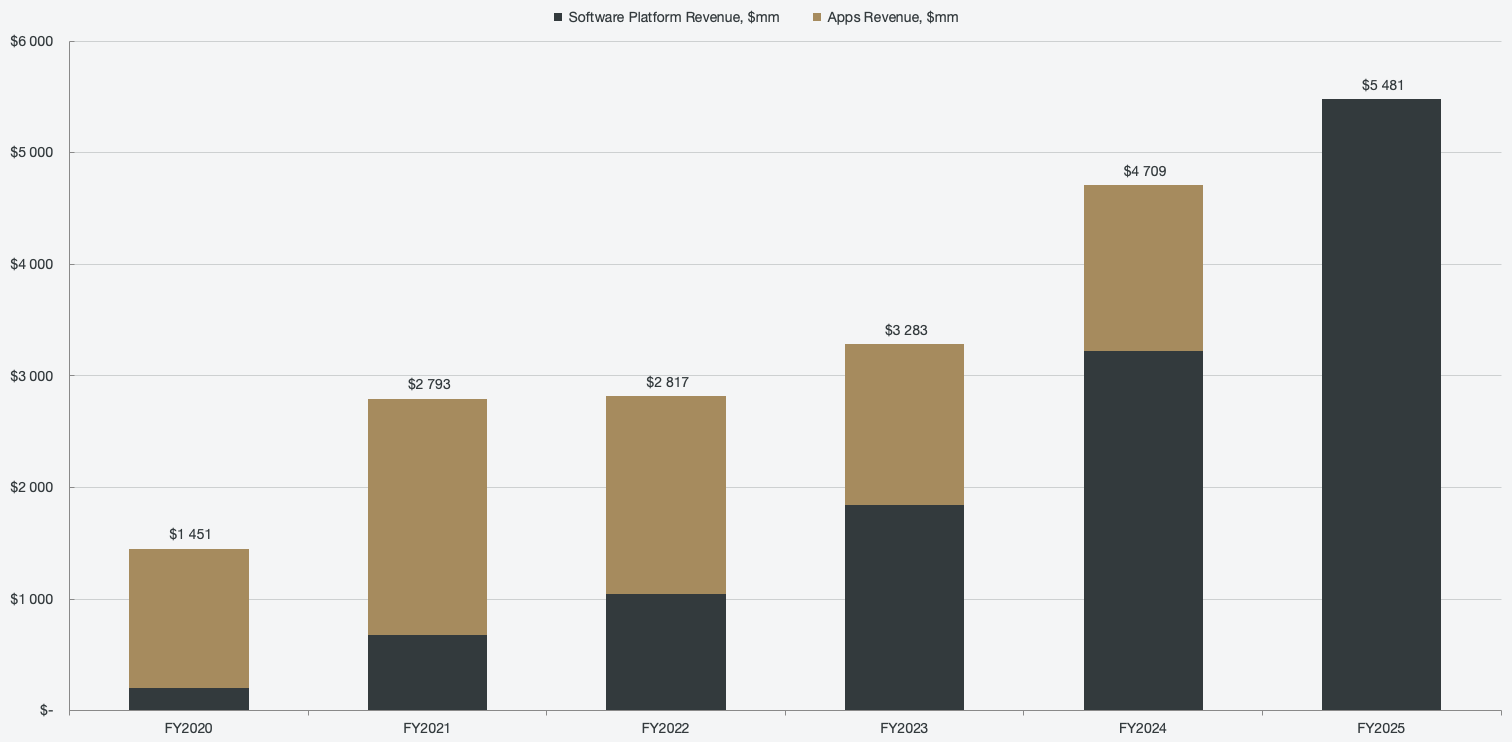
Historically, AppLovin also owned apps, a segment that was divested in 2025. Owning the apps was crucial for the core business, since apps meant users, and users meant data. Gaming studios are not too keen on sharing their user data with third-party companies like AppLovin, so they had to find their own solution. They bought and operated several apps in order to train AXON AI, giving AppLovin a technology edge over other market participants. Once the initial training was complete, AppLovin divested the apps segment, making it a pure AI advertising business.
Figure 2: Segmented revenue
Now, more spending means more auction outcomes, which become training events and improve the model. A better model increases its win rate on MAX, improving ROAS and driving more ad spend. It is absolutely crucial that the model keeps compounding in competence, since barriers to entry are very low and there is essentially no moat besides a technological advantage that delivers better ROAS for advertisers. There are no switching costs in this business; ad spend can be placed on the platform at any time, and it can dry up quickly if ROAS declines.
The global gaming user acquisition market is not expected to grow fast. That poses a problem for AppLovin, since it is already approaching a majority stake. There are no clean third-party estimates available, but Newzoo forecasts global mobile games revenue to grow in the mid-single digits over the coming years. AppsFlyer tracks global gaming UA ad spend, which is roughly 22% of global mobile games revenue, based on historical figures. Using that as a base against my own forecast for AppLovin, they will reach majority market share in 2026.
AppLovin reports revenue net of publisher payouts, meaning gross gaming ad spend through AppLovin is larger than reported revenue. The company does not disclose the take rate, so we have to make our own assumptions to measure market share. I assume a 50% net take rate, which may differ from the actual rate. This essentially means gross gaming ad spend is double the reported revenue. With that in mind, we can look at AppsFlyer’s reported global gaming UA ad spend to measure market share. However, 2022 was rebased, making it impossible to clearly read progress. The only real like-for-like comparison is 2024 to 2025.
Figure 3: Implied AppLovin market share of global gaming UA spend