


At the start of the year, management guided to $3.3 billion at the high end, already implying 50% growth from 2025. As Bloom Energy reported its Q3 2026 earnings, that estimate rose to $4.6 billion. During that time, Bloom Energy launched no new products or cut prices, while gross margins rose. The only changes were the buyer, financing, and, most importantly, capacity needs.
An AI data center does not care to compare Bloom’s fuel cells to gas turbines on cost performance. At this stage of the AI buildout, what matters is avoiding a center getting stuck with idle GPUs for years.
Company profile
Theme: Energy, Direction: Sell
Symbol: BE, Exchange: NYSE
Sector: Industrials, Industry: Electrical Equipment & Parts
Fair intrinsic value: $51.6 (-73.1%), as of October 26, 2026
Market capitalization: $62 361 million
Pricing data: P/S 16.3x, P/E 119.2
TYPEFCAPITAL.COM
Consider following me on X and YouTube.
This article is for informational purposes only and does not constitute investment advice or an offer to buy or sell securities.
At its peak year-to-date, the stock price was up ~300%. Even after its recent sell-off, the stock is still +120% YTD. The driver is easy to summarize: demand for energy is outsized, and Bloom Energy sells time. Its value is therefore tied to how long time stays scarce. Unfortunately for Bloom Energy, the queues that have created the time scarcity are finite. The current stock quote reflects a narrative that Bloom Energy will supply most of the world’s data center power demand for a decade, and I don’t see that happening.
Fuel cells were built for a problem that arrived late
The company designs, manufactures, and services its Bloom Energy Server, which is a solid-oxide fuel cell system. That’s a ceramic device that produces electricity by reacting fuel, such as natural gas, biogas, or hydrogen, with oxygen across a solid electrolyte at ~800C, without burning it. Bloom Energy manufactures these in Fremont, California, and assembles them into modules in Newark, Delaware. The modules are installed side by side to build plants ranging from a few hundred kilowatts to several hundred megawatts. The company then sells the systems to end users, utilities, and project-finance investors, and services them under long-term service contracts. As of September 2025, it had deployed about 1.5 GW across ~1,200 sites in nine different countries.
When the company was founded in 2001, the initial pitch was to provide clean, reliable on-site power for corporate campuses, hospitals, and retailers. The product worked, but it cost more than grid electricity, so it stayed niche. Bloom managed to survive on federal investment tax credit (ITC), on various complicated financing structures where customers buy power rather than equipment, and from a deal in South Korea in 2018 where SK bought systems under a renewable-portfolio mandate. The company went public and hasn’t posted a single full-year GAAP profit since, but that is about to change this year.
AI training and inference have created outsized electricity demand that is impatient, continuous, and enormous. Power demand was so large that interconnection queues at the end of 2024 were several years long. In addition, equipment meant to fill demand gaps became scarce, with turbine makers selling out production slots years in advance. Suddenly, Bloom Energy, which had been on the sidelines, found a clear use case because of its fast installation, modularity, easy permitting, and low emissions.
Figure 1: Total revenue and revenue growth
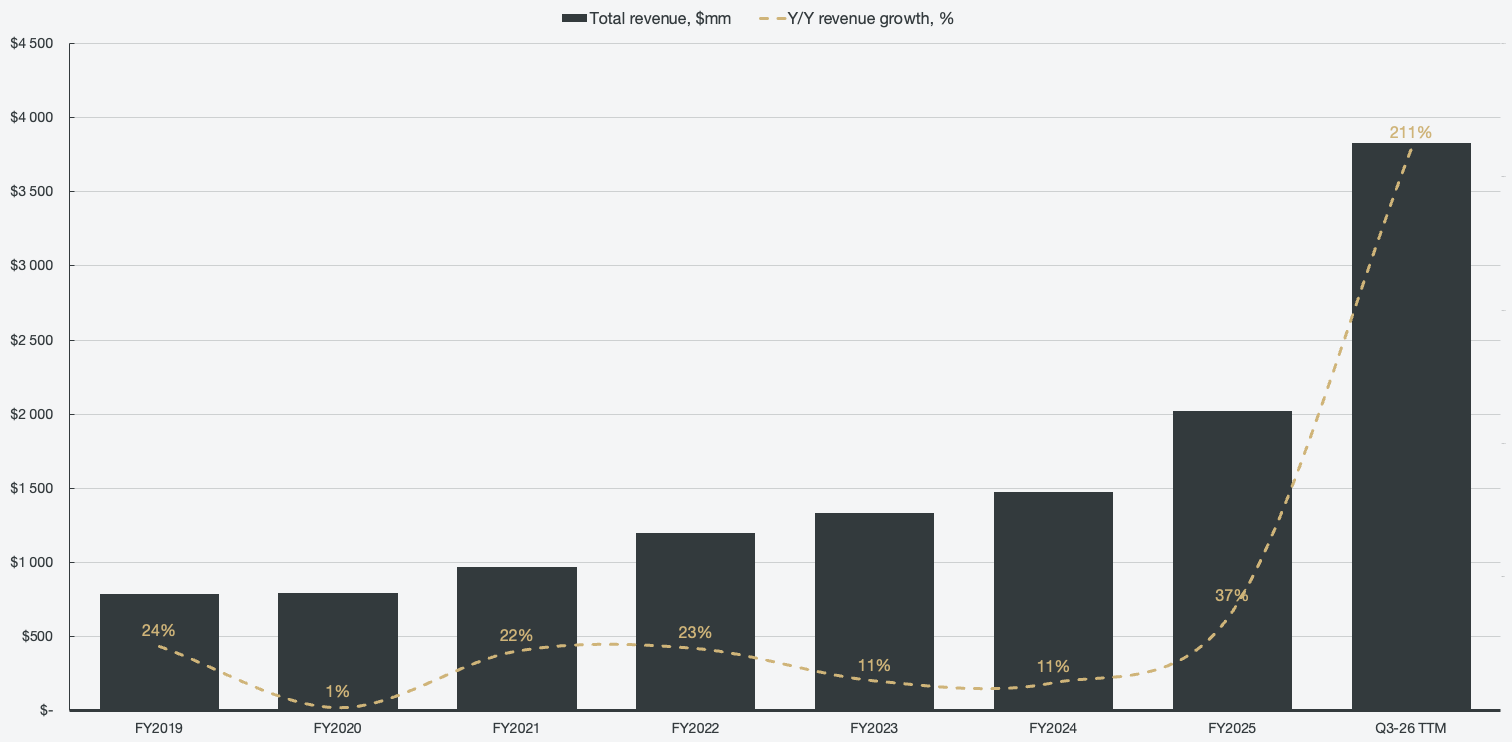
Bloom Energy looks like one of the major winners in the connected data center market. However, it didn't win by being the cheapest; it won because it was available, and that supply is finite. Turbines, engines, and grid capacity will catch up to demand, which means that Bloom has to start winning on attributes in the market that are durable: permanent primary power rather than bridge power, a servicing fleet that is compounding, and a cost per kilowatt that is competitive once customers are no longer desperate.
Business model
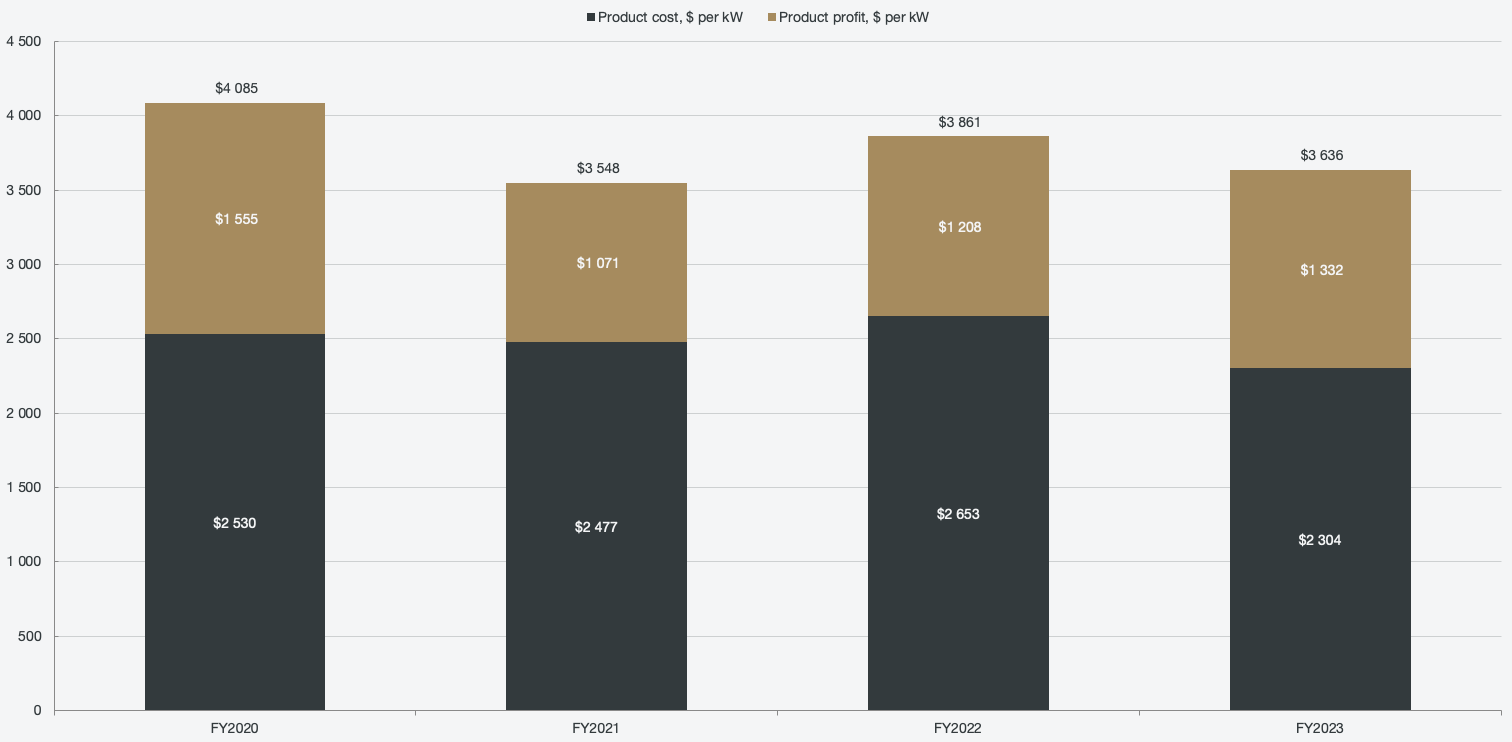
Bloom’s business is fairly straightforward. The value comes from three primary drivers: gigawatts delivered, revenue per kilowatt, and the installed fleet. Product and installation revenue equals the capacity Bloom ships in a year, multiplied by the revenue it earns per kilowatt. Revenue per kilowatt reflects the value of time-to-power to the customer, and in the current environment, that translates to the length of the queue the customer can skip. Every system that ships includes an operations and maintenance contract, meaning Bloom can collect service revenue from the fleet it deploys. Unfortunately, Bloom has stopped reporting product unit-economics KPIs, leaving investors to estimate what present-day values might be.
Figure 2: Historical segmented average selling price
The sales structure is interesting, as only a few end customers buy the equipment. Typically, a hyperscaler or neocloud signs for power, and then a financier buys the server from Bloom and ends up owning the plant. For example, Brookfield’s AI Infrastructure Fund, in which Bloom has a passive stake; Industrial Development Funding (IDF), backed by Oaktree, MUFG, and Morgan Stanley, with $2.6 billion committed; or a utility such as AEP that buys servers and then contracts the output. Oracle is a different customer that buys more directly from Bloom, a relationship that Bloom paid for in equity through a warrant of up to 3.53 million shares. The named commitments and their structure are as follows:
Oracle (Project Jupiter, New Mexico, and other sites)
Up to 2.8 GW. A direct purchase and warrant paid in Bloom stock (a $306mm contra-revenue asset).
Brookfield AI Infrastructure Fund
$25bn financing framework where the fund buys and owns plants, Bloom holds a passive stake of up to 9.9% in the fund..
AEP
1 GW framework; 702 MW Cheyenne plant for Google. Structured as utility buying servers and a 20-year power purchase agreement with Google, with a $4 bn AEP investment.
Nebius via IDF
300 MW campus where IDF buys the energy service.
SK ecoplant
~682 MW installed cumulatively since 2018, structured through a Korean assembly joint venture consolidated by Bloom.
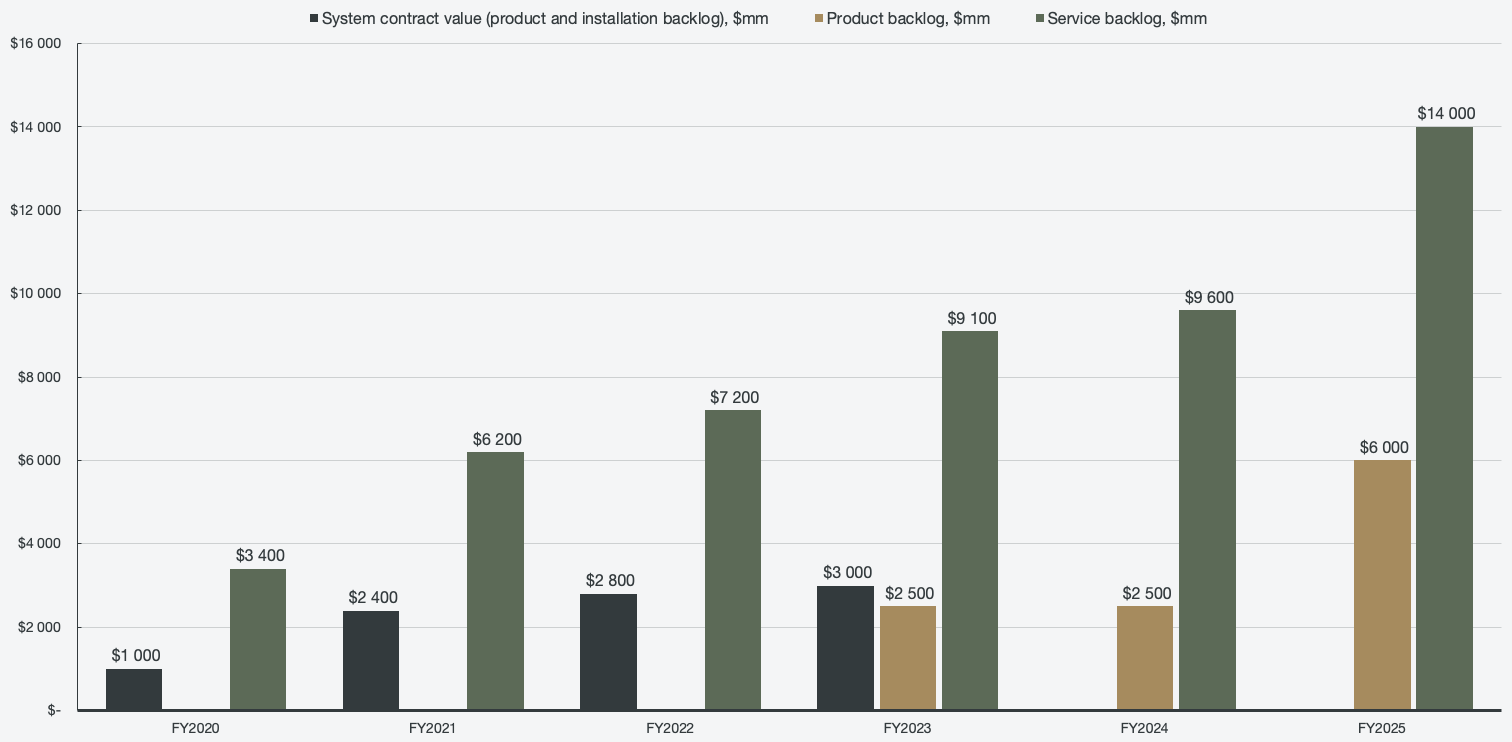
The problem with setting up these kinds of deals is that it hides two very important things for investors that affect valuation. First, the concentration. In Bloom’s 10-Q filings, it defines a customer as the contractual counterparty, “which in certain transactions may be a project-finance affiliate rather than the ultimate end user”. Using that definition, two counterparties account for up to ~70% of Q3 2026 revenue, split at 43% and 26%. The second point of concern is the gap between backlog and contracts. Bloom hasn’t reported product backlog since the end of 2025 (~$6 bn), but it reported $661 million in unsatisfied performance obligations as of Q3 2026, which is contractually committed. Most of what management has called backlog is framework agreements, financing shelves, and pipeline that hasn’t become an enforceable order, so it isn’t guaranteed.
Figure 3: Segmented backlog
The end market
Bloom reports revenue by type, as follows:
Figure 4: Segmented revenue
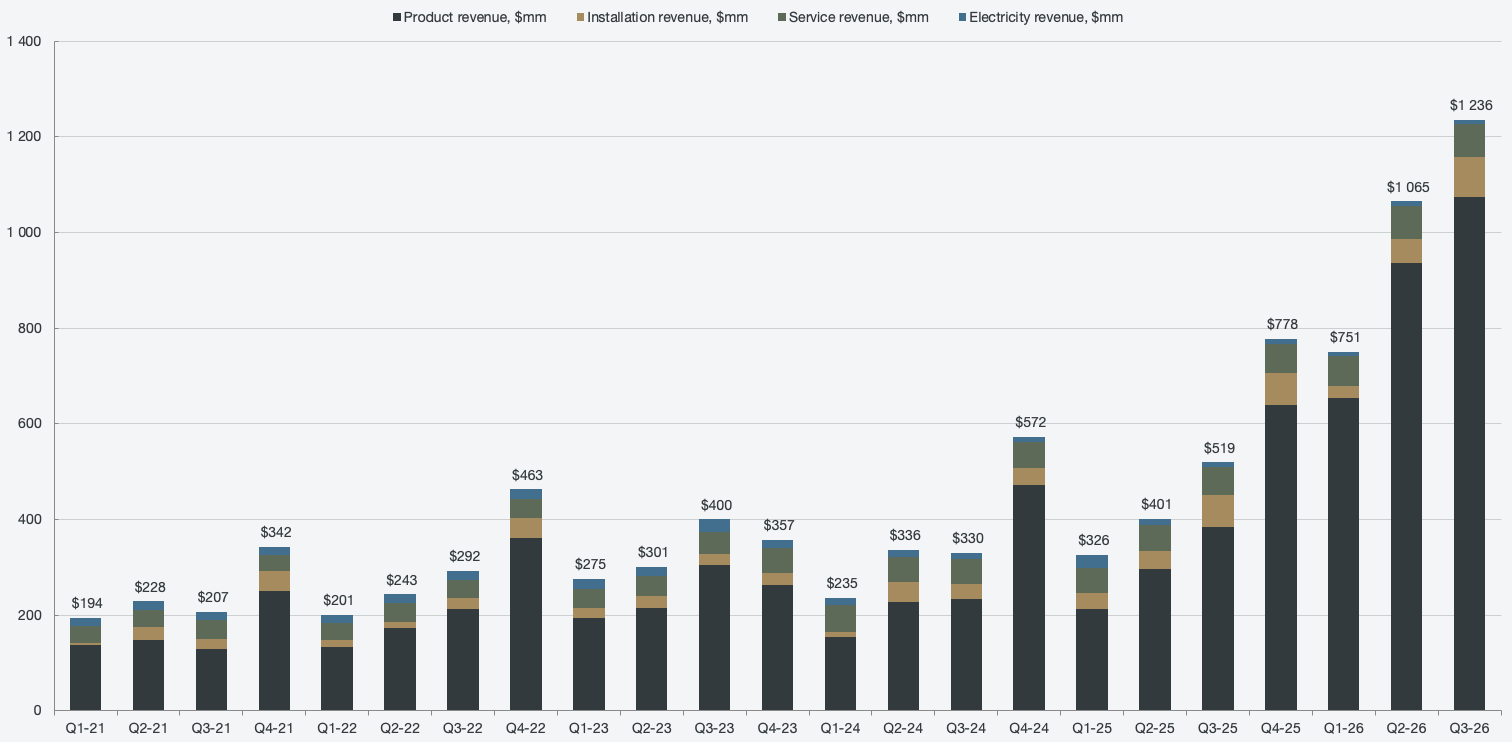
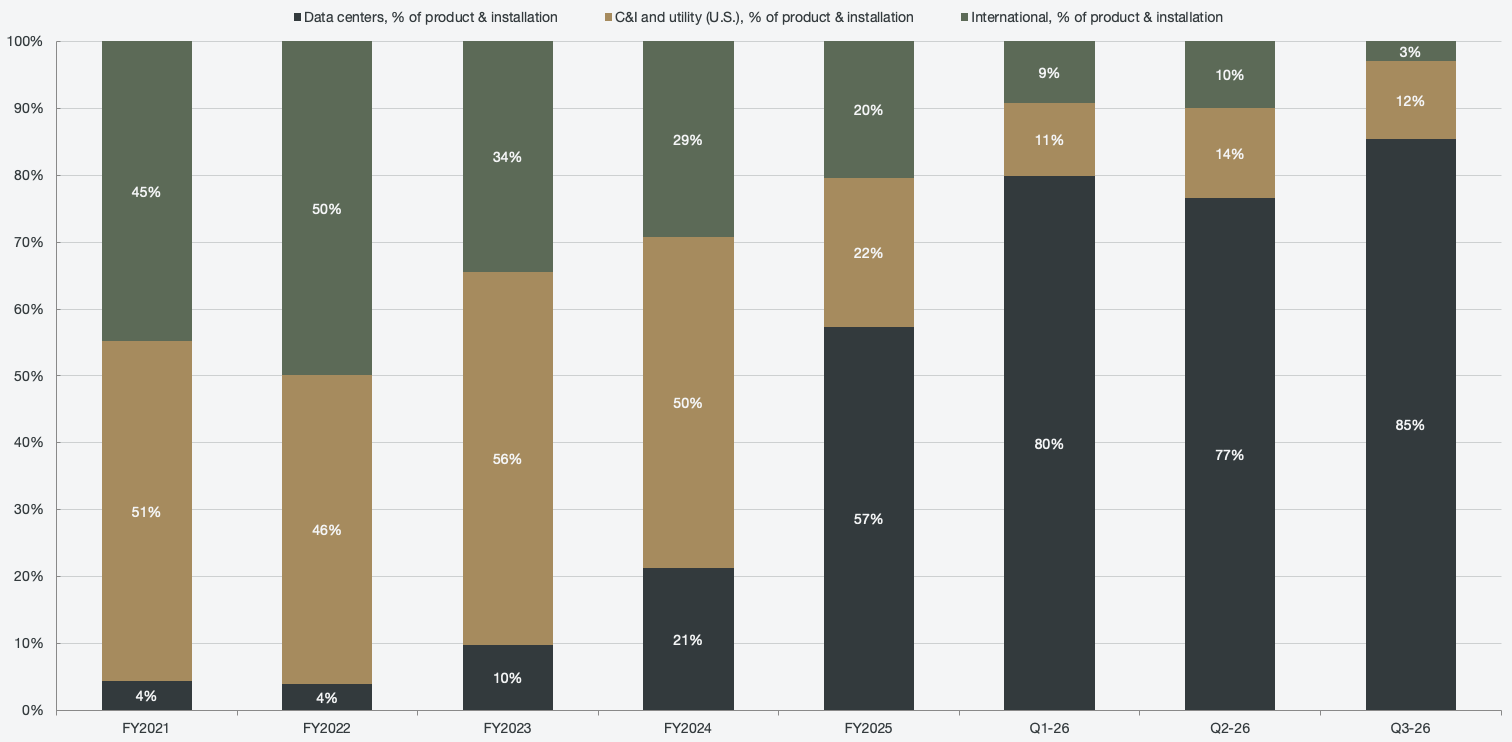
The revenue reporting categories don't tell us the end market, so I have to estimate where the revenue is attributed. To make sense of it, I split product and installation revenue into data centers, U.S. commercial and industrial (C&I) and utility, and international revenue, using the disclosed U.S. share of revenue together with the Brookfield fund revenue. This estimated end-market mix puts into perspective how big of a growth driver data center revenue has been for Bloom, going from ~4% of total revenue in 2021 to 85% in Q3 2026.
Figure 5: Estimated end-market mix
Rationale for end-market mix estimates:
In 2021 and 2022, data center sales were a small C&I sub-vertical, where Equinix was the main customer per company decks. Korea was the largest market in FY2022. I assume an 8% share of U.S. product & installation for data centers. In 2023, the Equinix program likely saw the first two AI-adjacent sites, with two disclosed customers at 37% and 26% of total revenue (SK ecoplant and likely a U.S. financier), so I estimate the value at 15%. In FY2024, AEP places a first 100 MW order for data center load in Ohio, and CoreWeave and Equinix are deploying, raising the estimate to 30%. In 2025, $862 million of revenue comes from the Brookfield AI Fund joint ventures, all of which are AI infrastructure. Beyond that, AEP and Oracle sales also contribute; I raise the estimate to 72%. Q1 2026 related-party revenue was $373 million, 50% of total revenue and ~60% of U.S. product & installation revenue. In addition, Oracle announced Project Jupiter, raising my estimate to 88%. In Q2, an MD&A note on product growth reads: “primarily due to ... a significant deployment for a large AI infrastructure customer and multiple projects executed through the joint venture with Brookfield”. In Q3, another MD&A note reads: “deployments for large data center customers”, with two customers accounting for 43% and 26% of total revenue. Of those, the joint venture was $322 million. Q2 at 85%, Q3 at 88%.
This segmentation shows that growth from this point onwards rests primarily on GW deliveries into data centers. The actual value depends on how long revenue per kilowatt holds and how long it takes for energy queues to shorten, and Bloom provides no visibility into these metrics and no longer reports them. We also don’t know how long the installed fleet stays in service. For instance, an important question is: will it be long enough to become an annuity for the business?
Data center
Management no longer describes the data center market by customer count, but in July it said that all major U.S. hyperscalers, and more than a dozen neoclouds, AI labs, and colocation operators have approved Bloom for their sites. Bloom serves two kinds of data center demands. First, bridge power that carries a site until its grid connection arrives, after which operators can remove the fuel cells, keep them as backup, or retire them. The second is primary power, meaning the center runs on Bloom permanently. In those instances, Bloom’s power is often islanded with no grid connection. A clear example of primary power is Oracle’s Jupiter campus, where Bloom replaced previously planned gas turbines and diesel generators as the sole power source. To win more primary-power contracts, it must offer more than speed; otherwise, customers will easily replace it when capacity isn’t as scarce. For instance, Bloom’s fuel cells produce direct current that fits the 800-volt architectures used in AI data centers, and follow the sudden load swings of AI training better than rotating machines. In addition, they don’t require water in steady operation and emit almost no NOx or particulates.