Formula 1 (F1) is the fastest-growing major sport in the world, and 2026 is poised to break all records. The coming season introduces a whole new set of regulation changes to allow for more exciting racing. In addition, there’s the introduction of an American 11th team (Cadillac), the addition of Audi, and the sport sees some returning faces.
Company profile
January 5, 2026 Follow-up coverage
Direction: Buy
Previous fair intrinsic value: 113.44, as of September 24, 2025
Symbol: FWONK, Exchange: NASDAQ
Sector: Communication Services, Industry: Entertainment
Theme: Motorsports
Fair intrinsic value: $116.80 (19.14%), as of January 5, 2026
Market capitalization: $24 706 million
Pricing data: P/S 6.39x, P/E 98.04x
Previous coverage:

TYPEFCAPITAL.COM
Consider following me on X and YouTube.
This article is for informational purposes only and does not constitute investment advice or an offer to buy or sell securities.
2026 regulation changes
A technical overhaul is always exciting, as the competitive pecking order gets scrambled and fans don’t know what to expect. The last set of regulations was primarily dominated by one team and one driver, which is exciting for the team’s fans but not so much for the other viewers.
The racing machines will be more agile and nimble, as the chassis will be overhauled with smaller dimensions. Both the length and width will be ~5% narrower, the cars’ weights will be reduced by ~4%, and the tire width will be decreased by ~8%. The cars have progressively become larger and heavier over the last decade, which has made it more and more difficult to overtake, especially on narrow tracks like Monaco. In a circuit like Monaco, qualifying first more or less guarantees a first-place finish barring mechanical failures, as it’s near impossible to overtake.
Figure 1: FIA regulation changes infographic
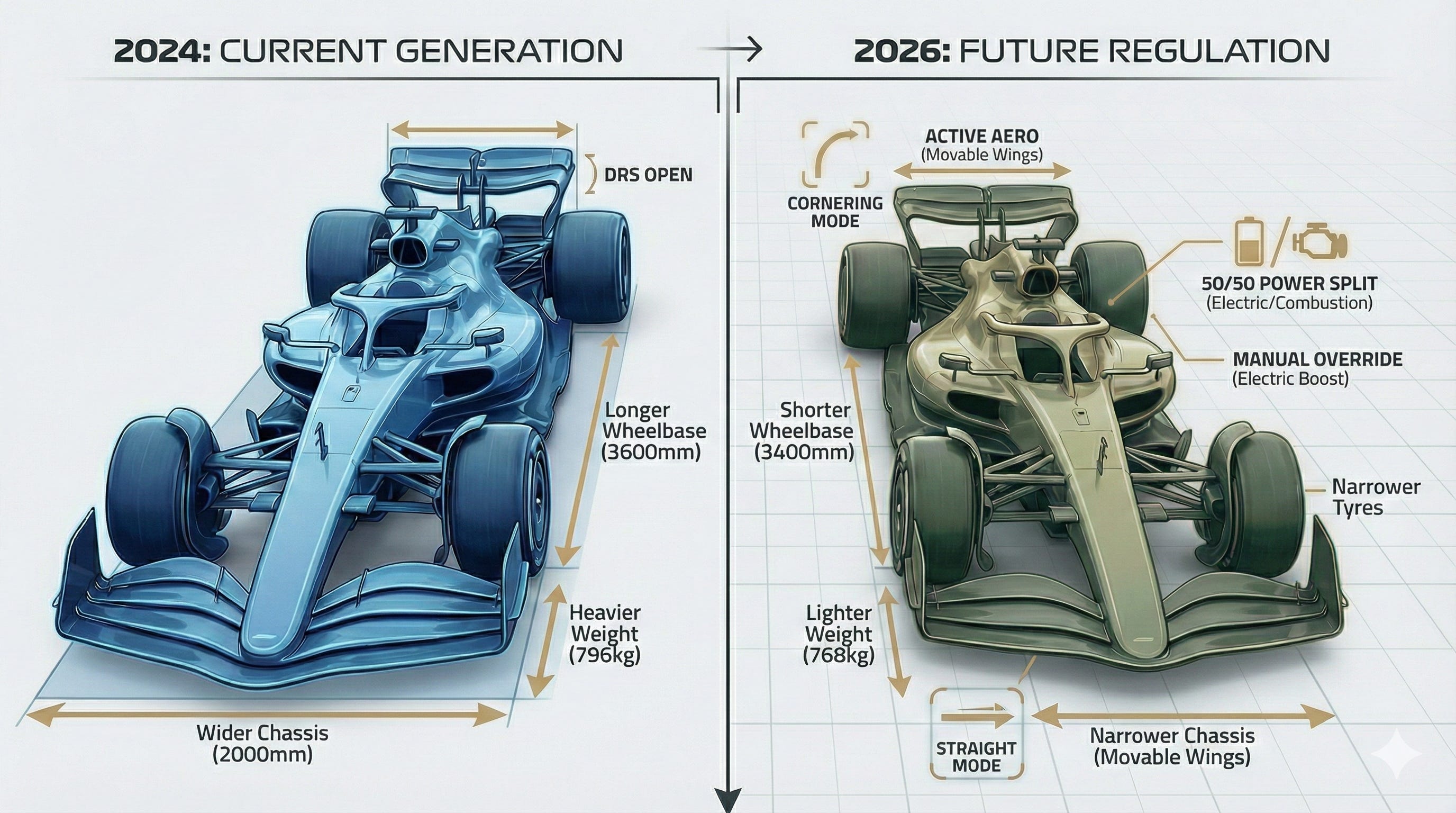
Furthermore, there is an introduction of new active aerodynamic components, which will replace the current drag reduction system (DRS). DRS allowed for the rear wing to open up during certain straights if the car was less than one second behind the car in front. This gave XX. 2026 will instead feature a corner mode where wings are angled for downforce and grip during cornering and a straight mode where wings flatten during straights to reduce drag and increase straight-line speed. Another major difference is that the new active modes are available for all drivers, regardless of gaps between cars.
In a similar vein to the DRS system, there will be a manual override mode where a driver can deploy extra electrical power for attack, which will be dependent on the gap to the cars in front. It’s a more strategic option than DRS and should lead to longer and more intense battles, where driver skill can be a bigger differentiator than a mere DRS system. The engine will now also be a 50/50 split between electric and combustion, which also allows for driver decisions to have a larger impact on the outcome, as they can choose when to recharge and deploy energy during the race.
Figure 2: Turbulent wake infographic (dirty air)
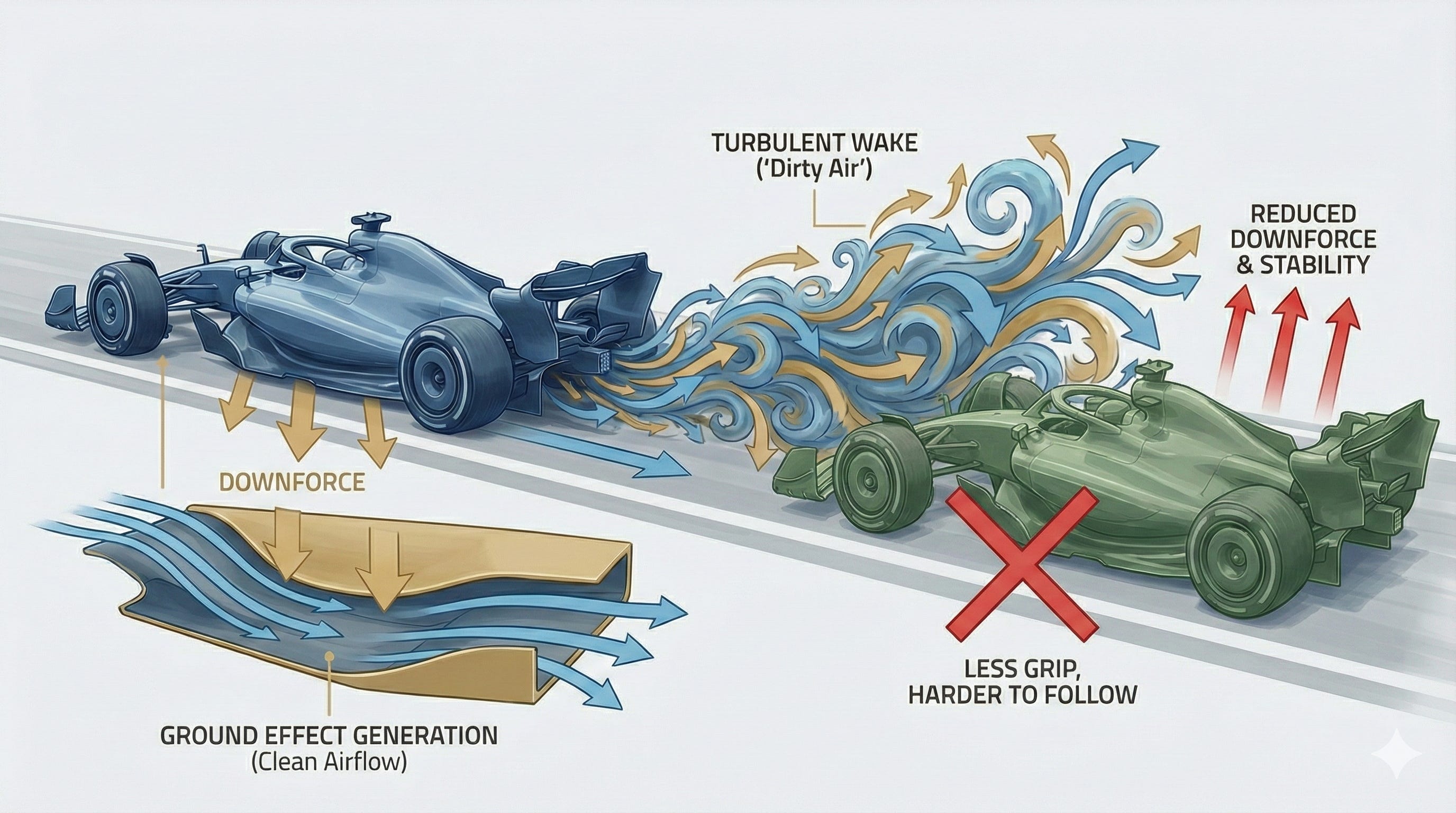
The final major change affects one of the core reasons it was difficult to race in the current regulations: the dirty air. The 2022 regulations introduced the ground effect, which means that the cars generate downforce from the floor of the car. Teams quickly found out that by disrupting the airflow for cars behind, it was easy to overheat the opponents’ tires and disrupt the aerodynamics. This made it difficult to follow the car ahead and disrupted racing. In 2026, the rules mandate flatter floors and less powerful diffusers, which allows chasing cars to stay closer through corners. and should allow for closer racing.
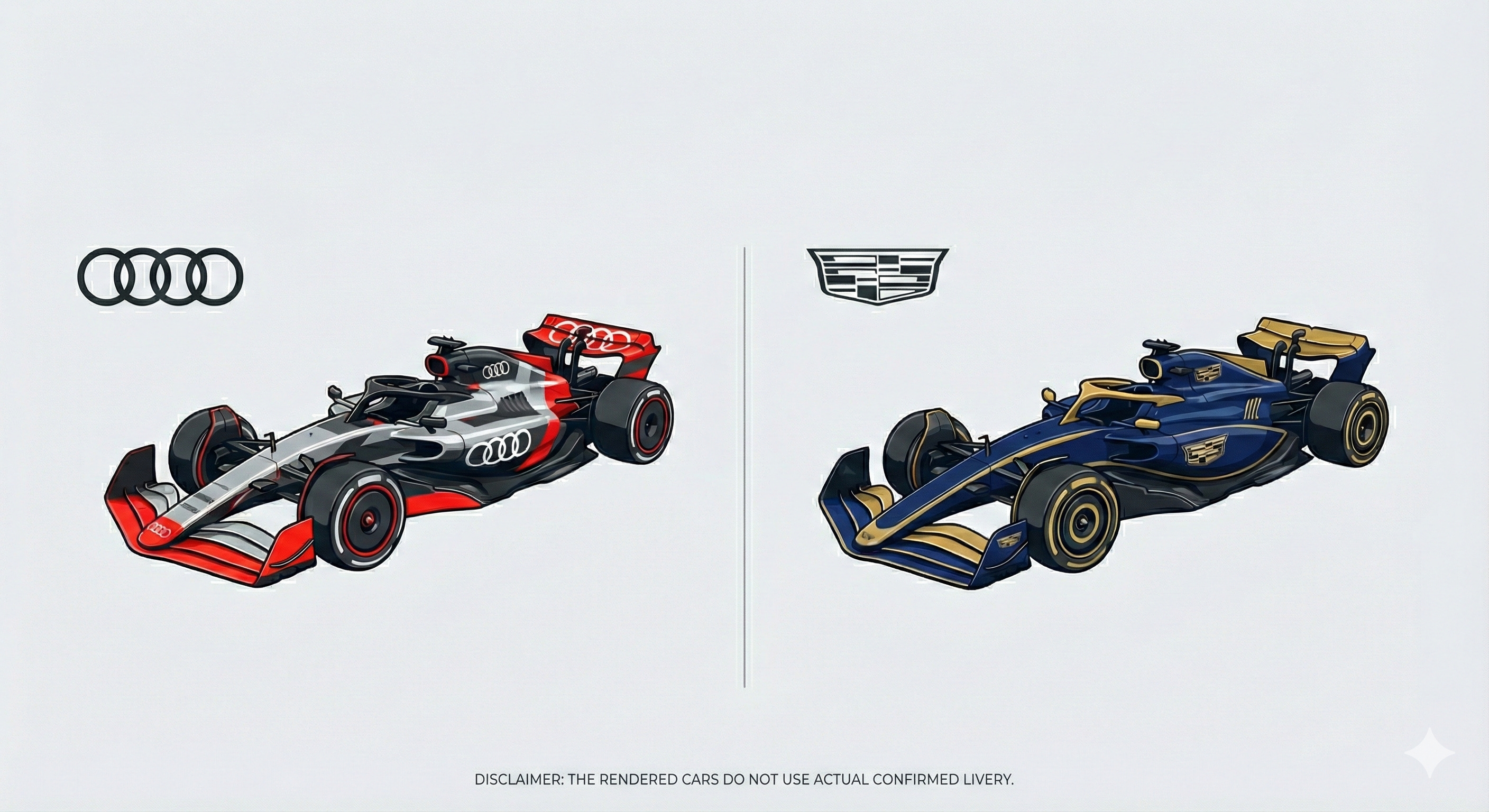
Aside from the formula changing for 2026, there is also the addition of two teams. The current Kick F1 Sauber team is being taken over by Audi, and Cadillac is joining the grid as a brand-new entry from the U.S. Audi has a rich motorsport history spanning over a century, including several world titles across different categories. Cadillac is an entry following a partnership between GM and Andretti Global, a company that has made several attempts at joining F1 with prior rejections.
Figure 3: New constructor entries, Audi and Cadillac
The problem with joining the F1 grid is that it affects all current constructors, not only on the track but also financially. Essentially, there is one more manufacturer to split revenues with, and as such, Andretti was historically rejected multiple times despite developing infrastructure and staff towards the endeavor. It was understood that a proposition to join F1 has to be a net benefit rather than a detractor for all the teams. Through a collaborative effort with GM, Andretti was able to get accepted into F1 as Cadillac but had to give up the Andretti name.
Overall, both Audi and Cadillac are exciting names that will hopefully increase interest in the sport and expand the viewer base in the U.S., the fastest-growing demographic. In addition to the regulation changes, the season will hopefully bring exciting races where the outcomes of each weekend will be unpredictable and entertaining.
Financial results
What’s important to remember regarding Formula 1’s revenues is that the company is limited in their revenue generation simply due to the number of races on the calendar. For example, 2021-2023 had 22 races, while 2024 had 24 races. In addition, the quarterly distribution of races is uneven from season to season. This naturally skews the total amount of revenue when comparing quarterly results. However, the company’s growth can be viewed on a trailing-twelve-month basis as well as on a per-race basis in order to properly gauge how the company is developing.
On a per-race basis, it is easy to see that fans are the most excited to watch the beginning of the season in order to see what the competitive teams will be for the season. Similarly, the end of the season, when the drivers’ and constructors’ championships are crowned, tends to be a large source of revenue.
Figure 4: Formula 1 revenue per race
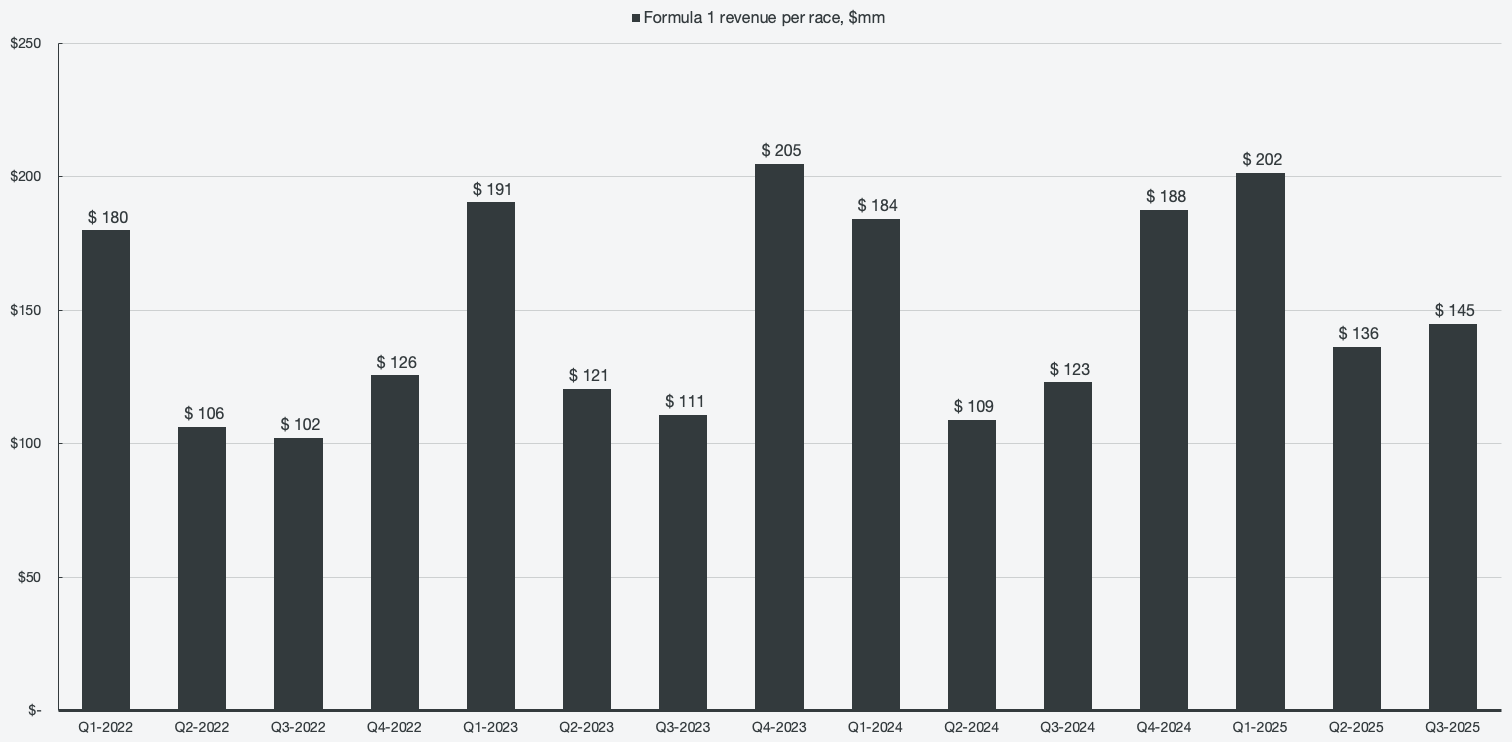
This quarterly chart makes it visually difficult to see actual progress that Formula One Group is making in terms of monetizing the sport. By looking at a trailing twelve-month, the narrative becomes more clear. The overall trend in revenue is positive, considering that the sport has historically stayed relatively stagnant.
Figure 4: Formula 1 revenue per race, trailing-twelve months
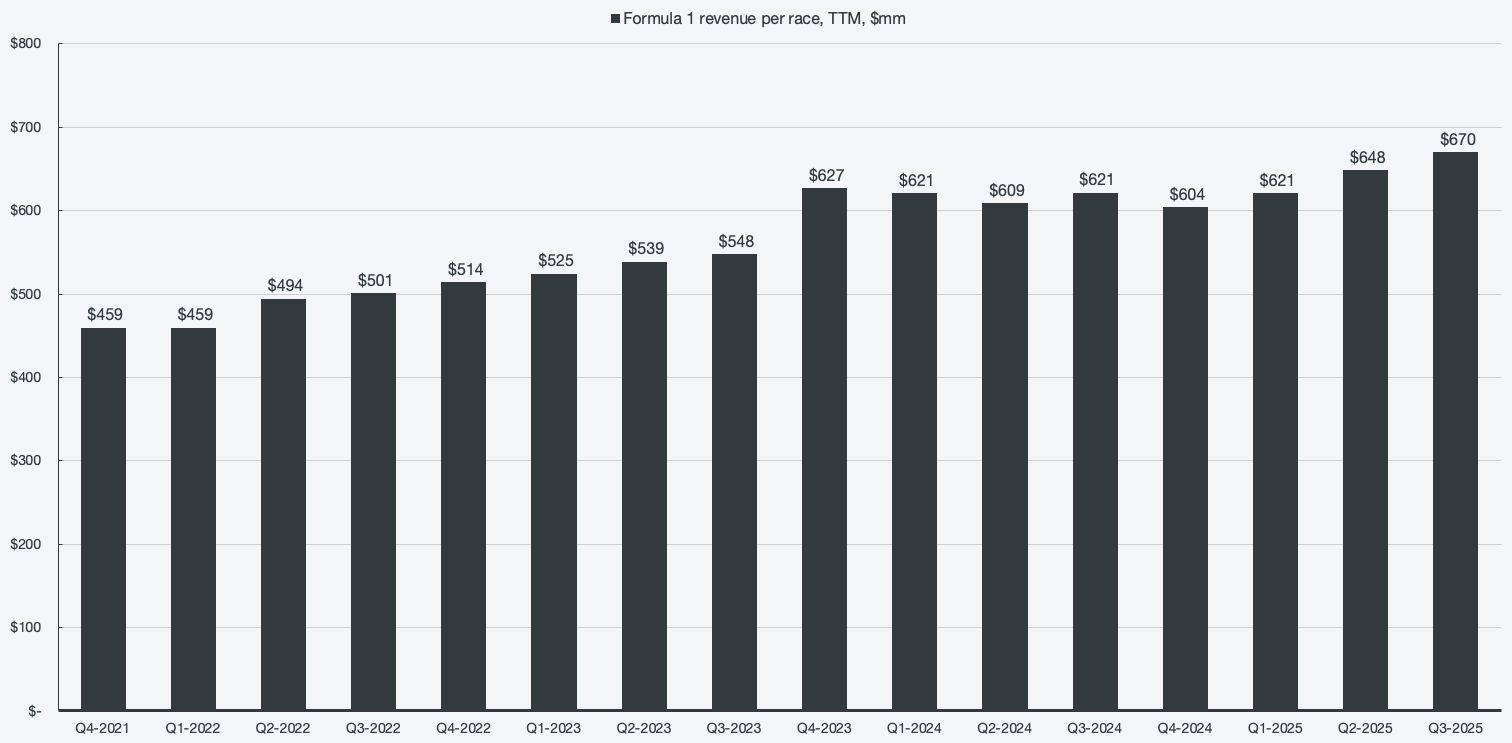
The corporate viewpoint would be to simply increase the number of races per season and thus also increase the overall revenues. However, that quickly becomes a major challenge considering that F1 is a global sport, and each race is a logistical nightmare, not only in terms of equipment but also in terms of thousands of personnel for each team.
I believe that 2026 will set new records, as the changes and additions will bring fresh excitement as well as a whole new viewer base. However, where Formula One Group’s efforts really start to show exciting progress is when investors take a look at the operating income the sport is bringing in.
Figure 5: Formula 1 operating income, trailing-twelve months
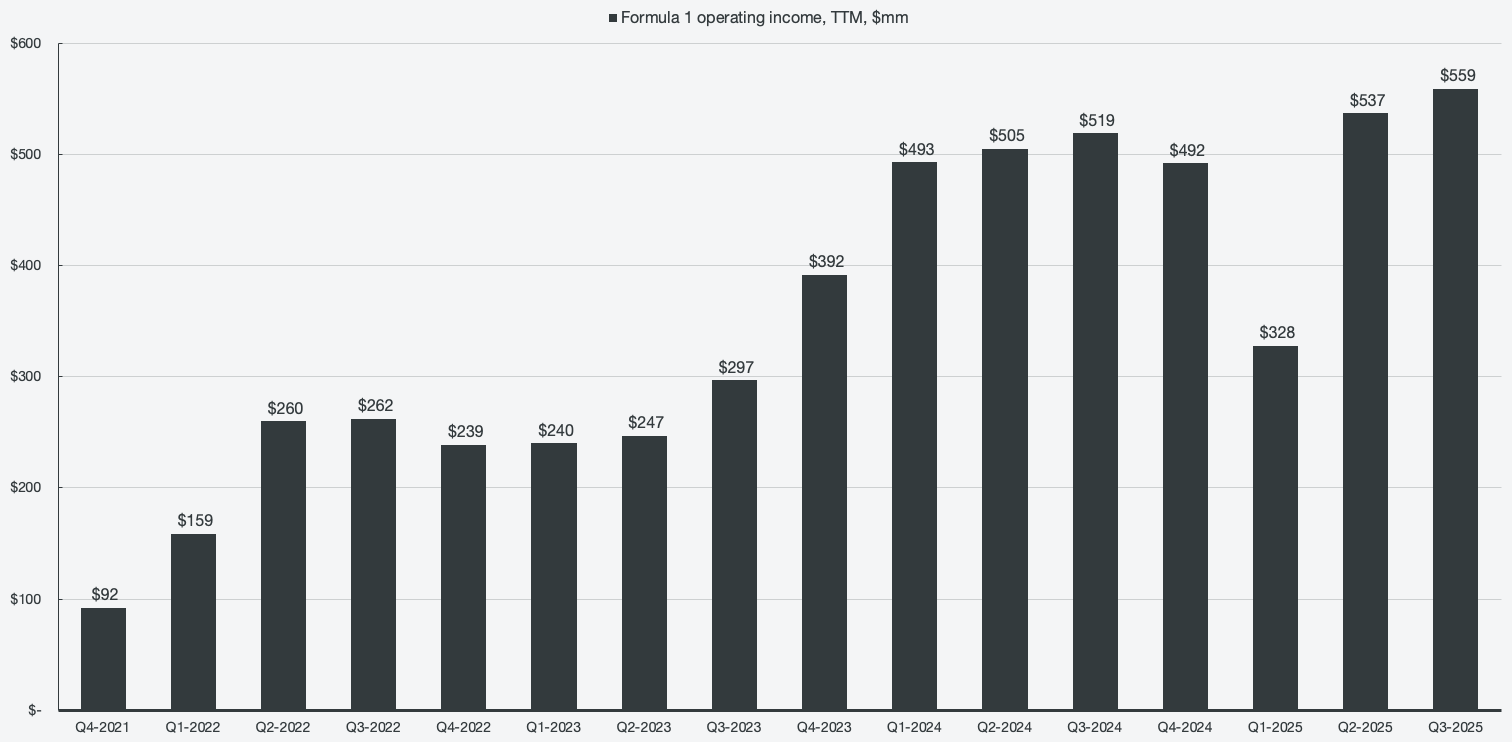
While revenue growth is not explosive by any means, the trend in profits associated with the revenue growth is becoming quite impressive.
Both revenues and operating income need to be viewed with proper context, as on-track activity largely dictates the level of fan engagement and excitement. More viewership equals more revenue and more opportunities to monetize those same viewers. This directly ties to all sources of revenue:
Race promotion is more attractive if fan excitement is large.
Media rights can be negotiated at better rates.
Sponsorship slots are more lucrative and thus more expensive.
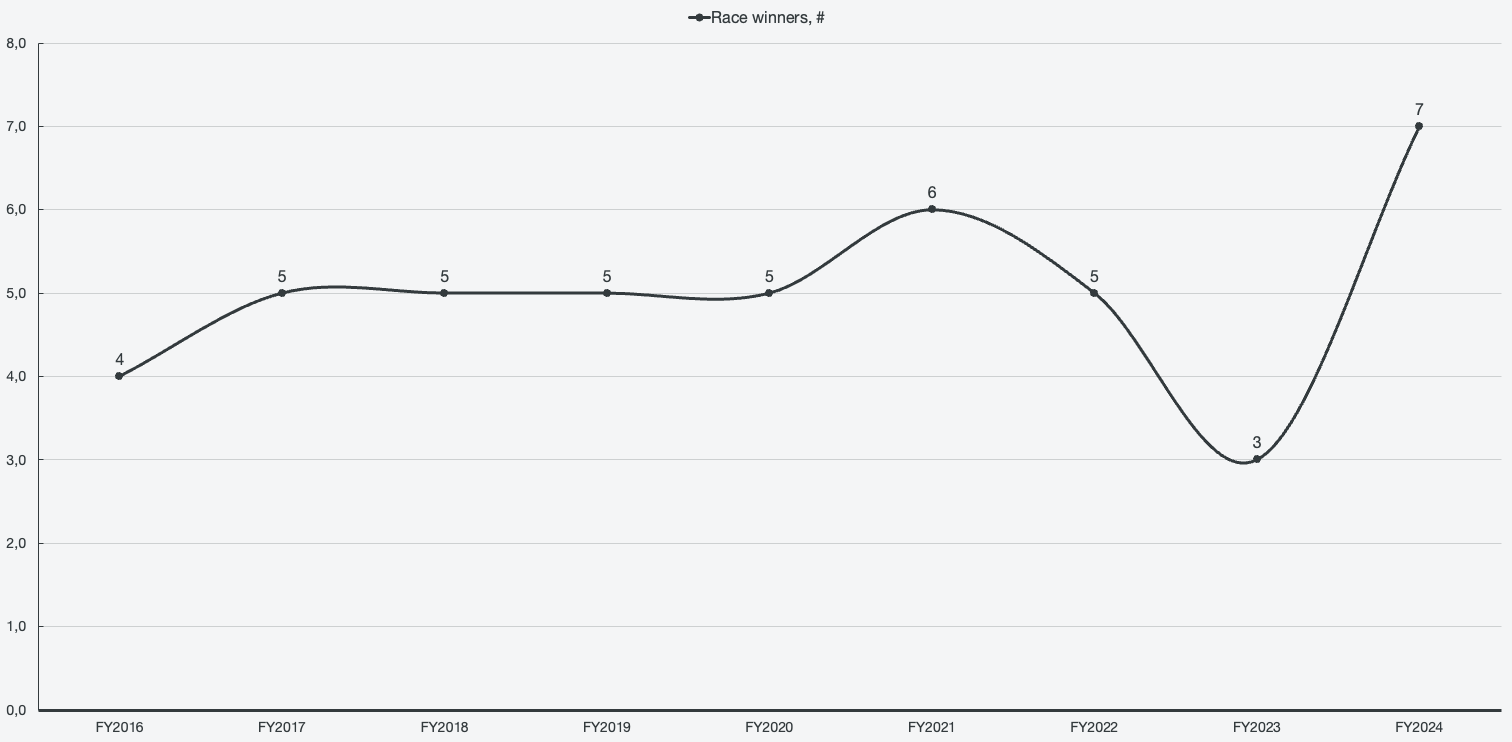
2024 set the bar high for per-race metrics, as it was also the most exciting season in recent times with 7 different race winners. 2023 was in aggregate one of the more boring seasons, as it was dominated by a single driver and constructor. Similarly, the 2025 season was in large parts also dominated by a single team (McLaren), but other constructors came alive throughout the season, which allowed later quarters to be elevated on a per-race basis. Q4 is not yet reported, but the season was exciting all the way into the final race, with a 3-way battle for the driver’s championship. As such, I expect Q4 to set a record for revenues.
Figure 6: Historical race winners per season