


One of the most lucrative parts of investing is finding a hidden gem: a company with the potential to explode in revenue, strong margins, and, most importantly, the chance to invest before the market discovers it. That is the typical recipe for harvesting a 100-bagger, the type of company that can create generational wealth inside one’s portfolio. There is just a small problem, and it lies in these companies being just that: hidden gems, with the emphasis on hidden.
Investors can use screeners, read about companies in small, dedicated niche communities, or find a piece of news that gives them a whiff of one of these hidden gems. In today’s short experiment, I will present four different companies with a brief description of what they do, some financial highlights, and then ask you to pick which of these four companies you would be interested in investing in or diving deeper into.
All the data is real, and I will reveal the companies at the end. You can be boring and scroll to the end, or challenge yourself by reading this article in full to play along and choose your favorite of the four businesses.
Each business mentioned below is profitable (cash flow positive, positive operating and net margins) and ranges from mid-cap to large-cap.
Business 1, Government analytics software
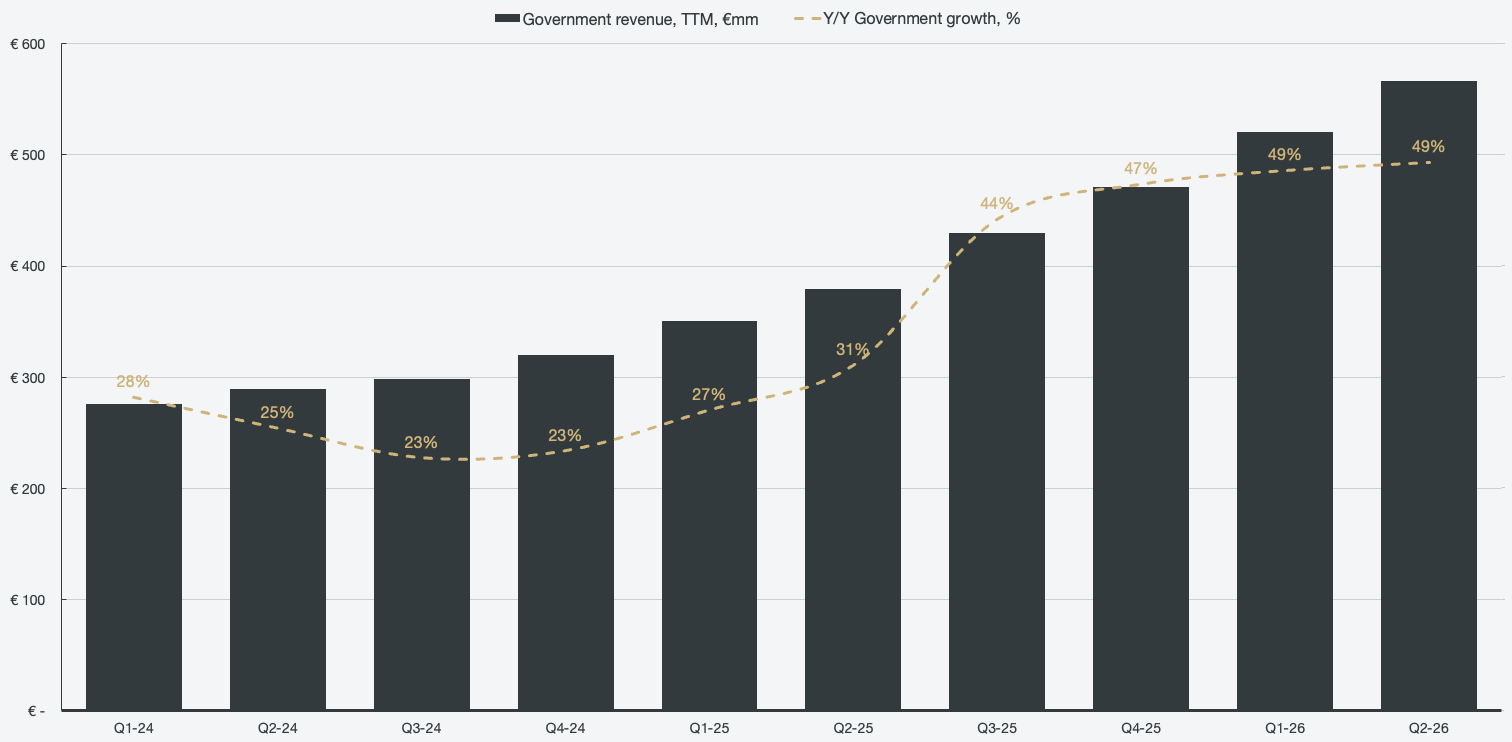
This analytics software business operates within government agencies outside the U.S., is growing at an accelerated pace, and continues to expand into more countries. Contract awards vary in size, and it can quickly offer solutions for specific verticals as needed, showing both the adaptability of its software deployment and how opportunistic the company is.
An example is a contract with the UK’s Department for Environment, Food & Rural Affairs (DEFRA). This company was awarded a contract for "Trade Analytics Solutions, where the company’s software was used to model goods trade across the customs border after BREXIT.
The company’s reach is worldwide, and it has won contracts in the EU, Asia, and Australia. In Australia, the Australian Transaction Reports and Analysis Center (AUSTRAC) uses the company’s software for a variety of use cases, including money laundering and financial criminal investigations.
Business 1, Figure 1: Revenue over the trailing twelve months, in Euro
Business 2, MRP software
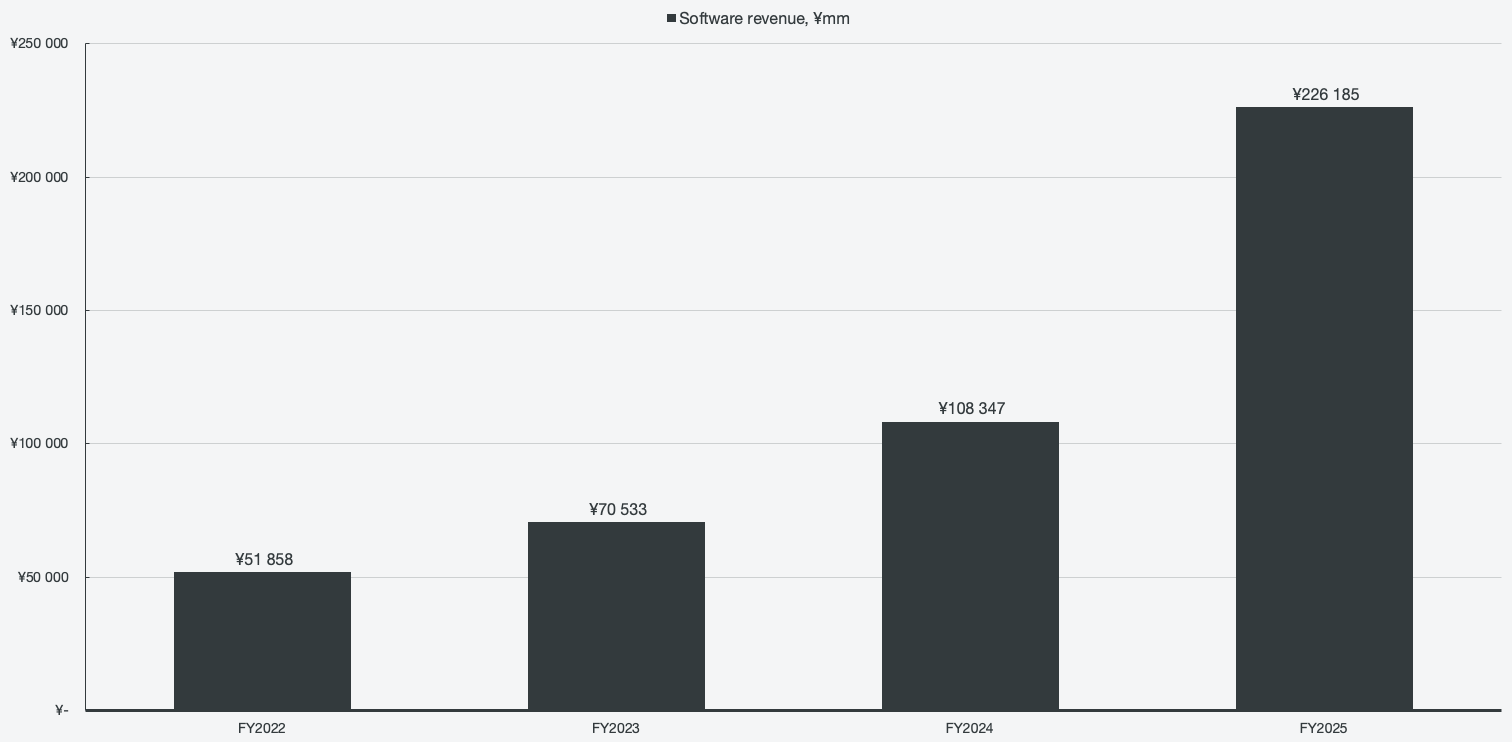
The business has seen massive growth, accelerated by AI. Use cases include modeling suppliers, bills of materials (BOMs), work orders, lead times, and parts. The software brings together previously siloed data so manufacturing and engineering can work seamlessly and efficiently with the supply chain. Using predictive analytics, the software can model different demand scenarios and algorithmically pinpoint actions to take with high impact in what would otherwise be like finding a needle in a haystack.
A customer testimonial reads that their master scheduler runs demand scenarios against live models of BOMs and supplier lead times, with up to 10x performance improvements over internal solutions. What’s most impressive is that the customer had a fully working solution within roughly six months of signing up for the software.
The growth for the business is not about to slow down anytime soon, with the business seeing a large backlog and strong demand.
Business 2, Figure 1: Revenue, in Japanese Yen
Business 3, Manufacturing OS for the U.S. government and primes
Manufacturing output has long been a segment where the U.S. has lagged behind adversaries such as China, which exceeds the U.S., Japan, and Germany combined, per the World Bank. While U.S. spending is far bigger, the physical industrial output is, by some estimates, up to two orders of magnitude larger in China. In shipbuilding, cited Office of Naval Intelligence estimates put Chinese shipbuilding capacity at about 232 times larger than that of the U.S. The output discrepancy also exists for munitions, drones, and other physical output.
Re-industrialization has been a major topic in recent times, highlighted by both the U.S. government and prominent voices within the defense industry. This business capitalizes on that by enabling real-time insights and operational efficiencies within manufacturing, which is required to start scaling the American industrial base. The company leverages its software to help identify and resolve scheduling conflicts, integration issues, equipment shortfalls, and ties legacy systems to enable seamless production planning.
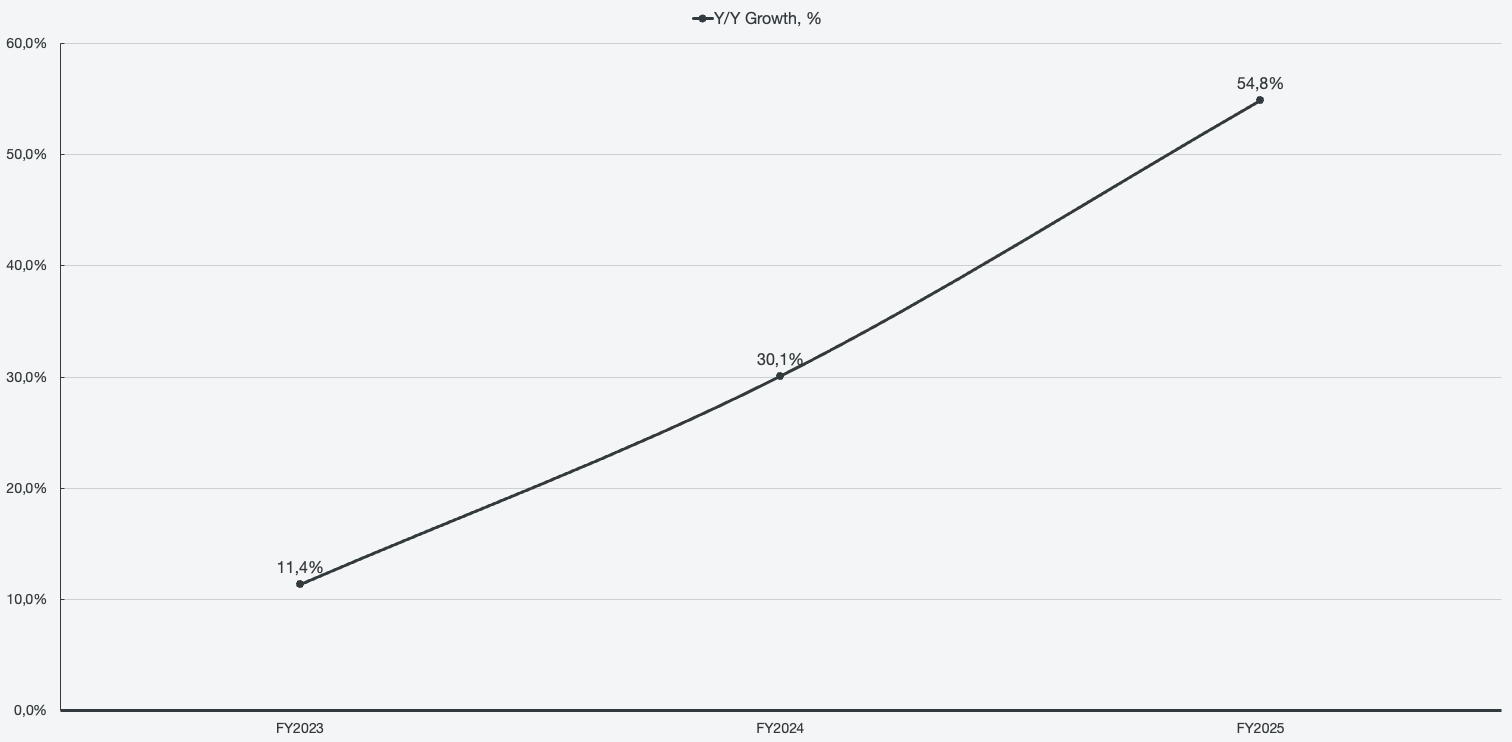
The business sees tailwinds tied to both the need for re-industrialization and the AI wave.
Business 3, Figure 1: Revenue growth
Business 4, AI model augmented generation
This business has built a platform where their customers can build and deploy AI LLM’s in a safe environment. The platform is model-agnostic, and regardless of which LLM the customers use, the models can be improved by providing superior context. The models are not retrained, which would be costly. Instead, through chunking and embedding, object-relationship retrieval, and indexing of the customer’s entire business, LLM performance can be far more efficient and purposeful because it references real context from the customer’s business.
We have seen many recent examples of IP theft from AI labs, where they use context from their own customers to then launch competing products or advance other discoveries which were not originally in their domain. By deploying on this business’s platform, the customer’s data is isolated, so that neither the model providers nor the business retain the transmitted data; the customer keeps their IP.
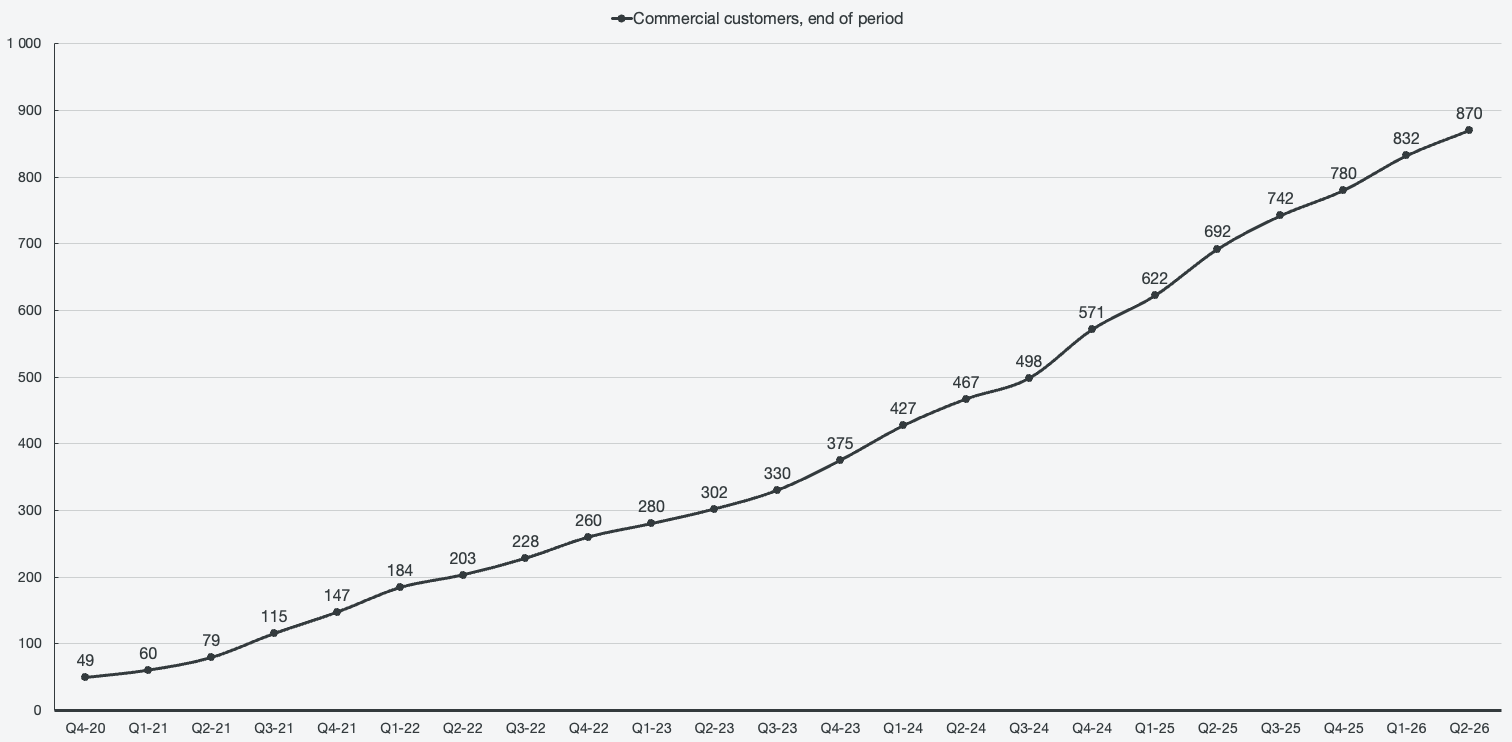
This business has grown massively in a short amount of time, and the runway and necessity of the solution see tailwinds for a long time to come.
Business 4, Figure 1: Total commercial customers
Out of these businesses, which seems the most lucrative, interesting, and most importantly, which business has the highest potential?
Well, I have good news. You don’t have to make a decision among the four proposed businesses; they’re all the same company.
Business 1: Palantir’s international government business example
Business 2: Palantir’s U.S. commercial business example
Business 3: Palantir’s Warpspeed business example
Business 4: Palantir’s Ontology-Augmented Generation business example
Palantir has virtually no limits on which industry or sector it can serve. The mentioned examples are vastly different, seemingly four different companies, and yet they are just a tiny fraction of what Palantir software is capable of.
Investors are obsessed with finding the next 100-bagger, so much so that they tend to ignore generational companies that have had a large run-up in stock price, despite the potential for much further upside. Palantir hasn't done a 100x yet, but it seems to have a limitless TAM, is incredibly sticky, has a scalable business, and has immense demand. Keep chasing the next 100x; I know I will, but don’t ignore the potential of companies you already know about, because who knows, you might already have the next 100-bagger in your watchlist.