Hailed as one of the great compounders, a company that sells a standard rather than a product. Investors have been willing to pay up for durability, especially in today’s volatile markets, and there are few businesses rivaling the durability of credit ratings. Companies like Moody’s MCO 0.00%↑ and S&P Global SPGI 0.00%↑ are not hyper-growers, but they are consistent growers. Moody’s grew revenues by 9% on 7% issuance growth, indicating plenty of pricing power and a lot of secular tailwinds approaching quickly.
Company profile
July 21, 2026 Initiated coverage
Direction: Hold
Previous fair intrinsic value: N/A
Symbol: MCO, Exchange: NYSE
Sector: Financials, Industry: Financial Data, Stock Exchanges
Theme: High quality
Fair intrinsic value: $413.13 (-18.5%), as of July 21, 2026
Market capitalization: $89 883 million
Pricing data: P/S 11.42x, P/E 35.98x
TYPEFCAPITAL.COM
Consider following me on X and YouTube.
This article is for informational purposes only and does not constitute investment advice or an offer to buy or sell securities.
AI as an accelerator or disruptor?
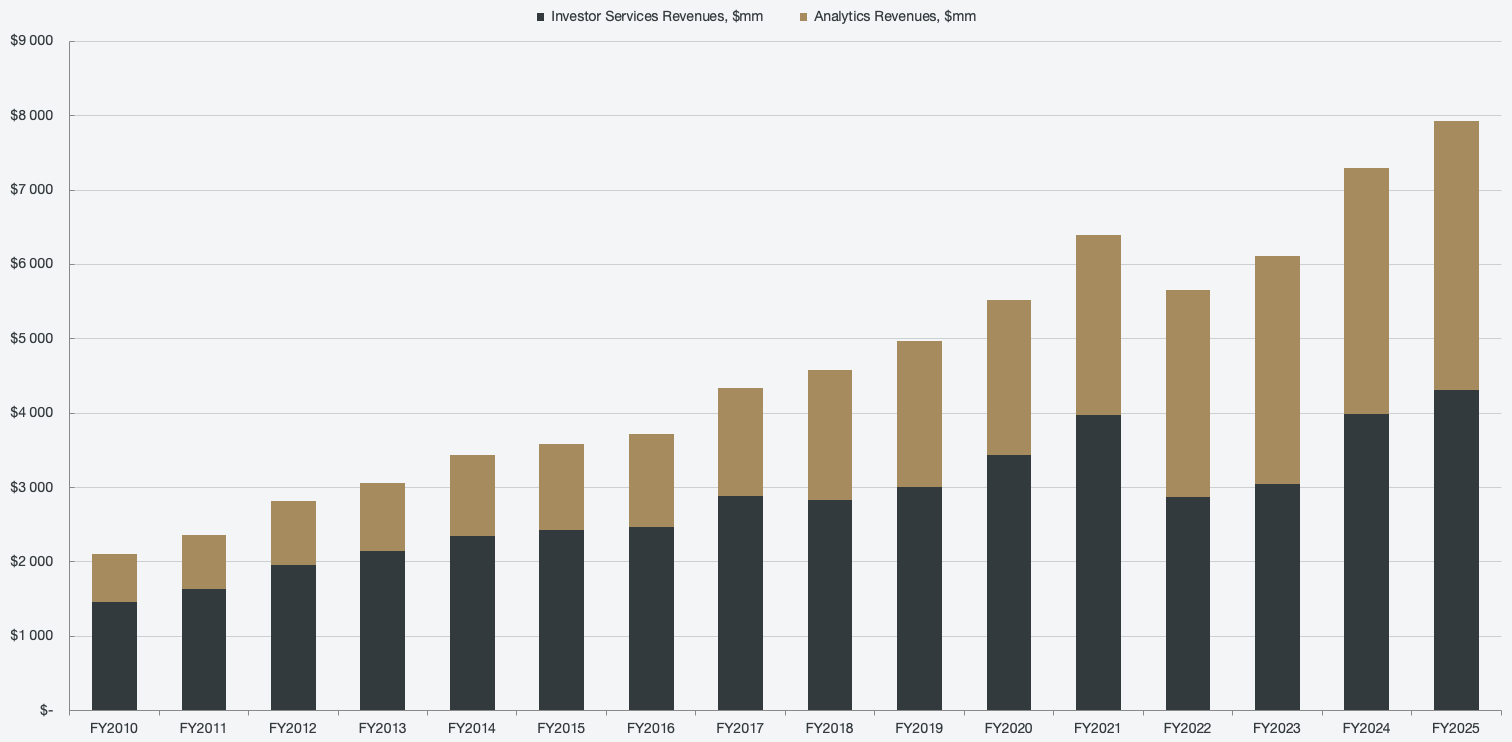
Moody’s operates two distinct revenue segments. Moody’s Investor Services (MIS) charges issuers for its credit ratings, similar to S&P Global’s ratings segment. They record a transaction fee whenever a bond, loan, or other financial instrument is rated, and then record additional revenue on the initial rating through fee schedules and monitoring fees for maintaining the rating. Moody’s Analytics (MA) sells workflow tools, risk software, and data feeds on a subscription basis, where close to all of the Analytics revenue is recurring.
Figure 1: Segmented revenue
Moody’s is flat year-to-date, but was down significantly earlier in the year on AI disruption fears. As mentioned, markets like compounders because they are a source of durability, and AI disruption fears left a question mark on that characteristic of Moody’s business. S&P Global made several statements in regard to how much of their data services are proprietary and unreplicable, and Moody’s has done the same throughout the year, though without S&P’s quantification.
First of all, a lot of the data just simply isn’t available to the public. We have a complex ecosystem of commercial agreements and IP rights. I mean, that has taken us decades to build, and we’re constantly curating that.
Rob Fauber, President and Chief Executive Officer
Moody’s, Q4 2025 Earnings Conference Call
There are two angles to the AI threat: one concerns which parts of Moody’s business can be replicated, and the other angle concerns whether it matters if they are.
For example, the credit rating value comes from the embeddedness of the standard; permissions and coordination relating to index eligibility, capital treatment, and acceptance by the bond market. In theory, an LLM could produce a credit opinion, and in some cases it could even be indistinguishable from a Moody’s rating, but that does not mean that it produces a rating that a bond mandate accepts. As a reference, FICO scores have had a competitor for two decades that hands out its credit scores for free, and the market still does not switch from FICO because FICO scores are simply too integrated into the financial system.
As for the more vulnerable part, the data in Orbis might be proprietary, but that does not mean that the raw facts behind the data are exclusive to Moody’s. Where the value lies is the curation layer, where the accumulated labor over decades has built an entity resolution with ownership graphs, identifiers, licensing agreements, and so forth. To use FICO as an example again, owning the raw data doesn’t get the standard, exemplified by FICO’s competitor VantageScore being owned by the big three credit bureaus, which actually own the consumer data that the FICO scores utilize. The very owners of the underlying data could not disrupt or displace the standard sitting on top of their data.
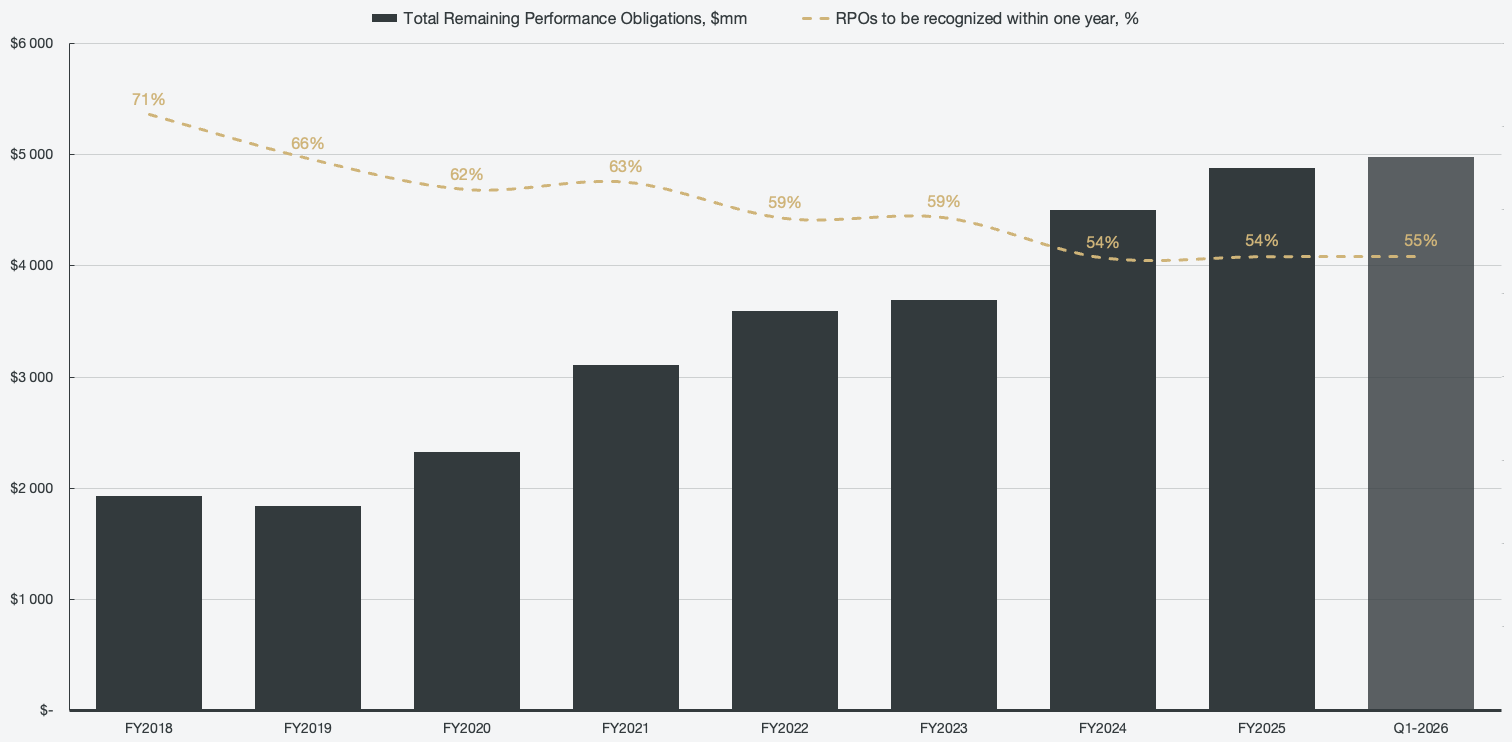
One key metric for evidence against AI disruption is remaining performance obligations (RPO). RPO is contracted rather than assumed, and as such, if AI were eroding demand for Moody’s, the backlog would take a hit before revenue, and it has not. The percentage of RPO that is recognized over the next 12 months is a tell for duration extension, and if it were to start increasing, it would mean that customers are less committed. A falling near-term share means more of the backlog is long-dated, meaning that customers are signing longer contracts.
Figure 2: Remaining performance obligations
Analytics
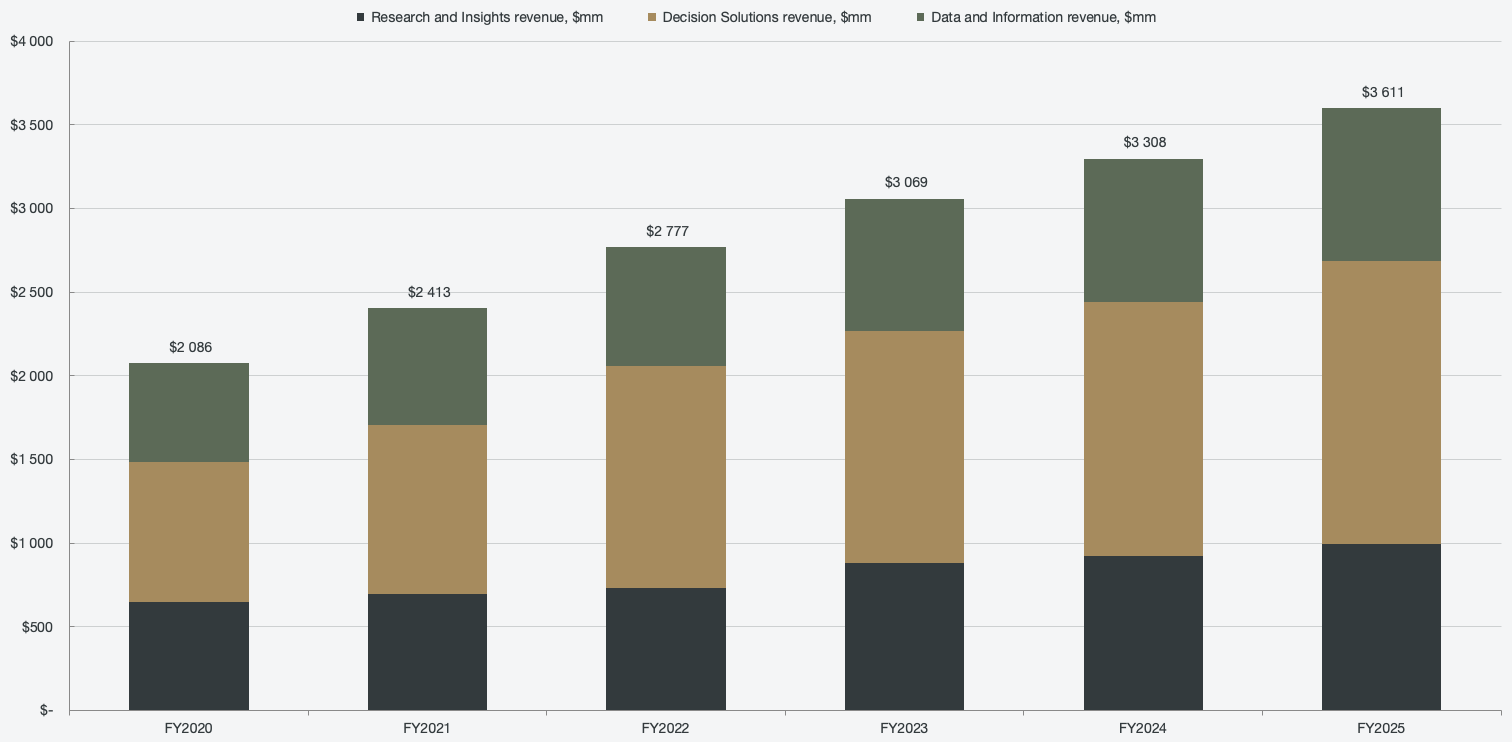
Perhaps the strongest counterargument is that we are about three years into the generative AI era, and Analytics organic revenue growth has not slowed. In addition, margins have been increasing, showing the increased attractiveness of the segment despite the market’s assumed AI pressures.
Figure 3: Segmented Analytics revenue
What Moody’s sees is that AI drives demand for its data, where customers adopting generative AI solutions from Moody’s grow at 2x the rate of their other customers.
We see that market recognition reflecting a broader truth, that as AI becomes a new interface for decision-making, the need for trusted context increases, not decreases.
AI systems require verifiable permission, domain-specific data and analytics to produce outputs that are accurate, explainable and defensible. And that’s exactly what Moody’s provides, and it gives us the opportunity to become even more deeply embedded in customer workflows.
[…]Customers who have purchased or upgraded into at least one standalone GenAI or agentic solution are retained at a rate of 97% and are growing at roughly twice the rate of the rest of the customer base. So this isn’t experimental usage.
Rob Fauber, President and Chief Executive Officer
Moody’s, Q4 2025 Earnings Conference Call
However, the point at which the customers want to consume the data is shifting, and Moody’s has recognized it. Historically, customers would have to go to the data providers’ platforms to get the full breadth of the data, but that is quickly changing with AI implementations. Moody’s largest enterprise customers are building out their own AI infrastructure internally, and the data has to be able to live within those environments. The new consumption demand preference requires change, which is why Moody’s has built an MCP (model context protocol) integration to meet the demand before it becomes a threat.
Moody’s has partnered with both hyperscalers (Amazon, Microsoft) and frontier AI labs (Anthropic, OpenAI) to build a scalable agentic stack. For investors in Moody’s, this change further strengthens the predictable nature of the Analytics revenue as it further drives revenue towards a recurring mix. Moody’s is also deliberately partnering with several major AI platforms, positioning itself as an infrastructure layer, rather than betting on one winner in the AI frontier race. The infrastructure keeps monetization within licenses and stays neutral on which AI interface wins.
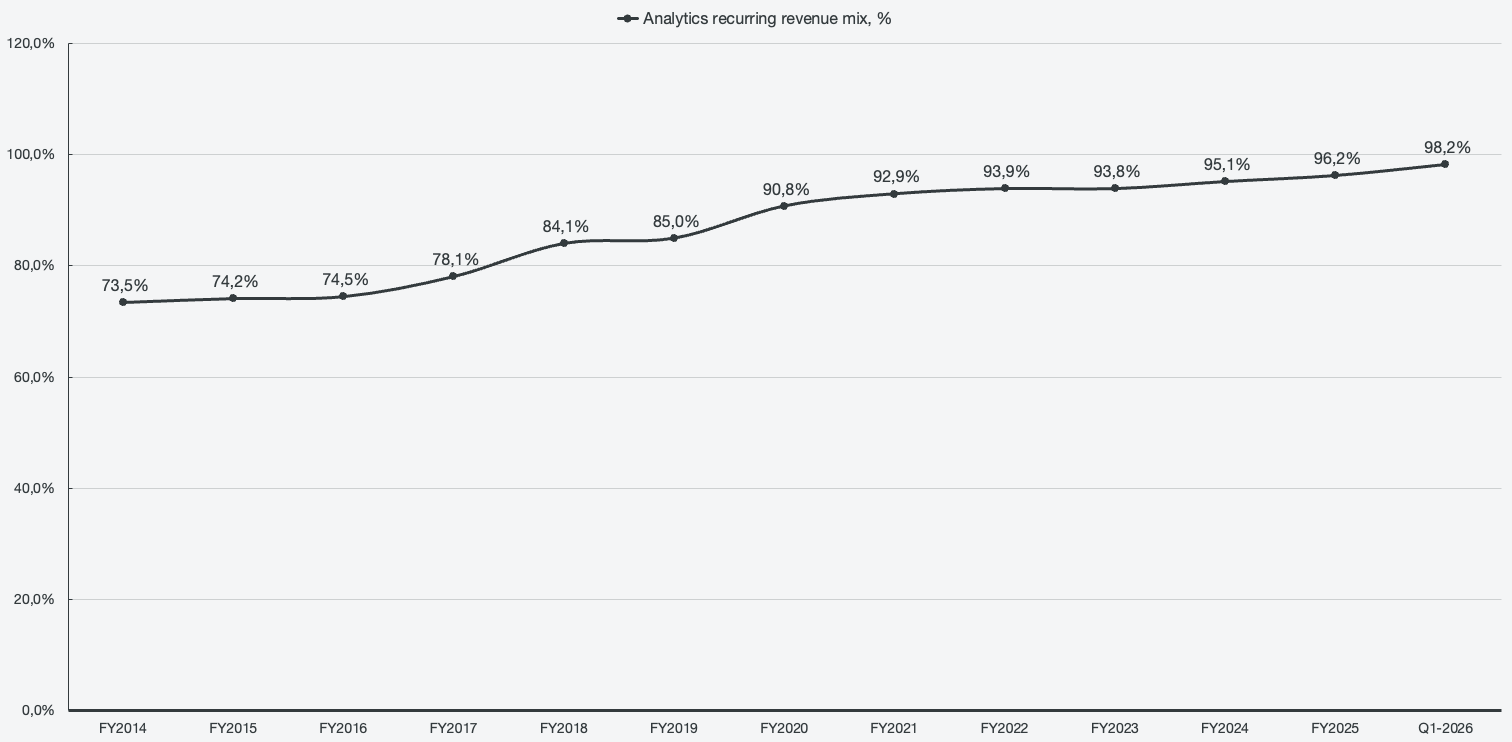
Analytics revenue is quickly approaching being rounded up to a full 100% recurring mix, and makes up ~45% of overall revenues.
Figure 4: Analytics recurring revenue mix