


I have never published research on a pre-IPO business before, but this future listing warrants an exception. PayPay has disrupted Japan’s cash society and become the country’s undisputed leader in the digital payments space. That early-movers advantage is now being leveraged into becoming the country’s first financial SuperApp, and they are well-positioned to take that crown.
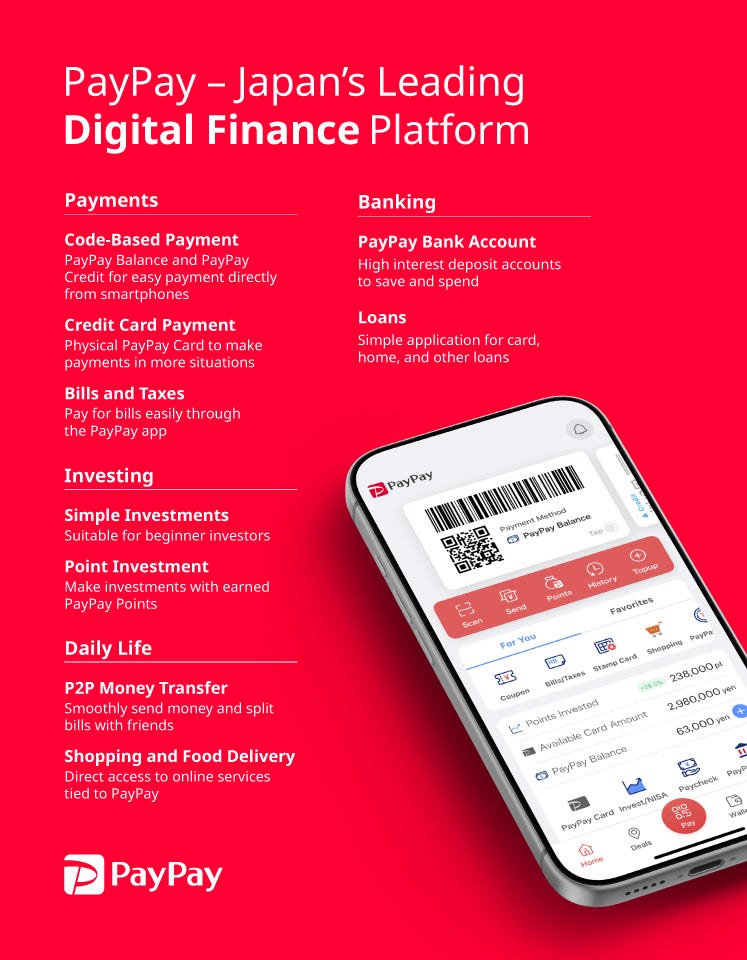
Illustration 1: PayPay’s ecosystem
Company profile
Theme: Financial SuperApp, Direction: Buy (within fair value range)
Symbol: PAYP, Exchange: NASDAQ
Sector: Financials, Industry: Credit Services
Fair intrinsic value: $18 927 billion, as of March 6, 2026
Targeted IPO valuation: $14 000 - $20 000 billion
Major underwriters: Goldman Sachs, J.P. Morgan, Mizuho, Morgan Stanley
TYPEFCAPITAL.COM
Consider following me on X and YouTube.
This article is for informational purposes only and does not constitute investment advice or an offer to buy or sell securities.
Not just another Fintech
The Tokyo Stock Exchange has been largely stagnant for 25 years; however, that has now changed. The Nikkei index is up 53% over the past year and has had a massive resurgence as of late. Many Japanese companies have seen extreme upside in a relatively short amount of time, as outside investor interest has skyrocketed. An interest that SoftBank wants to leverage by expanding overseas with its PayPay subsidiary.
PayPay was initially expected to float in December, but due to the U.S. government shutdown, it was postponed. In mid-February 2026, PayPay Corp filed for a U.S. IPO and is expected to float as soon as this month (March).
Another fintech company may not be too exciting for Western investors, as it is regarded as a highly competitive space with eroding margin profiles. That is not true for Japan. Japan’s unique culture and core demographies turn that narrative on its head, as the country is predominantly cash-heavy and has an aging population. A digital payments transformation is a secular tailwind, and there are not many players in the space vying for market share.
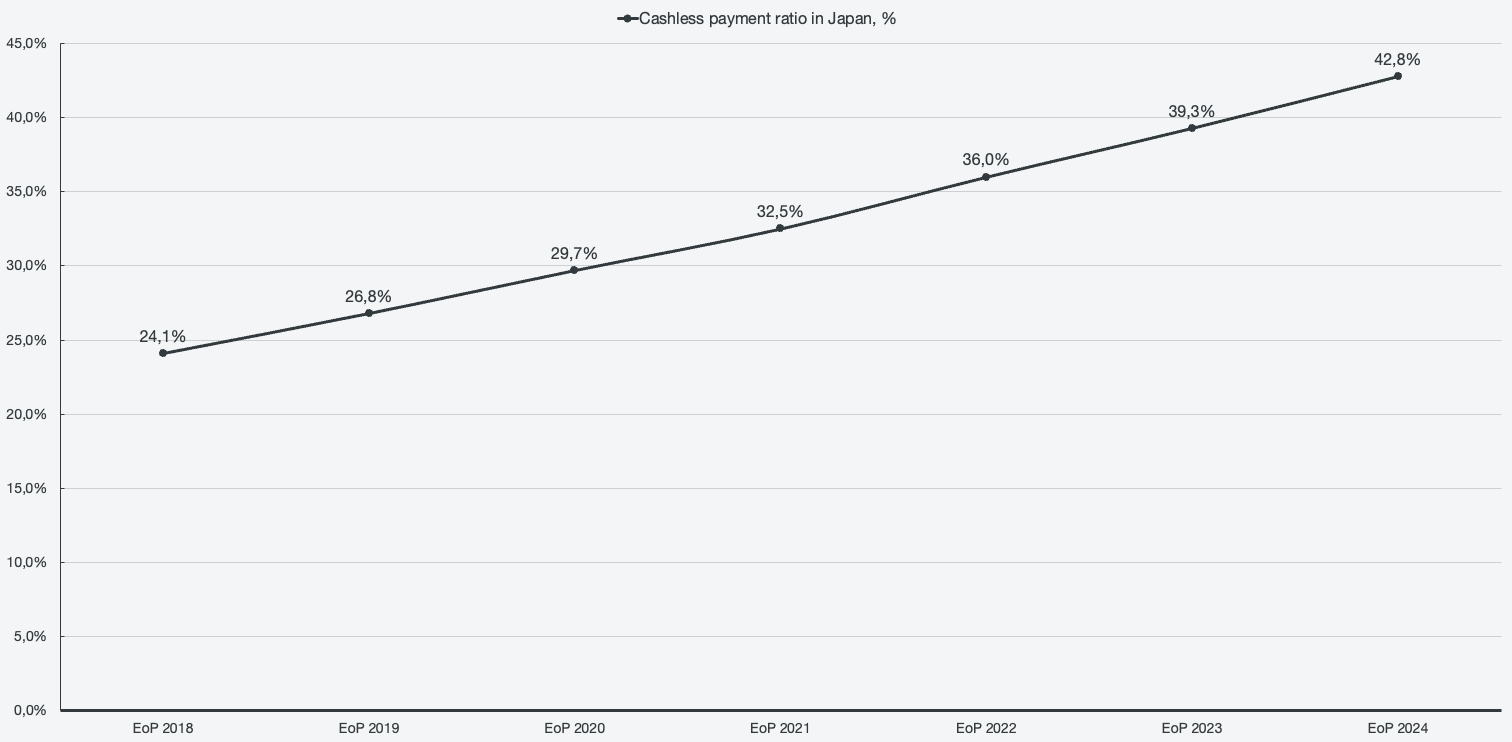
In 2018, Japan’s government set a goal of reaching 40% cashless payments by 2025. Japan was lagging behind the rest of the developed countries. For reference, at the start of 2018, Japan sat at 21% cashless, while South Korea’s cashless ratio was ~90%, China’s was over 60%, and the U.S. around 50%. The government realized that maintaining a physical cash infrastructure was costing the economy trillions of yen annually. The same year that the goal was outlined by the government, PayPay was launched through a joint venture between SoftBank Group and Yahoo Japan.
As a stark contrast to the cashless adoption, Japan has the highest smartphone penetration rate globally of adults under 50 (~100%). That is an impressive feat, considering how late Japan was to adopt smartphones, as they relied on an advanced ecosystem of domestic feature phones (flip phones) that already had features such as mobile TV, internet, email, and digital wallets. All that was needed to start the cashless revolution was a catalyst and someone to capitalize on the opportunity. The catalyst was the Japanese government, and the company to take advantage of the opportunity was PayPay. The 2025 goal of reaching 40% cashless, laid out by the Japanese government, was effectively reached by the end of 2023.
Figure 1: Japan’s cashless payment ratio, end of period
How PayPay dominates
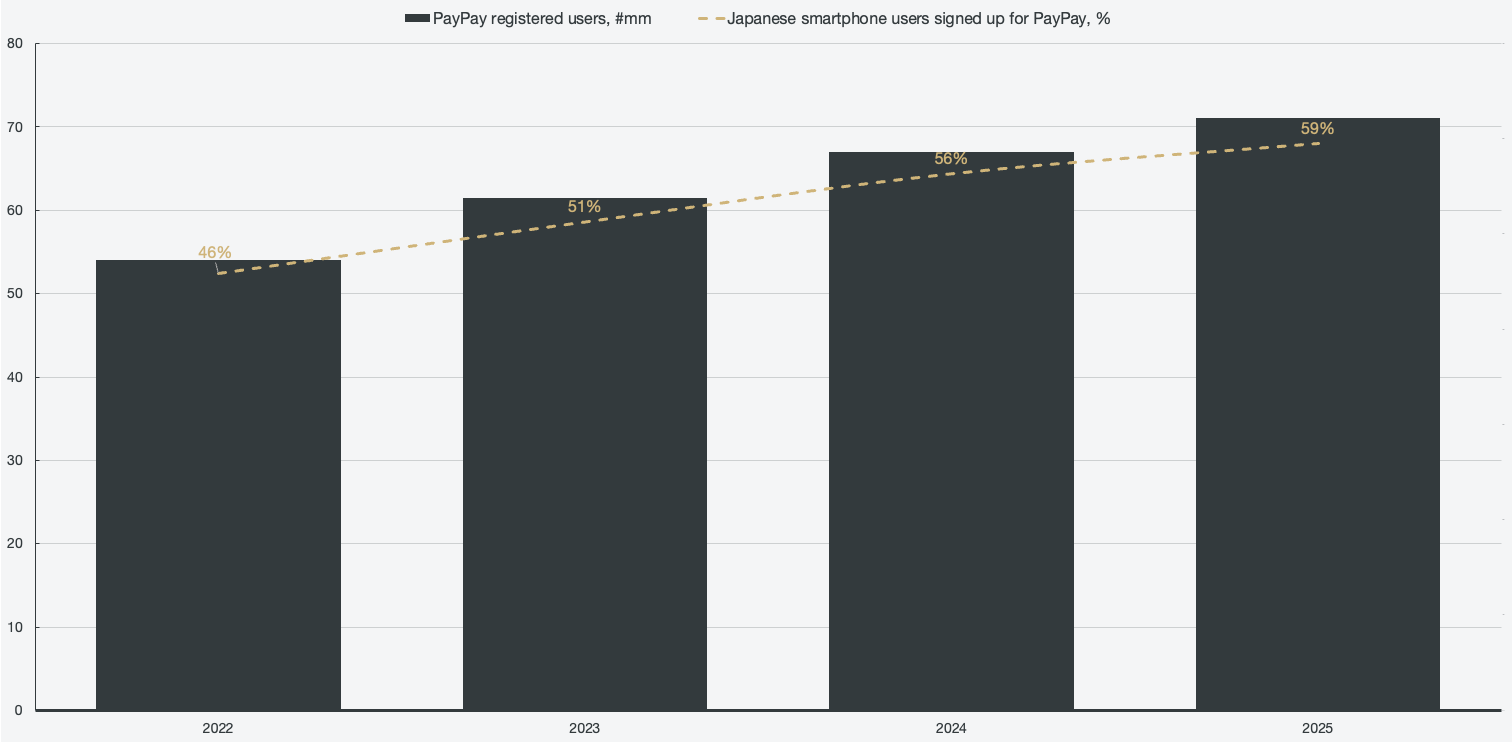
Depending on which third-party estimates of Japan’s smartphone penetration you use, about two-thirds of all Japanese smartphone users are registered for a PayPay account. In the most optimistic assumption, implying that 98% of all Japanese use a smartphone in 2025, PayPay has a ~60% registry rate. A rate that is still trending upwards aggressively.
Figure 2: PayPay registered users and market share of Japanese smartphone users
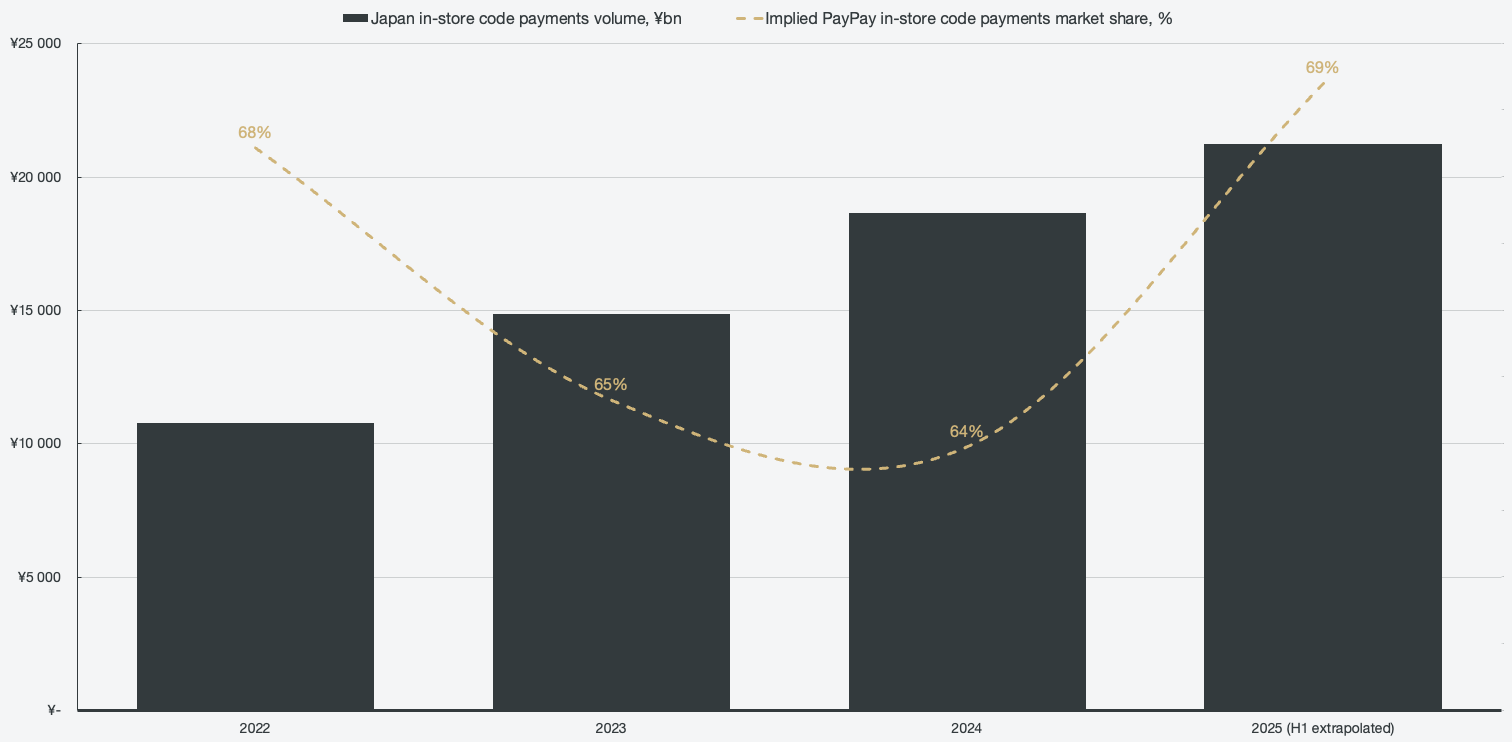
The PayPay usage rate translates to an even higher overall market share of the primary service, which is code-based in-store payments. Over the past four years, of the ¥64.56 trillion in-store QR code payments volume, around 67% was paid through PayPay. Calculated using the following formula:
Figure 3: PayPay in-store code payments market share
The playbook that PayPay employed to capture a majority of the market combines network effects with a powerful flywheel effect. The key elements of the strategy can be outlined as follows: