


Many investors have a strange obsession with finding “the next X,” and I have seen that behavior over the years. For instance, investors who missed the run-up in Tesla stock a few years ago positioned themselves in companies like Nio, Rivian, and Lucid Motors because they saw those companies as “the next Tesla.” For some investors, Rocket Lab is “the next SpaceX.” That notion is doing Rocket Lab a disservice, since Rocket Lab has carved out a clear market, one that is at a different scale from SpaceX and with a different core mission.
The final piece to counter that narrative is that the “next X” typically fizzles out and has historically been a weaker business, such as Lucid Motors, which is now teetering on the brink of bankruptcy. Rocket Lab is a credible company with high launch success rates, a clear path to profitability and scalability, and a clear path to business expansion.
Company profile
Theme: Space, Direction: Hold
Symbol: RKLB, Exchange: NASDAQ
Sector: Industrials, Industry: Aerospace & Defense
Fair intrinsic value: $28.1 (-56%), as of September 5, 2026
Market capitalization: $40 463 million
Pricing data: P/S 53x, P/E N/A
TYPEFCAPITAL.COM
Consider following me on X and YouTube.
This article is for informational purposes only and does not constitute investment advice or an offer to buy or sell securities.
The full stack
Rocket Lab, together with SpaceX, is one of only two companies that can design a satellite, build it, launch it on their own rockets, and operate it once it is in orbit. As Rocket Lab describes itself, they are an end-to-end space company. They manufacture everything from solar arrays and star trackers to laser optical terminals and robotic arms. It is a prime contractor for the Space Development Agency (SDA) and the Space Force.
The company manufactures satellites, launches them on its own rockets, and then operates them for its customers. To own the chain end-to-end, it also plans to own and operate its own constellation.
Rocket Lab reports two primary segments with different economics. The first segment is launch services, comprising launches of Electron, HASTE, and, soon, Neutron. The other segment is space systems, consisting of spacecraft and constellation programs, components and subsystems (solar cells and arrays, star trackers, radios, etc.), and related software, services, and payloads.
Figure 1: Segmented revenue
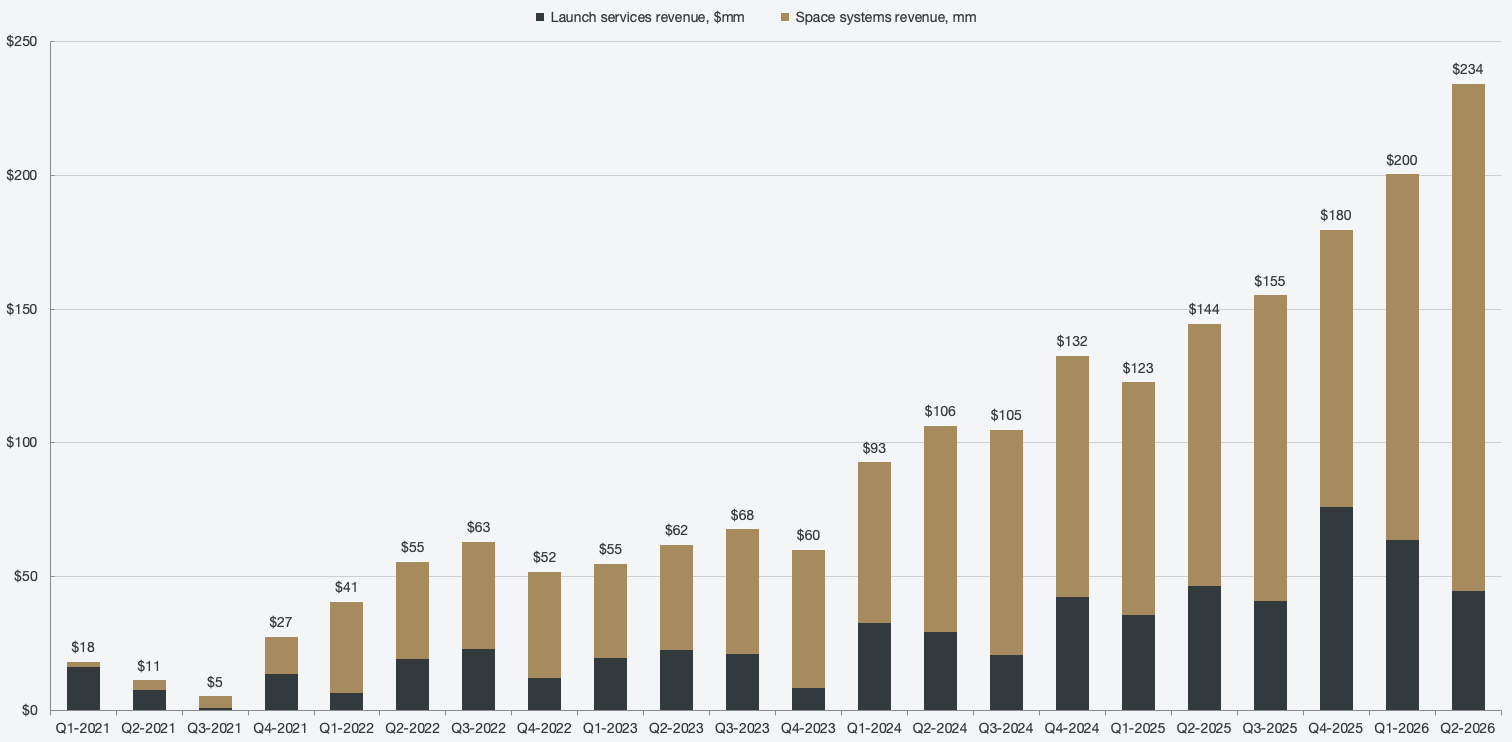
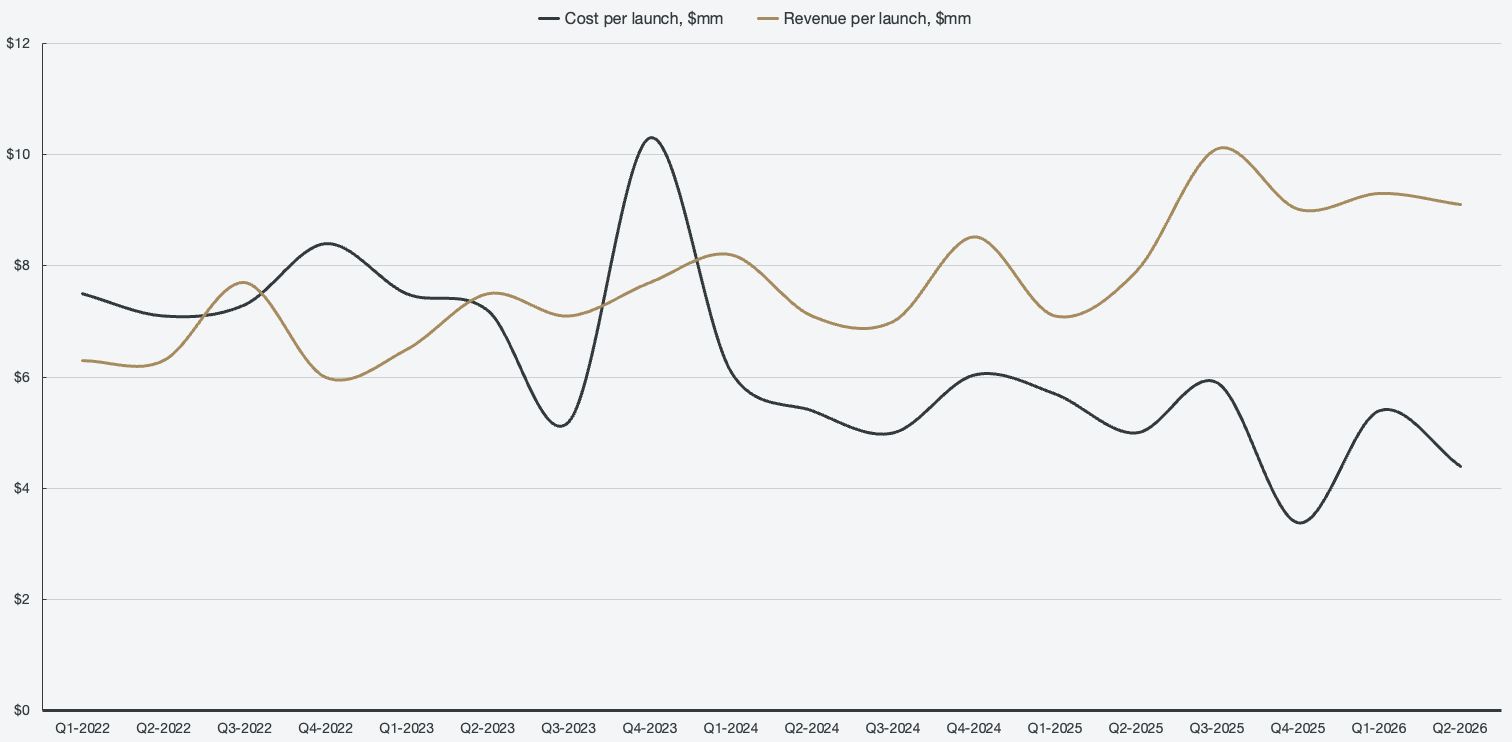
Rocket Lab’s advantage in the industry lies in time and availability. SpaceX might be a far cheaper option in terms of launching a customer’s payload, but it would happen on an orbital plane and date of SpaceX’s choosing. Capacity scarcity in this industry allows Rocket Lab to exercise pricing power. Customers pay for orbit choice, date control, and an established track record, rather than the cheapest kilogram. The broader launch market has gotten cheaper over time, but Rocket Lab’s average revenue per launch has been rising.
The truth is that if you want to book a launch now, or especially after 2029, the options are extremely limited. Rocket Lab is uniquely positioned in this sense.
Peter Beck, Chief Executive Officer
Rocket Lab Corporation, Q2 2026 Earnings Conference Call
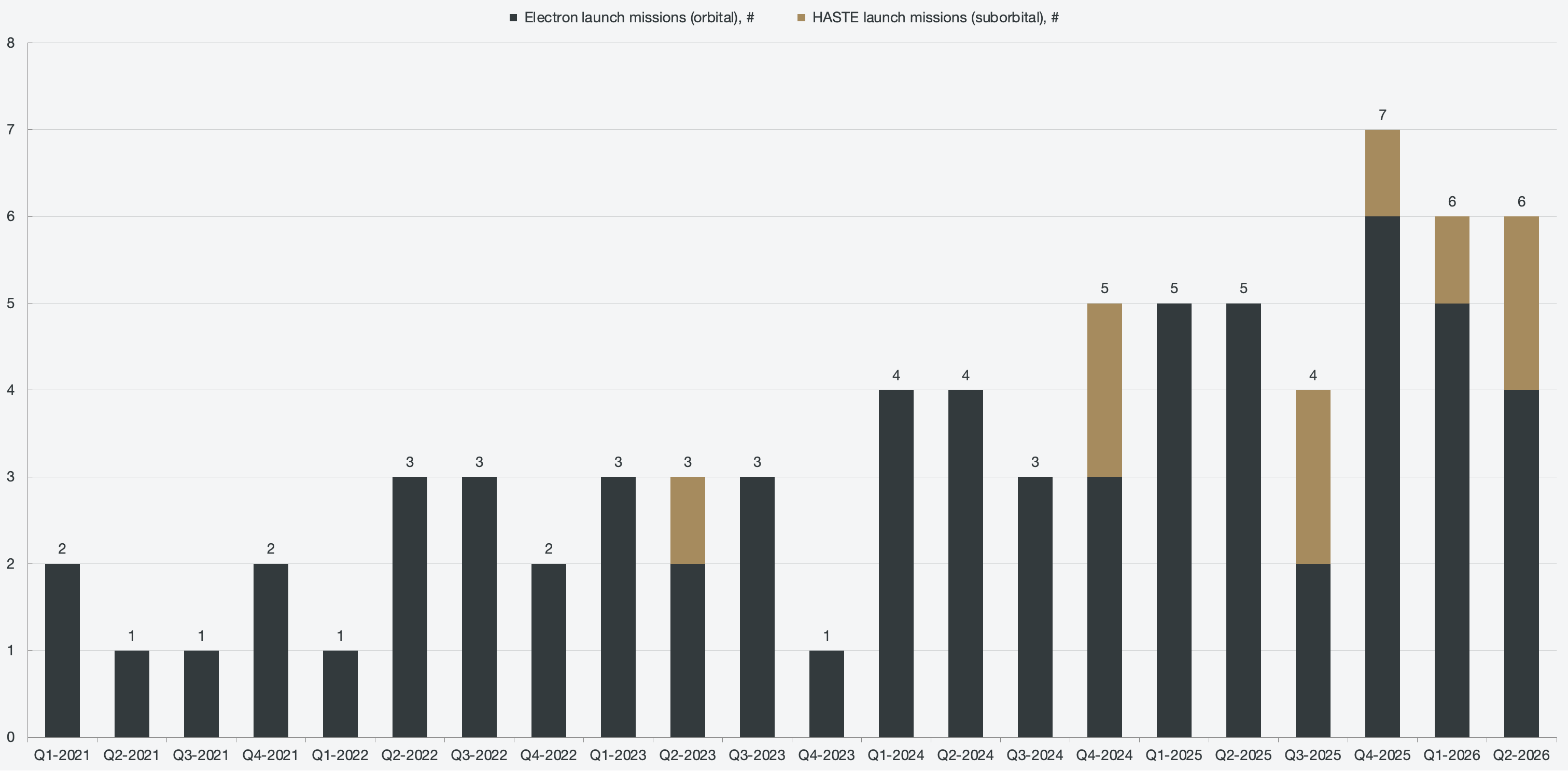
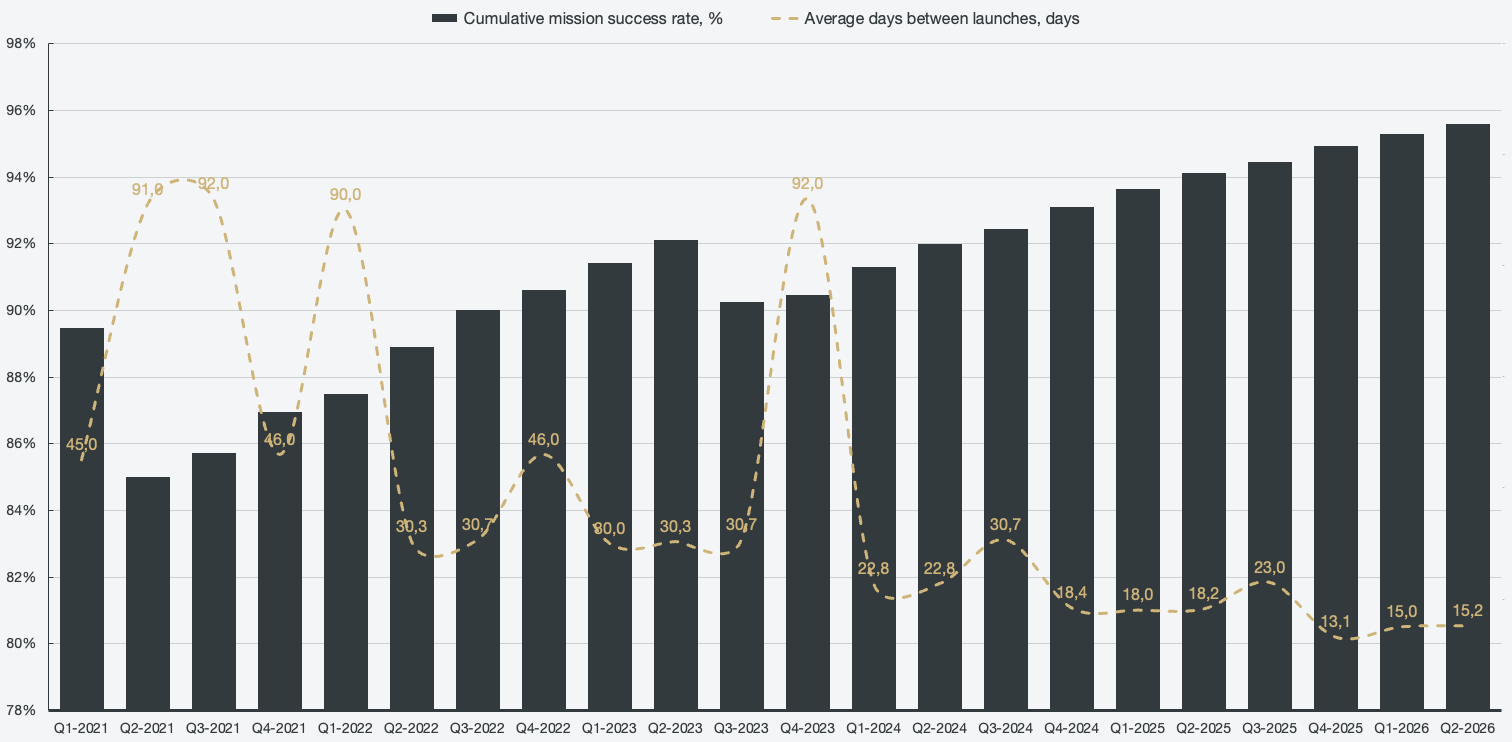
What matters in the industry is operating record. Rocket Lab has a 100% mission success rate over the past 3 years, and a 96% cumulative mission success rate as of Q2 2026. Through Q2 2026, Rocket Lab has flown 93 times, with a total of 4 failures. The average time between launches has fallen dramatically, from 61 days in 2021 to a mere 15 as of Q2 2026. Electron was the second most frequently launched orbital rocket globally, only behind SpaceX’s Falcon 9.
Figure 2: Segmented launch missions
In Q3 2021, Rocket Lab lost $9.2 million on a launch. In Q2 2026, they generated $4.7 million in gross profit per launch. This is because fixed costs for manufacturing overhead and direct labor remain the same whether Rocket Lab launches 10 or 20 vehicles.
Another part of the story is more efficient manufacturing: increased automation and better yield over time, less scrap, less rework, in-house structuring, and better supplier lots as volume became predictable. Flying more often on the same infrastructure, charging more as credibility increased, and scarcity for small dedicated launches increasing, and more flights being done for the government.
Figure 3: Cost and revenue per launch
Lastly, the mix of spacecraft launched also affects the segment's gross profit. Currently, Rocket Lab flies Electron and HASTE. Electron is an orbital rocket that is built to give small spacecraft their own ride to low Earth orbit instead of hitchhiking on a larger rocket. Typical uses include:
Earth-observation and communications satellites for companies like BlackSky, Planet, Synspective, and Capella.
Intelligence and National-security payloads for Space Force, NASA, DARPA, and NRO.
Both dedicated and rideshare missions of up to 300 kg to low Earth orbit.
Typically, a customer will reach out to Rocket Lab to get their satellites into an orbit of their choosing, on a date they request. Because Rocket Lab lets customers control the schedule and destination, it can charge a premium over SpaceX flights.
HASTE, or Hypersonic Accelerator Suborbital Test Electron, is a modified Electron that stays suborbital. Since it doesn’t need to reach orbit, it can carry larger payloads (up to ~700 kg) and can push the payload to anywhere between Mach 7 and Mach 20 (or more). Typical use cases for HASTE include:
Hypersonic weapons and vehicle flight tests.
Interceptor and missile-defense experiments, such as Golden Dome-related flights.
Earth re-entry technology testing.
Guidance and aerothermal tests in high-speed atmospheres when wind tunnel simulations are not enough.
Essentially, the Pentagon needed frequent and cheap hypersonic test shots. Legacy testers are slow to book and a lot more expensive per shot. Because HASTE uses the same factory, engine, and launch pads as Electron, Rocket Lab can fly tests more frequently and at a lower cost than legacy testers. As such, most missions relate to the U.S. government and defense work, with many payloads remaining classified.
Calculating the average revenue per launch for quarters consisting only of Electron launches gives a launch-weighted average baseline of $7.49 million/launch. Backing out the implied HASTE revenue per launch for quarters where HASTE launches are part of the mix gives an uplift in revenue/launch of up to 145%, and as low as 35% from 2024. From Q1 2024 to Q2 2026, a regression cross-check implies that Electron’s revenue/launch is $7.86 million, and $11.86 million for HASTE, implying an uplift of ~51% per HASTE launch.
Figure 4: HASTE implied uplift per launch
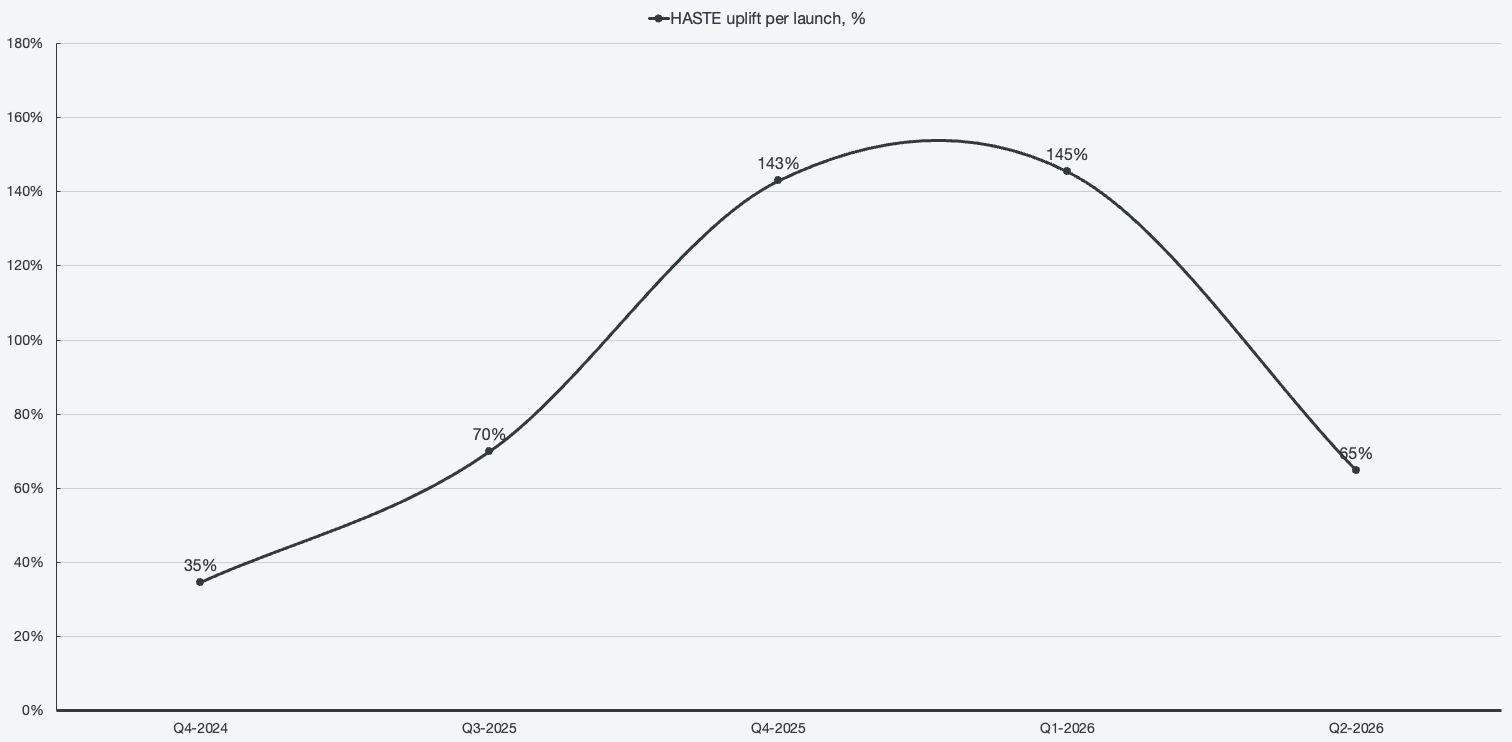
Rocket Lab does not publish ASPs for either vehicle. In essence, ASPs vary with orbit, payload, launch site, schedule urgency, and volume discounts. Compared with contracted defense data, HASTE’s implied $11.86 million per launch is roughly in line. The Space Force award implies $22 million per mission at twelve launches, and ~$15 million if all eighteen fly. The Anduril contract implies $10 million using the same arithmetic.
Neutron is the next stage in Rocket Lab’s arsenal that provides vastly different capabilities to Electron. It is a much larger rocket and can carry up to 13,000 kg on a reusable basis, compared to Electron’s ~300 kg and limited reuse. It has not flown yet and is targeted for late 2026, but it has already been pushed back multiple times, making a 2027 debut not unlikely.
[…]it is not just to get to the pad quickly for flight one. Of course, we all want that one. No one more than I. But it is really about how do we get to flight 10 in the shortest time possible.
Peter Beck, Chief Executive Officer
Rocket Lab Corporation, Q2 2026 Earnings Conference Call
While Electron targets niche customers willing to overpay for a dedicated ride, Neutron can target a much larger swath of the market: mega-constellations, SDA and Space Force-class sats, national security launches, and customers competing with Starlink. Essentially, it would become a second U.S. medium-lift option alongside SpaceX. It is also the next step toward operating large constellations through their own vehicles, which ties into the Iridium acquisition target. More on that shortly.
Financially, Neutron is expected to have an ASP roughly 6 times larger than Electron’s at ~$50-55 million. Even with a slow ramp in flights, such as ~7-10 in the first 3 years, it would mean hundreds of millions in launch revenue. However, part of Rocket Lab’s backlog already assumes Neutron’s existence, since some space-systems awards include it as an option on the contracts.
Figure 5: Cumulative mission success rate and average days between launches
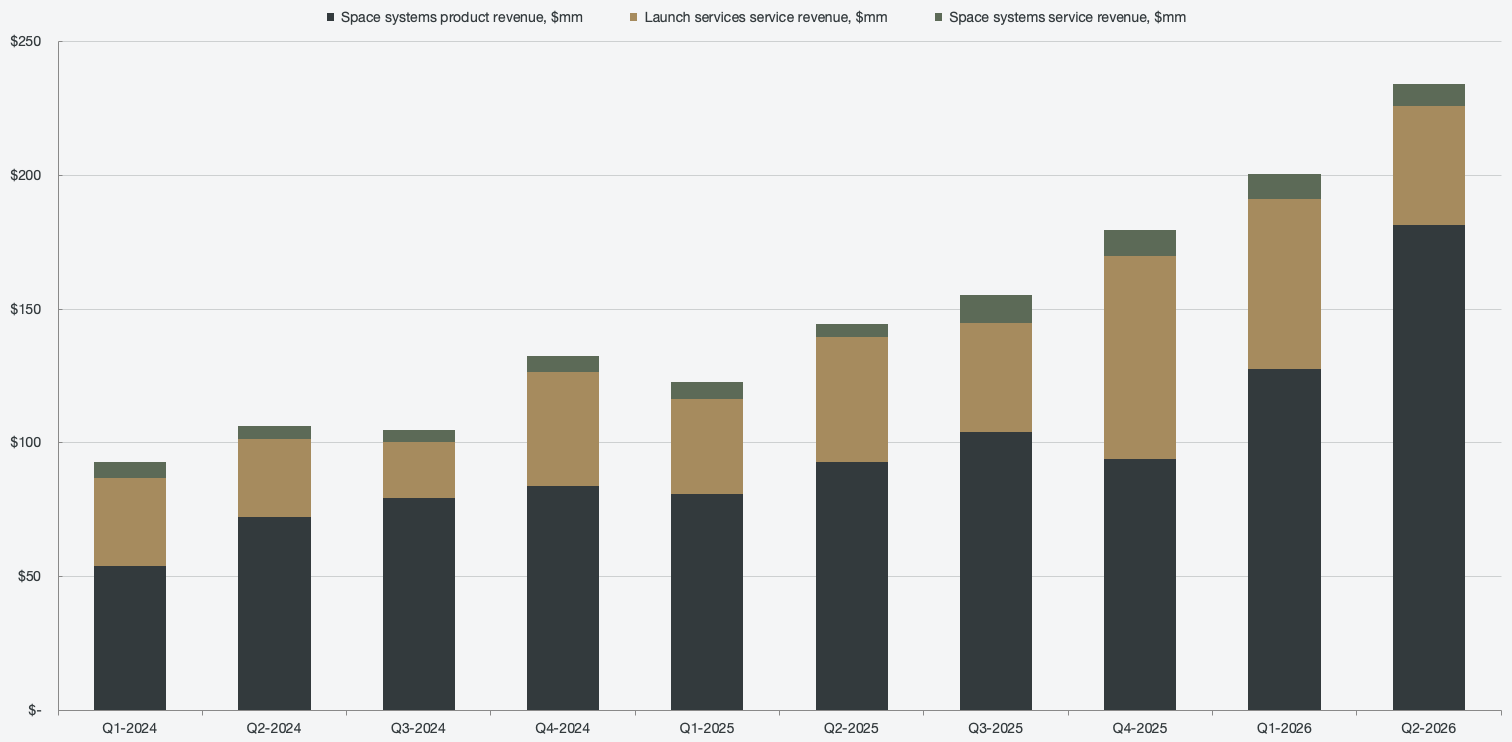
Space systems is the larger and faster-growing segment. It includes complete spacecraft, individual satellite parts, and related services. Most revenue comes from products, with a smaller share from services. Rocket Lab can sell a complete design, build, launch, and operate package by pairing the space systems segment with launch services.
There are essentially two businesses inside of the space systems segment. First are merchant components, including solar, reaction wheels, star trackers, software, separation systems, and optical terminals and mechanisms. In a sense, it is a pick-and-shovel revenue stream.
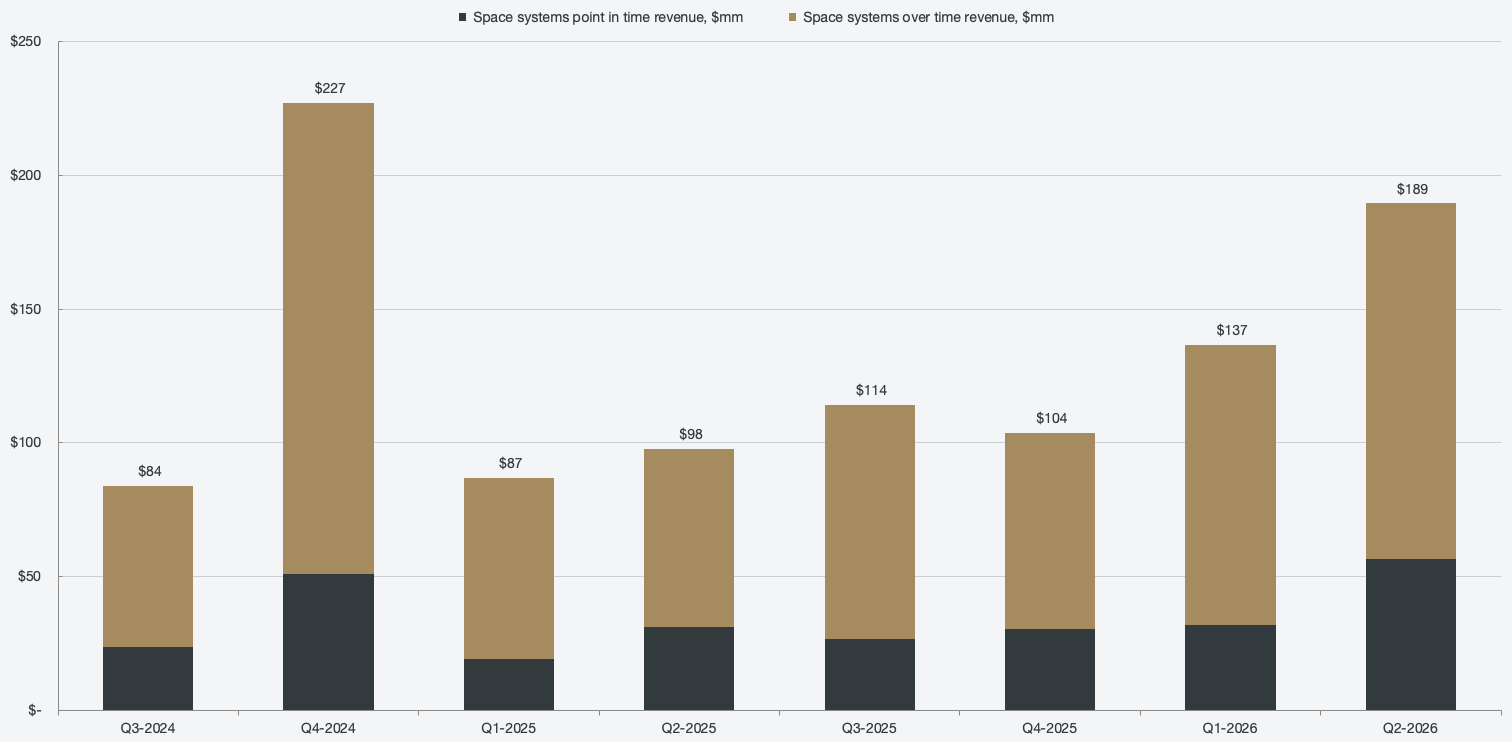
The other part of the business pertains to satellite platforms and full spacecraft, including the SDA transport and tracking layer, GEO domain-awareness satellites, flatellite, and photon-class buses. These are typically large, multi-year contracts delivered over time, at lower margins than the merchant components. Most of the backlog is tied to the satellite platforms and spacecraft part of the segment, and as such, can bring down overall margin as the mix increases.
Figure 6: Space systems revenue recognition
The real value is providing the full stack, end to end. SDA Tranches II and III (goal of building, scaling, and upgrading a resilient LEO satellite constellation for the U.S. military) are worth more than $1.3 billion. Sourcing SADAs (Solar Array Drive Assemblies), gimbals, sensors, optical comms, and other parts in-house raises the captured margin on produced satellites and lets Rocket Lab bid without tracking supplier margins. This allows the company to undercut on both price and schedule, compounding platform wins. Rocket Lab winning SDA Tranche III as prime was tied to owning both bus and payload. Value for the segment lies in winning future tranches, as well as Golden Dome ($1.2 trillion over 20 years, of which $723 is the space-based interceptor layer), and other SDA-like contracts.
Rocket Lab also supplies its own competitors through the Space Systems segment, including other primes competing for the same prime contracts. However, components must be qualified, and once qualified into a satellite bus, they become difficult to displace. That creates a long-lasting, sticky, high-margin revenue stream. As an example, Rocket Lab notes that its hardware and spacecraft have flown on over 1,800 missions over a twenty-year period.
Both operational segments tie together and create more value as a sum, rather than individually. Designing, manufacturing, and launching as one increases win rates on national-security primes and captures margin that would otherwise leak to suppliers and third-party launch suppliers, but the trade-off is concentration risk. A delay on Neutron, or a cost overrun on SDA, could hit the business across seemingly unrelated operations.
Figure 7: Segmented service and product revenue
In essence, Rocket Lab's current launch value is driven by flights, cost per flight, and Neutron's reusability capabilities. Space systems derive value from component margin, manufacturing efficiency, and the duration and durability of government platform wins.