


Over the past year, from peak to trough, ServiceNow stock fell as much as 58% due to AI disruption fears and seat-based software becoming obsolete. However, the business shows no signs of the fears materializing. Renewal rates are intact, ACV is increasing, the backlog is lengthening rather than shortening, and the business is well-positioned to continue to grow meaningfully over the coming years. AI adoption among ServiceNow’s customers is soaring, and management is quick on its feet to adapt the business to meet the new challenges it faces.
Company profile
Theme: SaaS, Direction: Hold
Symbol: NOW, Exchange: NASDAQ
Sector: Technology, Industry: Software - Application
Fair intrinsic value: $112.6 (-10%), as of August 19, 2026
Market capitalization: $130 776 million
Pricing data: P/S 8.9x, P/E 78.3x
TYPEFCAPITAL.COM
Consider following me on X and YouTube.
This article is for informational purposes only and does not constitute investment advice or an offer to buy or sell securities.
The ever-present AI fears in the market
In recent times, the SaaS darling of the market has not been spared from the cannon of AI disruption fears. However, none of the reported financial metrics suggest that ServiceNow is being disrupted by AI.
Figure 1: Revenue and revenue growth, TTM
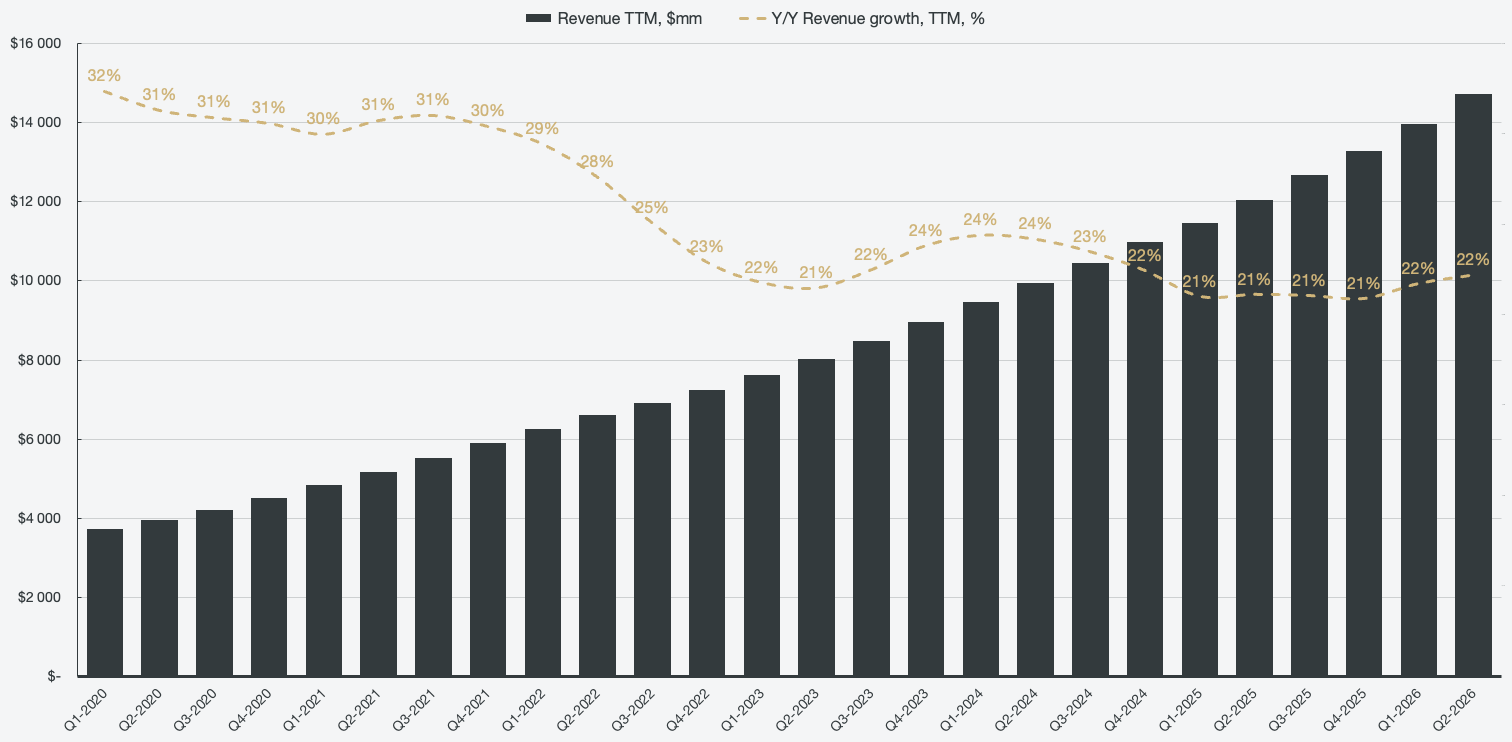
There are two angles to AI disruption fears: one to the business itself, and one to the business model. Anthropic sparked a majority of fears in the market when it started shipping products across a wide variety of categories, including creative and visual design, cybersecurity, and enterprise productivity and automation. The notion is that AI will be able to create software products within any given vertical and disrupt existing software companies. In regard to targeting the business model, the fear is that AI agents will take over seats in a seat-based SaaS, and with that, the revenue associated with the seat will be lost.
In the ServiceNow context, if ServiceNow only offers seat-based SaaS contracts, then agentic AI would be akin to an extinction event for the business, and that seems to be what the market has begun to fear for the company. Both volume and price would be under pressure, but such a scenario is not materializing. Instead, ServiceNow has embraced AI and integrated AI capabilities across its suite of products, which is resulting in increased volume and pricing for the offerings instead. The approach is a hybrid pricing structure of both seat-based pricing for predictability, as well as a consumption-based model for flexibility.
[…]half of our net new ACV has already shifted to non-seat-based pricing models as they catch those tailwinds. Those underlying units, including assets, infrastructure, platform usage, are seeing significant growth. We don’t count seats here, we count dollars.
Gina Mastantuono, Chief Financial Officer
ServiceNow, May 4, 2026 Investor Day
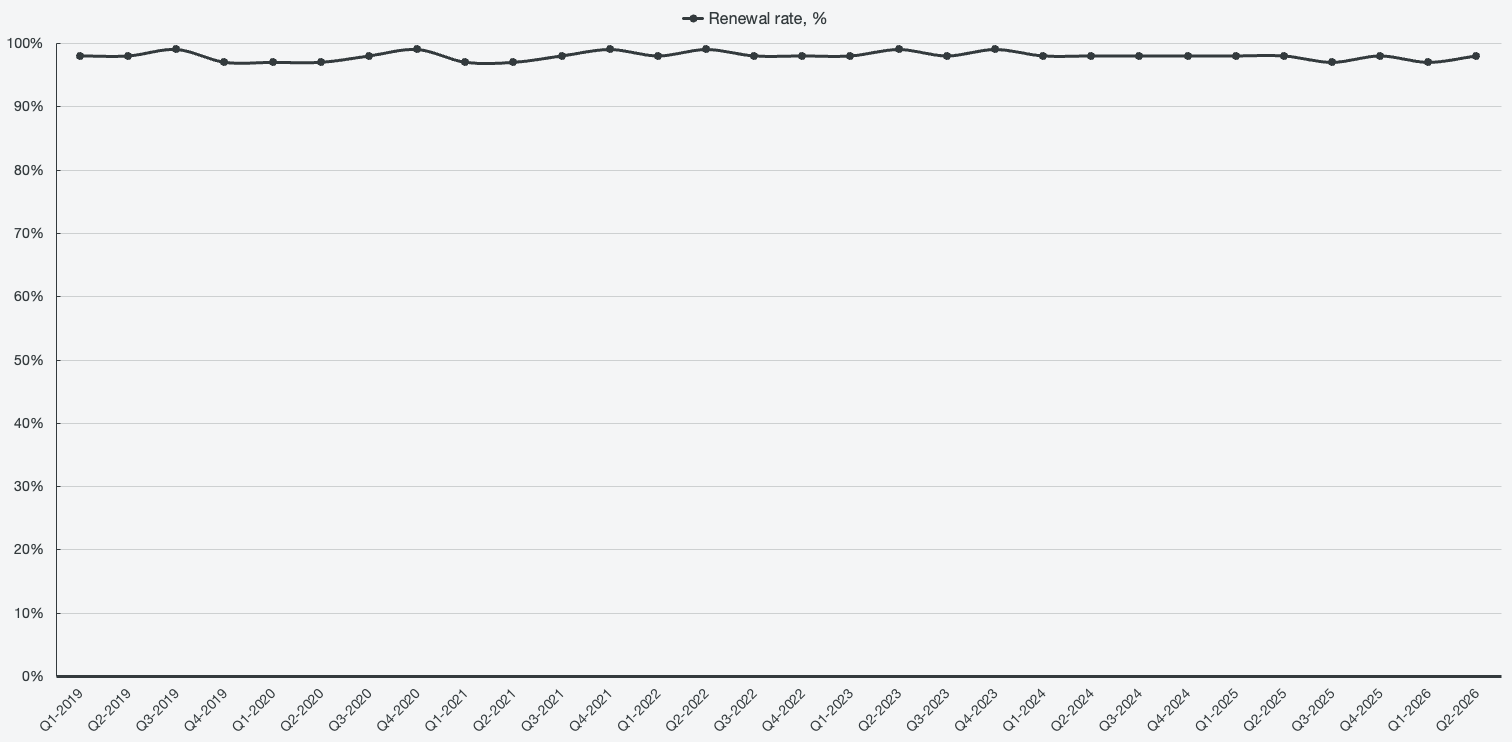
ServiceNow reports some of the most consistent financial figures that I have seen in a business, making it easy to spot any kind of disruption across the business. Renewal rates have stayed consistent, annual contract value (ACV) expansion across customers continues to accelerate through peak AI fear, and even the geographical mix is undisrupted.
Figure 2: Renewal rate
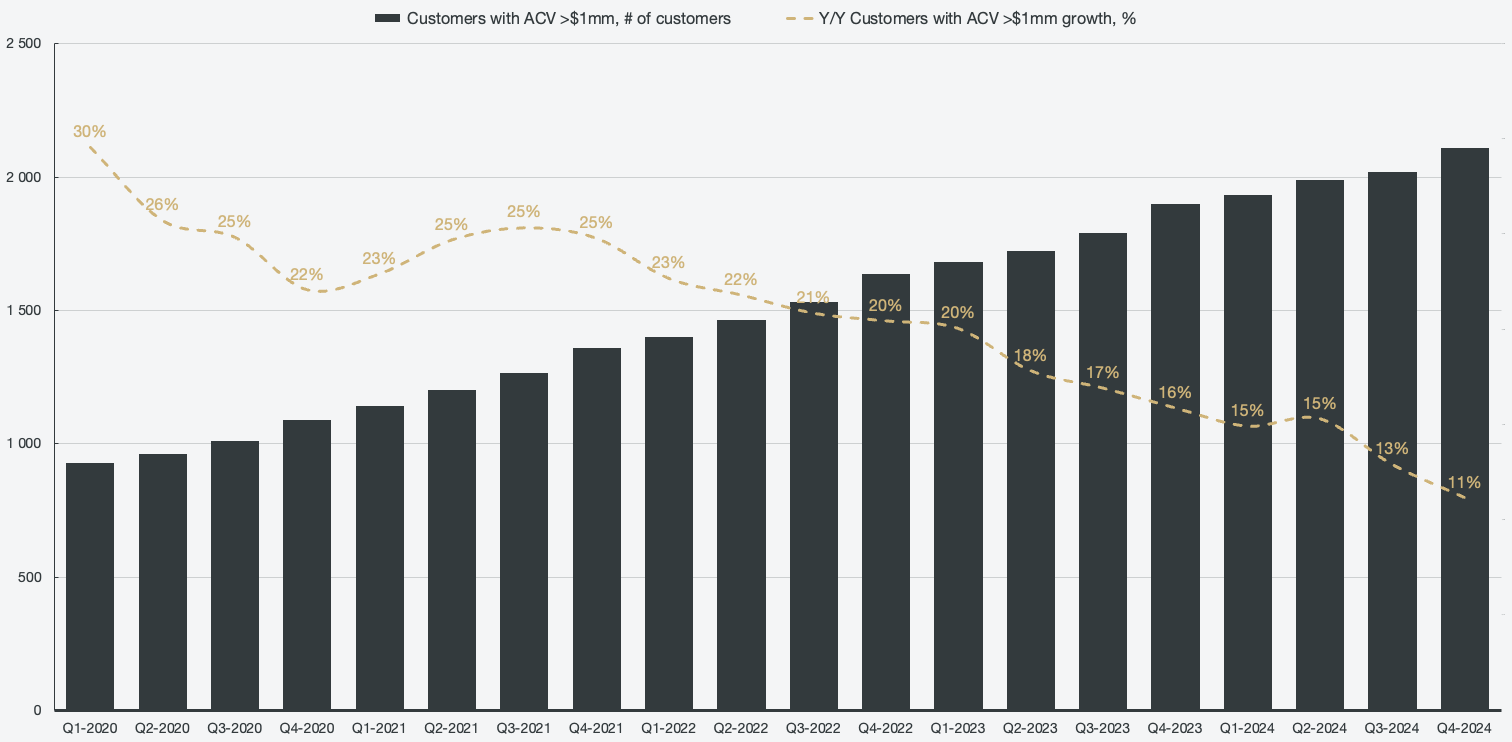
One chart that may seem alarming at first is the number of customers with ACV’s exceeding $1 million. The growth rate has steadily been dropping until it ultimately ceased to be reported on altogether, just as the growth rate was about to drop below 10% Y/Y
Figure 3: Customers with ACV exceeding $1 million
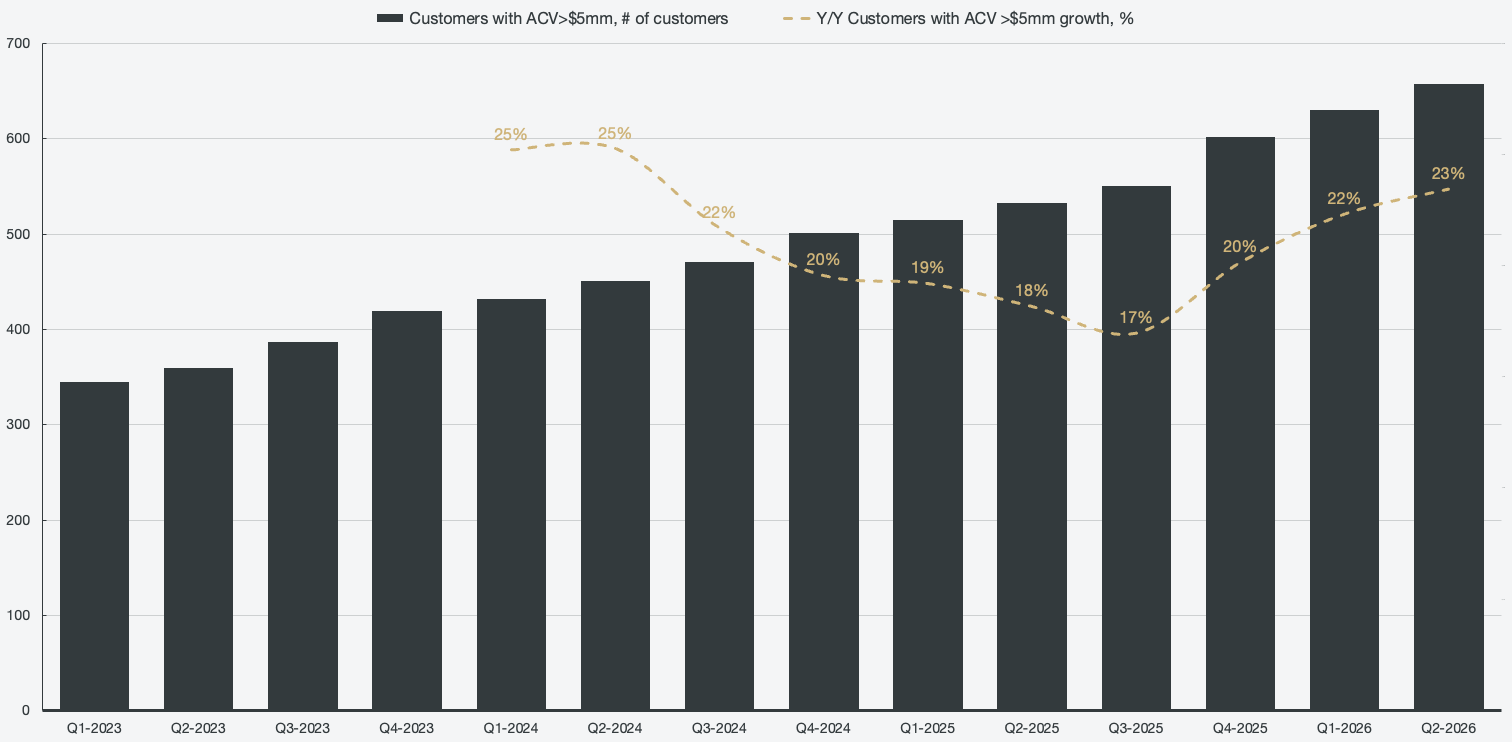
What replaced the metric is customers with an ACV exceeding $5 million, and that cohort of customers has been accelerating over the past year, through peak AI disruption fears.
Figure 4: Customers with ACV exceeding $5 million
Among the cohort of customers with an ACV exceeding $5 million, the average ACV per customer has steadily been increasing throughout the AI fear narrative.
Figure 5: Average ACV of customers with an ACV exceeding $5 million
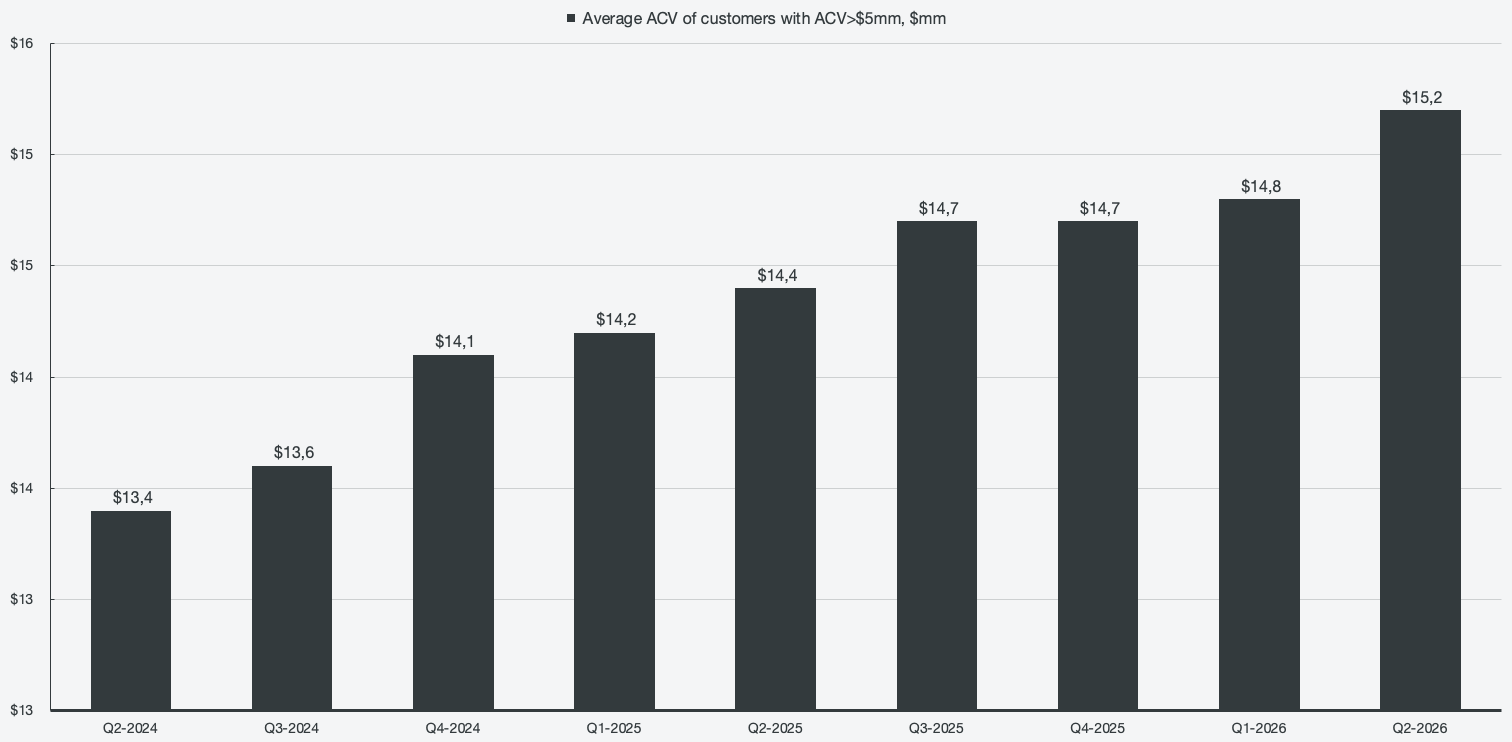
To recap, AI disruption would show up in both volume and pricing, ultimately impacting growth. What we are seeing is consistent and healthy renewals, accelerating revenue growth, and expanding ACV both in terms of average ACV as well as the number of customers signing large contracts. ServiceNow’s own AI solutions are seeing rapid adoption, with a majority signing consumption-based pricing, and customers spending over $1 million of ACV on ServiceNow’s AI solution grew 130% Y/Y in Q1 2026, signaling expansion rather than contraction. If AI agents were displacing ServiceNow’s solutions, the outlook would look quite different.
Now Assist NN-ACV to date continues to outperform even our expectations. The number of customers spending $1 million-plus grew over 130% year-over-year.
Bill McDermott, Chief Executive Officer
ServiceNow, Q1 2026 Earnings Conference Call
ServiceNow’s software
ServiceNow and its “Now Platform” is originally an IT service management (ITSM) system covering the core incident, problem, and change service requests. Since then, it has expanded into covering wider parts of an enterprise’s operations, including:
IT operations and asset management.
HR and employee service delivery.
Customer service and CRM workflows.
Security, risk, and compliance.
Low-code application development.
Generative AI and agent platform.
These types of workflows and platforms are described in a myriad of acronyms: ITSM, ITOM, ITAM, CMDB, and so forth. However, it’s the last one, the configuration management database (CMDB), that matters competitively. A CMDB is a centralized repository that stores the enterprise’s IT assets and infrastructure components, as well as their relationships and dependencies. Configuration Items (CIs) that populate the CMDB include hardware, software, virtual resources, business services, and virtually any asset within the enterprise.
The purpose of a CMDB is to act as a single source of truth for the whole IT environment, which enables teams to understand the infrastructure of the business and its services. For example, the team can see that a specific application runs across these particular servers, in this data center, dependant of this database, which is maintained by that team, and during an outage, these applications and services will be impacted, which affects these teams, and so forth.
Understanding the importance of a CMDB is also a key to understanding ServiceNow’s competitiveness in the market, as well as its moat. Because of the CMDB serving as a single source of truth for the whole enterprise, the switching costs become massive as years of accumulated populating and mapping of a CMDB would be lost, quickly turning into an operational nightmare. It also helps ServiceNow to expand within existing accounts and sell more platform capabilities, as each module makes the entire platform deployment more valuable and more efficient. For example, if an enterprise’s security team purchases ServiceNow’s Security Operations module, they already have a CMDB dependency map to rely on to see which services, servers, and applications are vulnerable to threats.
The business
The revenue can be divided into two disaggregated revenue lines: subscription revenue, which encompasses the software itself, and a professional services segment, which is a small and limited part of the business. The professional services segment accounts for a mere ~3% of total revenue, which is on purpose as ServiceNow relies on a broad network of implementation partners. By outsourcing a majority of implementation, configuration, advisory, and training to partners such as Accenture, Deloitte, EY, KPMG, and others, ServiceNow can keep reporting high software-like margins and scalability. The professional services revenue is recognized as the work is performed, unlike the ratable recognition of subscription revenue.
Another reason to push professional services to partners is that a large consulting ecosystem gets built, and all of the world’s top consultancies have a reason to keep recommending and pushing the platform. In essence, it can be seen as a customer-acquisition infrastructure.