


There is an existential crisis ongoing in the equities markets targeting software companies. Will AI disrupt every software business model, or will it empower it? Shopify is one of the few companies thriving from AI adoption, and is continuously at the forefront of launching AI features and embedding new, cutting-edge technology into its platform.
Company profile
Theme: Shopping ecosystem, Direction: Buy
Symbol: SHOP, Exchange: NASDAQ
Sector: Technology, Industry: Software - Application
Fair intrinsic value: $128.63 (16%), as of June 9, 2026
Market capitalization: $144 385 million
Pricing data: P/S 11.7x, P/E 108.4x
TYPEFCAPITAL.COM
Consider following me on X and YouTube.
This article is for informational purposes only and does not constitute investment advice or an offer to buy or sell securities.
Capturing every vertical
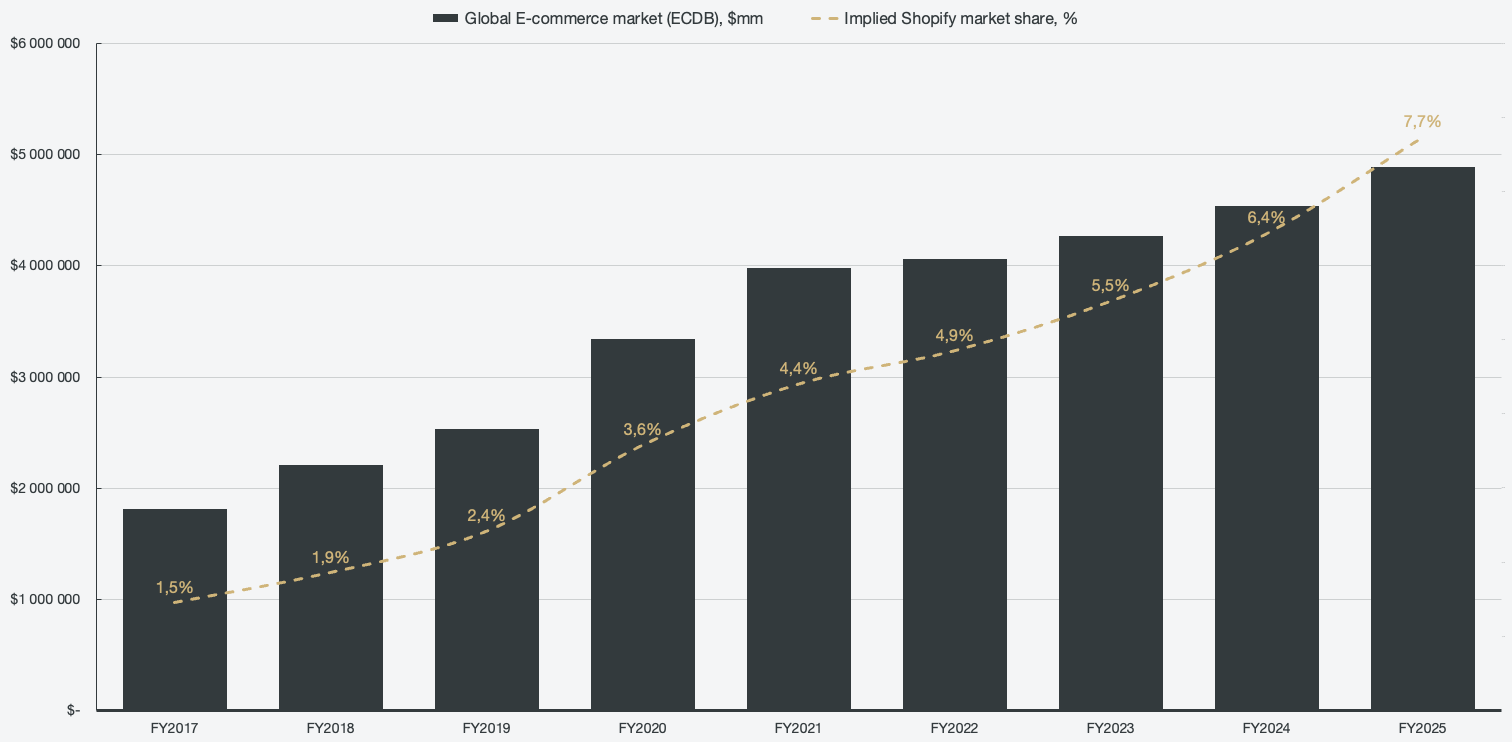
Shopify has become the go-to e-commerce platform for SMBs, serves large brands, and is expanding across all verticals of payment. Most commonly associated with its e-commerce platform, Shopify now also offers offline point-of-sale (POS) terminals, a payments processing business, and a checkout solution. Shopify is rapidly expanding its market share in e-commerce, a sector slated for strong long-term growth.
Figure 1: Global e-commerce market and Shopify’s implied market share
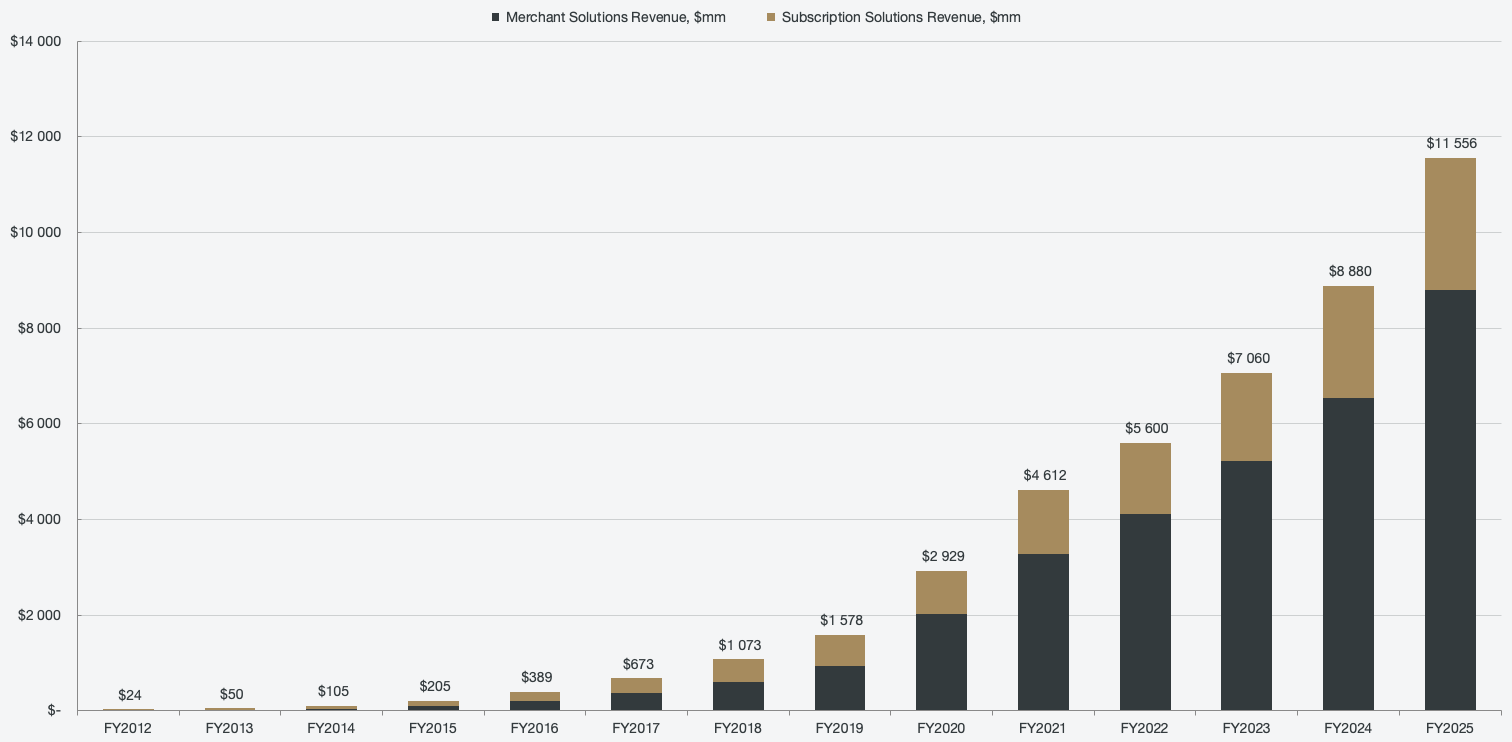
The revenue is comprised of two business segments: subscription solutions and merchant solutions. Subscription solutions serve as a stable growth base and backbone, where merchants pay a monthly fee for utilizing the Shopify platform. Merchant solutions are the primary growth driver and include Shopify payments, transaction fees, shipping logistics, POS systems, and other merchant apps and services.
Over the past 10-year period, total revenue has grown at a 60% CAGR, and the company is still exhibiting a strong pace of growth, despite having grown massively in scale compared to 10 years ago. FY2025 saw 30% Y/Y growth, up from 26% in 2024. Q1 2026 grew 34% Y/Y, meaning that Shopify is still finding ways to accelerate its growth.
Figure 2: Segmented revenue
Shopify is consistently at the forefront of technology, which helps create a moat for the business. Switching costs are high once a merchant builds their business using the Shopify platform. A merchant sets up themes, apps, code, and designs for its storefront and has extended analytics on customer data and order details. The integrations are seamless for not only payments but also shipping, marketing, accounting, and inventory systems. For merchants using Shop Pay (Shopify’s own accelerated one-click checkout solution) and seeing the increased conversion rates, or for merchants who use Shopify Payments for fraud tools, payouts, reporting, and capital offerings, the friction is even greater. Knowing that the next technological innovation will inevitably find its way to Shopify and get integrated attractively is a comforting feeling for staying loyal to the platform.
One of the key pieces for strategically positioning Shopify at the helm of AI solutions such as agentic commerce is the vast data layer. By leveraging millions of merchants and billions of transactions, Shopify has a proprietary data layer that grows smarter with scale and, in turn, makes the solutions more attractive, creating a flywheel effect.
Shopify has a huge advantage that is about to compound. We have 20 years of commerce data. We have data on purchase intent across millions of merchants, hundreds of millions of buyers, and billions of products.
Harley Finkelstein, President
Shopify Q1 2026 conference call
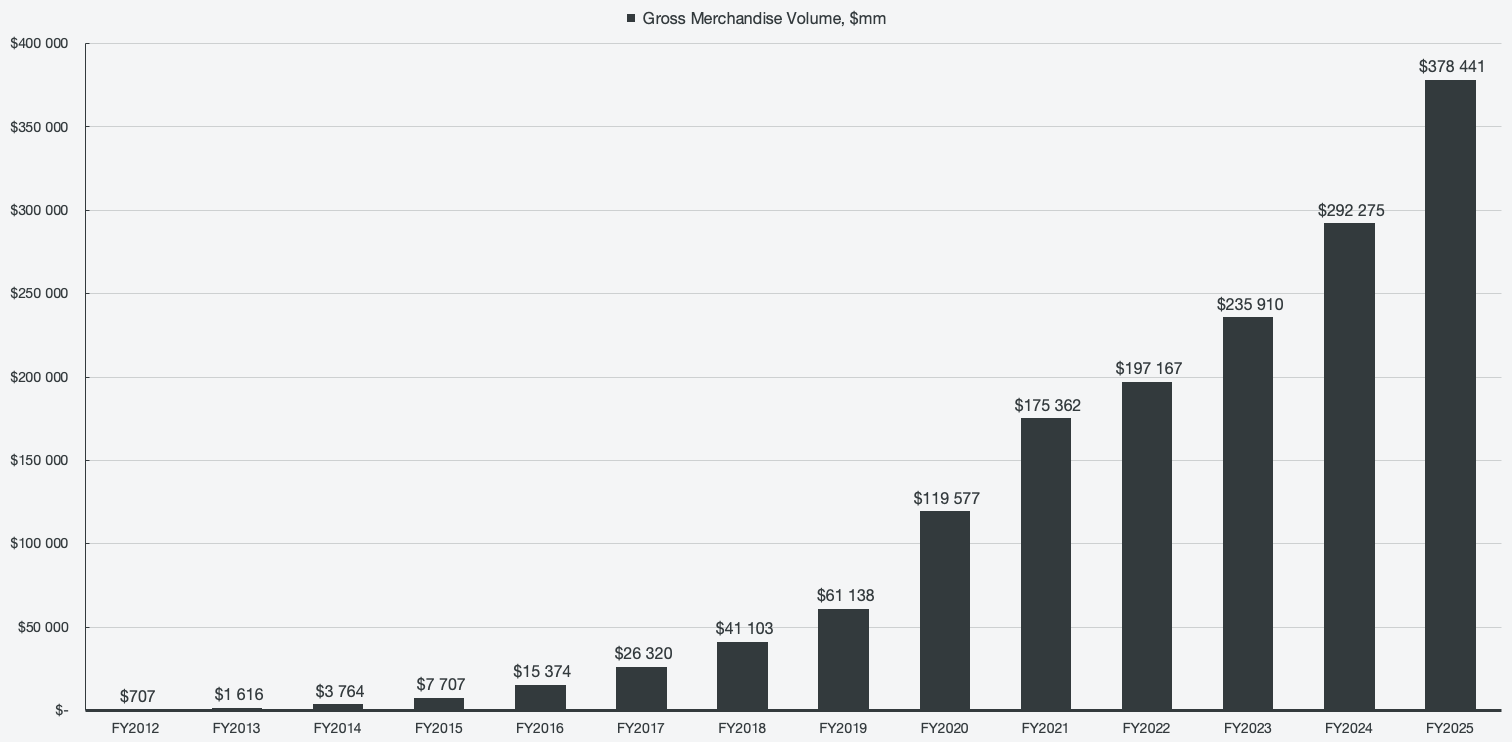
As more merchants join the ecosystem, more transactions and customer data occur, and the ecosystem grows more intelligent. That intelligence, along with the full transaction layer encompassing everything from the store-front to checkout, to taxes, serves as a powerful network effect layer for attracting more merchants and increasing GMV.
Figure 3: Gross merchandise volume
The network effects are the results of growing components within the ecosystem. There are thousands of third-party developers building on Shopify. More merchants mean a more attractive platform for developers, which means more applications, and in turn, more merchants. There is a large ecosystem of agencies, freelancers, and development experts who specialize in Shopify’s ecosystem.
There is also a buyer-side network effect through the Shop Pay buyer network, where shoppers save their payment information. Shop Pay adds convenience for shoppers and drives higher conversion rates, meaning it is more attractive for merchants to offer it. More merchants offering it means it is more convenient for shoppers, and the resulting increase in shoppers makes more merchants want to connect to Shop Pay.
In regard to Shop Pay, merchants report up to 30-50% conversion increases when Shop Pay is enabled. On mobile, improvements can be as great as 1.91x, which makes it a very attractive offering, and the growth reflects the prospects. It reduces cart abandonment since shoppers dislike having to type in addresses and card details, and the bigger the network, the more merchants want to offer it, and the better the offering becomes for shoppers since it becomes more widely available. A win-win situation. However, Shopify does not report Shop Pay KPIs in a consistent manner, forcing investors to stitch bits and pieces together from the available data. Since we get rough Y/Y growth rates and some GMV figures, we can backfill the GMV figures.
Figure 4: Shop Pay gross merchandise volume
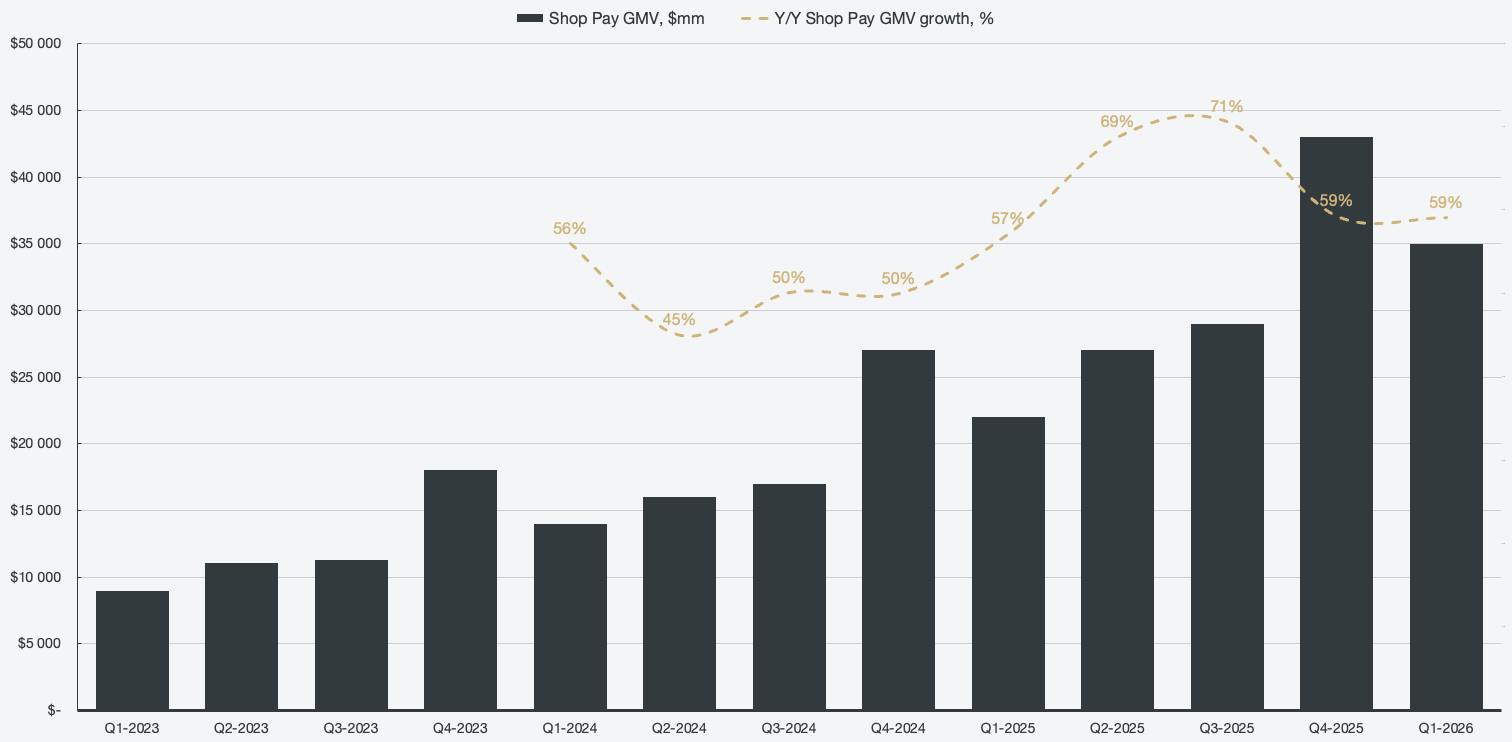
Another important aspect of Shop Pay is that it drives Shopify Payments adoption. Shop Pay works best when merchants use Shopify Payments, which they are more likely to do when enabling Shop Pay. Higher adoption of Shopify Payments means that Shopify drives higher Gross Payments Volume (GPV), which results in significantly higher take rates. Shop Pay GMV as a percentage of total GMV has grown from 18% in Q1 2023 to 35% in Q1 2026, almost a double in three years.
Figure 5: Gross payments volume
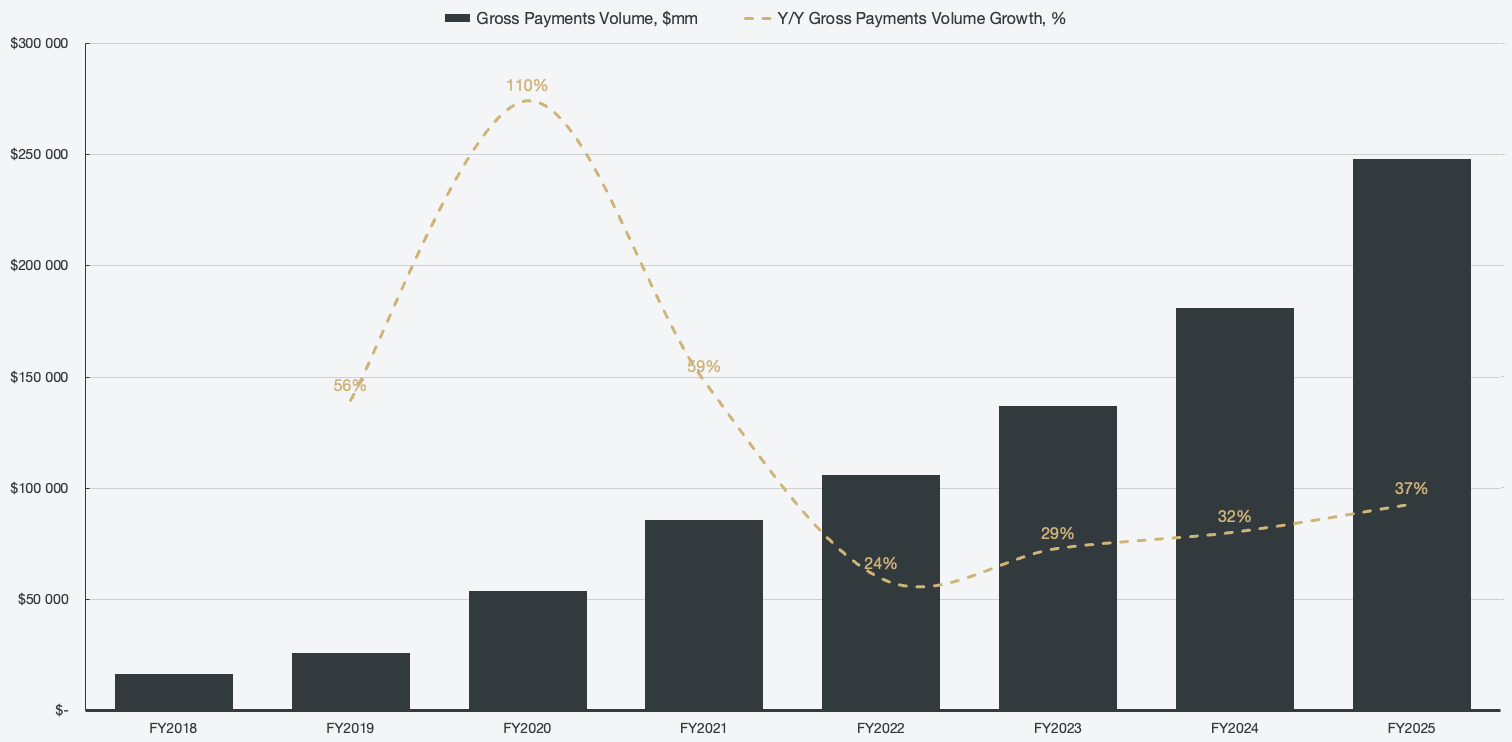
It may be confusing to see GMV, GPV, Shop Pay, and Shopify Payments, and you might be wondering what the differentiation is. These are all distinct metrics and can be seen as follows:
GMV, Gross Merchandise Volume: The total value of all orders processed across Shopify.
GPV, Gross Payments Volume: A subset of GMV that is specifically processed through Shopify Payments
Shop Pay: Shopify’s one-click checkout solution that stores returning customers’ shipping and payment details for an accelerated purchase process.
Shopify Payments: Shopify’s built-in payment processor.
Shop Pay is more than just a checkout solution. As I mentioned, it drives Shopify Payments adoption, but it also plays a big role in the future of Shopify and its competitive advantage. Adoption helps prepare Shopify for agentic commerce, where AI agents shop on behalf of users.
