


Zeta is positioned for strong, sustained growth, with plenty of room to scale its current customer base. Zeta is entering a growth phase where operating leverage has made the business profitable, and given its organic growth and retention rates, both margins and the top line have significant upside. Advertising is a crowded space, yet Zeta’s 10-K confidently states that no competitors match Zeta’s platform. While each part of the business faces competition, no one else currently offers a fully operational platform, and no one else does it with the most valuable asset and differentiator: vast customer data.
However, as with any business that has spent time in the spotlight and is going from good to better, the market has already rewarded the stock with 71% returns over the past year, leaving limited room for upside to fair value.
Company profile
Theme: AI Advertising, Direction: Buy
Symbol: ZETA, Exchange: NYSE
Sector: Technology, Industry: Software - Infrastructure
Fair intrinsic value: $34.75 (+7.68%), as of October 15, 2026
Market capitalization: $8 280 million
Pricing data: P/S 5.27x, P/E N/A
TYPEFCAPITAL.COM
Consider following me on X and YouTube.
This article is for informational purposes only and does not constitute investment advice or an offer to buy or sell securities.
A toll booth on a discretionary road
It seems I can’t escape researching advertising businesses lately. Recently, I covered Meta, Alphabet, and AppLovin, but Zeta differs from those three. Pure-play businesses primarily own their distribution channels and operate somewhat like walled gardens. Put simply, pure-plays work by an advertiser choosing a budget, a ROAS goal, and creatives, and then an AI decides who to show the ads to, all within their distribution channels. Zeta does not own a social distribution channel, and ads aren’t limited to a specific app.
Zeta has one of the largest consumer data assets in the U.S., and it rents it out through its software. Their identity graph covers more than 245 million individuals in the U.S., and 535 million globally. Each individual has an average of more than 2,500 attributes, plus over one trillion content-consumption signals ingested every month. Enterprise customers plug their customer data into Zeta’s data store and, through the Zeta Marketing Platform (ZMP), decide who to contact, when to contact them, and through which channel. Channels range from straightforward methods like email and text messages to web, social platforms, and connected TVs. The integrated platform can be seen as a complete advertising OS.
Zeta reports a single revenue segment, split into two delivery channels: direct platform revenue and integrated platform revenue. The segments are not separate products; they describe where customer activation happens and who controls the inventory and related channels. Direct platform revenue is revenue from activities run entirely on Zeta’s own platform and channels, which include Zeta’s email and messaging, Zeta’s own demand-side platform (DSP), connected TVs, and so forth. This is the higher-margin segment and accounts for 70-75% of revenue, which is the preferred revenue mix. Integrated platform revenue is when Zeta’s intelligence is activated inside third-party platforms such as Meta’s Facebook and Instagram, Google, TikTok, and other social and search platforms. In this segment, Zeta passes through most media costs to the customer, so margins are lower than on Zeta’s own platforms.
Figure 1: Segmented revenue
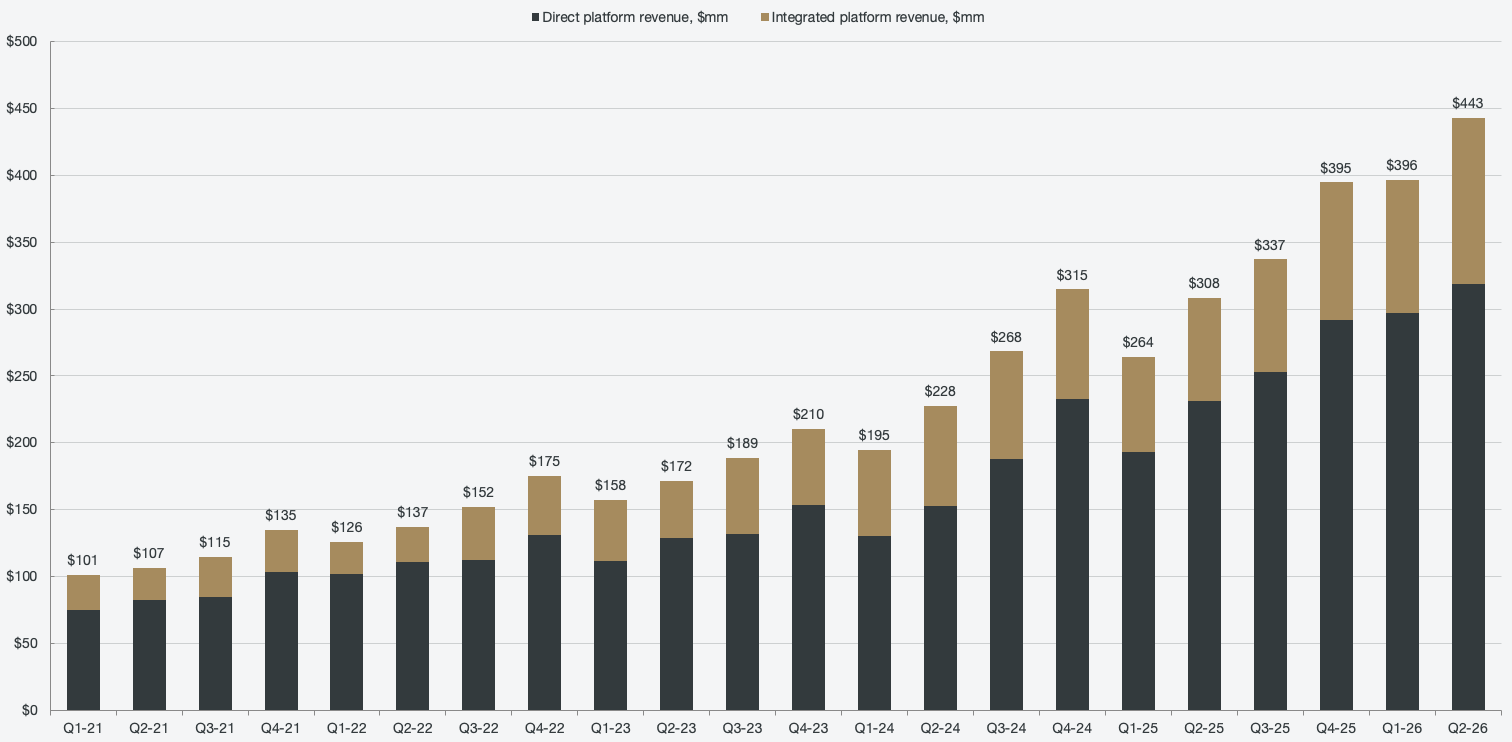
Customers tend to onboard through the integrated platform and use Zeta audiences and data to run better campaigns on third-party platforms like Instagram. As the relationship deepens, customers tend to expand into Zeta’s direct channels, like Zeta DSP, CTV, and so forth, which improves Zeta’s margin mix because third-party platforms no longer take a large cut of media spend.
The way money flows to Zeta is similar to a toll booth, a business model I tend to gravitate toward. A corporation, be it a retailer, insurer, or telecom company, runs its customer acquisition, expansion, or retention programs through Zeta. Zeta gets paid a subscription fee for the software and data, a usage fee that scales with volume, and revenue from the media it buys on the client’s behalf and books gross. However, unlike a true toll booth like a credit bureau or ratings agency, customers can avoid Zeta’s tolls because marketing budgets are often among the first line items a CFO cuts. Fighting for a marketing budget is a balancing act, but if Zeta can deliver attractive ROAS, the reasons a customer would cut spend thin out.
Zeta’s revenue sources are well diversified, with concentrations in consumer and retail (24% of revenue), Telecom (10% of revenue), Insurance, and Travel and hospitality (11% of revenue each). Per Zeta’s presentations, they serve 51% of the Fortune 100, and in these concentrated revenue categories, they serve either all the largest Fortune 100 companies or most of them. This creates stickiness as they integrate more deeply into top companies per category and start scaling.
One Zeta
The core driver of the business is the ability to scale its customers. After acquiring a new customer for one use case, the goal is to expand that customer's adoption of more of Zeta’s services. Management calls the strategy One Zeta, but in general terms, it is a land, expand, and scale strategy. The AthenaOS platform is positioned to reduce friction in adopting additional use cases, and expansion is necessary for several reasons.
Expanding customers feed the flywheel: more use cases mean better data and more learning, which improves the model and drives further expansion. More importantly, customers who adopt two or more use cases generate more than 3 times the annual revenue of single-use-case customers, with management citing up to 5 times more.
One Zeta is very simple. It's convincing the vast majority of our clients to use us for multiple use cases. Interestingly enough, the more use cases they use, the higher the return on investment to them. It makes sense, right? Because if you're doing their acquisition, that information informs retention. That information informs monetization, which in turn both inform acquisition.
David A. Steinberg, Chief Executive Officer
Goldman Sachs Communicopia+Technology Conference 2025
Zeta provides ample data points to track how customers scale throughout the business. The data helps investors understand two things: the sustainability of growth and how much it can accelerate.
First, Zeta splits its scaled customers into two buckets: regular scaled customers, who have recorded between $100 thousand and $1 million in revenue on a trailing-twelve-month basis, and super-scaled customers, who have recorded over $1 million over the past twelve months. The differences between the two cohorts are vast; a super-scaled customer records 17.4x the average revenue of a regular scaled customer.
That figure sounds massive, but it is a bit deceiving. The $100 thousand to $1 million cohort operates within a fixed range, whereas super-scaled customers have no ceiling. As such, a 17.4x figure on its own does not say much. What does tell us a lot is the trend in how that figure is improving. If ARPU for super-scaled customers increases every quarter, it means customers are getting more value and ROAS from their marketing budgets with Zeta, and they want to keep expanding. Unfortunately, the data is incomplete, as Zeta has not reported ARPU for scaled customers and scaled customers between $100k-$1mm since Q4 2025.
Figure 2: Cohort average revenue per user
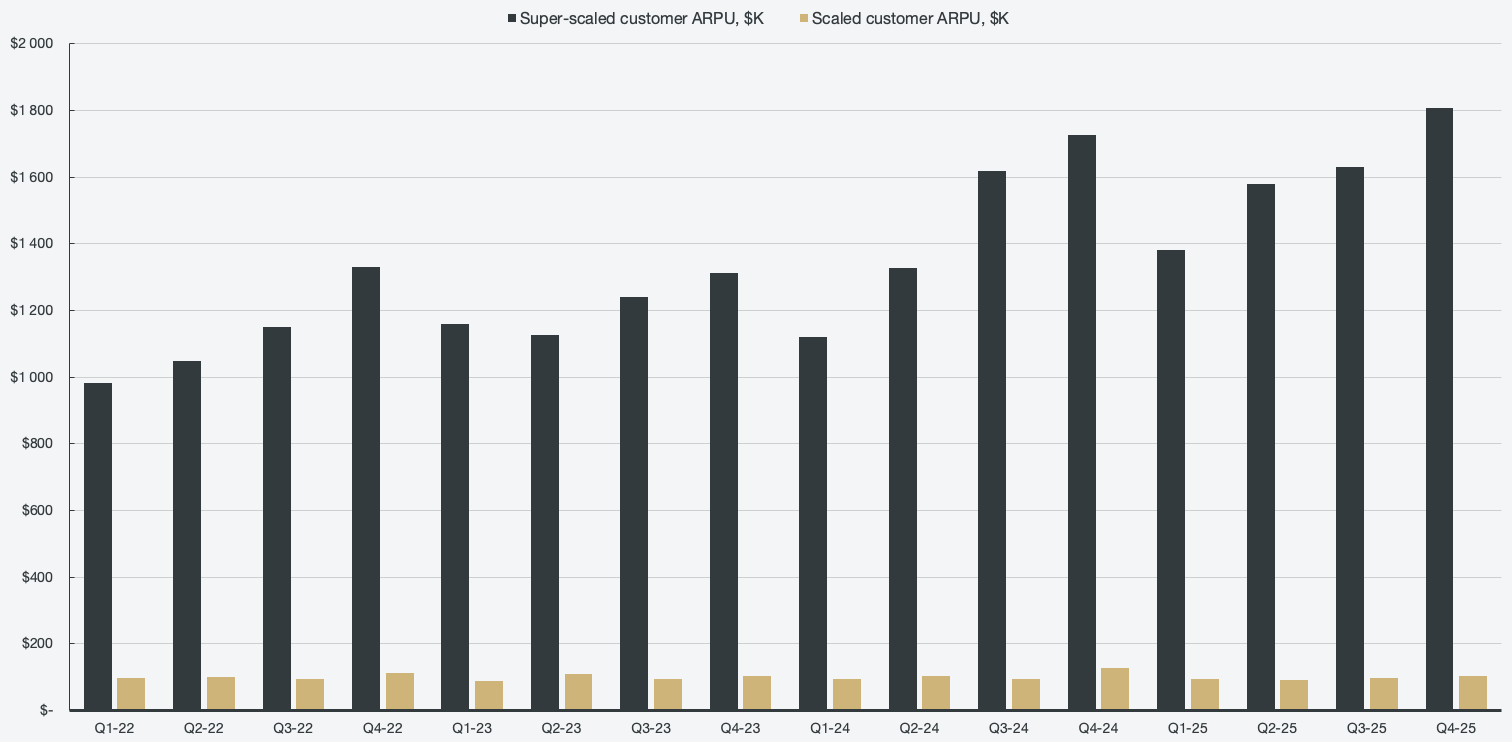
While the ARPU difference is about 17 times larger for super-scaled customers, the average number of channels per cohort doesn't differ much. An average scaled customer had ~1.9 channels during the periods reported, while a super-scaled customer had about one additional channel. This is from a pool of mid-teens channels a customer can activate.
Figure 3: Cohort average number of channels
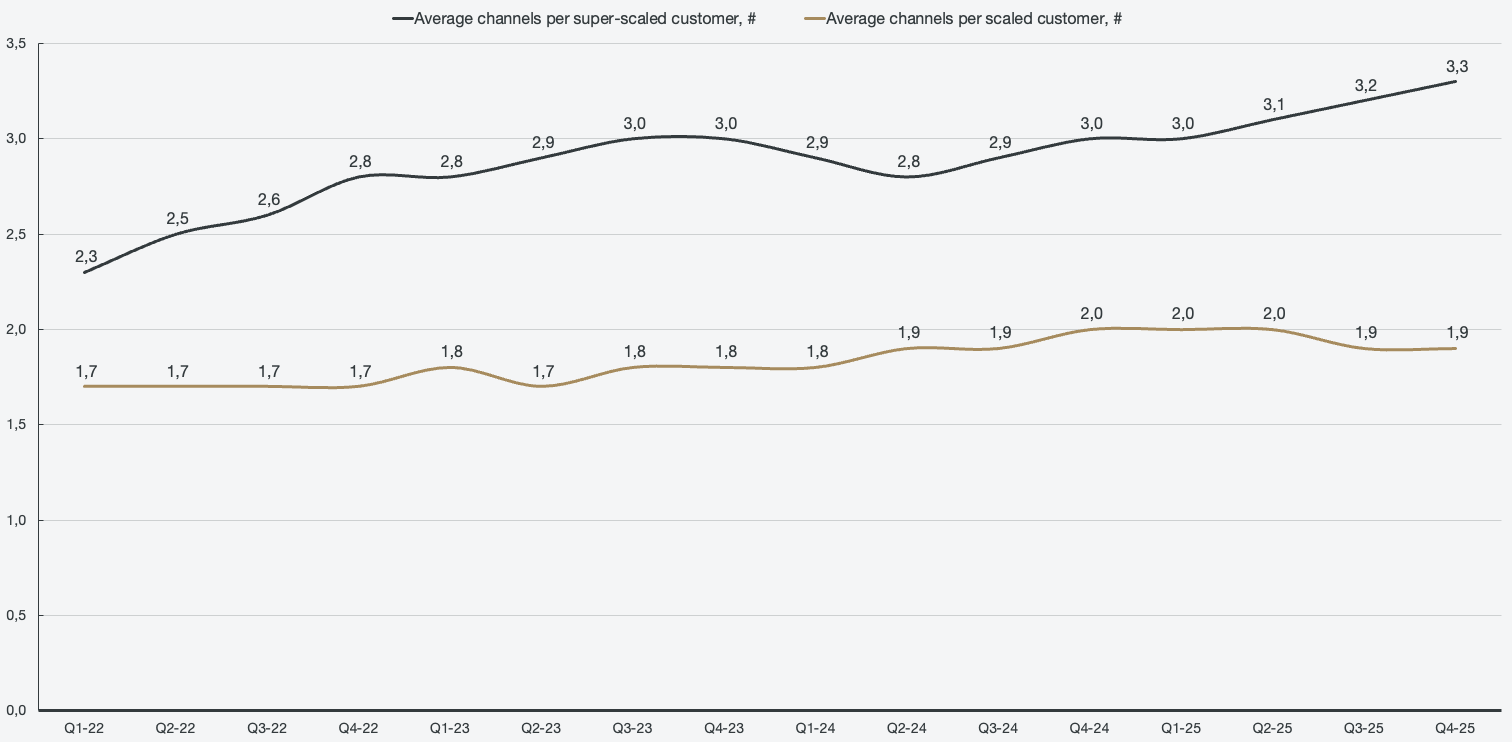
This tells us two things: so far, spending is not as heavily tied to the number of channels that are being adopted by a customer, and it also tells us that there is a lot of room for expansion. If ARPU was hitting a ceiling, and super-scaled customers on average adopted ~10 channels, then there would be a real reason to worry about future growth. As it stands, customers still have ample room for scaling. During the same Goldman Sachs Communicopia conference, management
[…]we started three or four years ago with an average of 1.2 channels per client. Now we're at just about three channels per client. I don't see any reason we can't be at four, five, or six channels per client.
David A. Steinberg, Chief Executive Officer
Goldman Sachs Communicopia+Technology Conference 2025
The final piece of the puzzle is how much of the customer base is scaled, and to what degree. If all of Zeta’s customers were already scaled, there would be few pillars to support future growth. The figures support sustained growth, as customer growth has outpaced scaled customer growth since 2023. As of FY2025, 23% of total customers are scaled, of which 30% are super-scaled. That means that even with no new customer acquisition, the super-scaled customer base can grow 14x before the unscaled customer base is exhausted.