


The past few research reports on FICO have focused on the narrative that FICO has been branded a villain in the eyes of the public, largely through FHFA director Pulte directly targeting the company. FICO has immense pricing power and has exercised it, but as covered in previous research pieces, up to 1850% of the cost per FICO score pull has been a markup by bureaus and resellers. With that in mind, it seems logical that FICO would target an increase in take.
The other emerging fear among investors is that VantageScore 4.0 is disrupting FICO’s gold standard, which no financial data seems to support. When the market comes around to that realization, the upward correction in the stock quote may be violent, as implied in recent price volatility.
Company profile
August 25, 2026 Follow-up coverage
Direction: Buy
Previous fair intrinsic value: $2116, as of May 2, 2026
Symbol: FICO, Exchange: NYSE
Sector: Technology, Industry: Software - Application
Theme: High quality
Fair intrinsic value: $2269 (98%), as of August 25, 2026
Market capitalization: $26 055 million
Pricing data: P/S 10.9x, P/E 32x
Previous coverage:

TYPEFCAPITAL.COM
Consider following me on X and YouTube.
This article is for informational purposes only and does not constitute investment advice or an offer to buy or sell securities.
Data points to the market being wrong
Uncertainty tends to unequivocally have a downside impact on the stock quote of the targeted company, something evident in the sharp decline in FICO’s stock price. However, the market seems undecided because the company is delivering stellar results each passing quarter, suggesting no disruption is taking place. As a reminder, here is a policy timeline that has led us to today’s status, with bolded events causing direct crashes in FICO’s stock price.
October 2022: The FHFA approves both FICO 10T and VantageScore 4.0 for GSE loans with a planned multi-year implementation runway.
March 2025: Director Bill Pulte is sworn in as the FHFA director.
May 2025: Bill Pulte repeatedly targets FICO over cost increases.
Jul 2025: FHFA Director Pulte announces VantageScore 4.0 as an allowed model on all Fannie Mae and Freddie Mac loans.
End of Q4 2025 - Present: The credit bureaus lower VantageScore prices to ~$1 (Experian made it free for a limited period) as a response to FICO’s recently announced Direct License Program, which bypasses bureau markups.
March 2026: Senator Josh Hawley writes an oversight letter to FICO, citing concerns over pricing power hurting the consumer housing market.
April 2026: The FHFA launches a pilot with the 21 largest lenders for VantageScore 4.0.
April 2026: FICO changes the price of the DLP performance model from $4.95 per score in addition to a $33 funding fee, to $0.99 per score and a $65 funding fee to encourage 10T adoption.
July 2026: GSEs release historical data for both VantageScore 4.0 and FICO 10T.
In recent coverage, I have covered a response refuting each point raised by Josh Hawley, as well as discussed FICO’s status as the gold standard and why I believe it won’t be disrupted. Today I want to focus on the actual data from calendar quarter 2’s financial results for the publicly traded bureaus and FICO.
First things first, VantageScore has seen a genuine increase in usage. It appeared in fewer than 5% of TransUnion’s mortgage credit inquiries at the start of the year, to reaching almost 30% by Q2 across more than 900 lenders. Such rapid adoption at face value may seem like disruption of FICO’s gold standard being imminent, but what the headline does not cover is that VantageScore is being sent along for free with FICO score pulls. Meaning, it is pulled alongside FICO, not instead of FICO.
[…] are we seeing volume loss? No, we are not, which suggests that they’re pulling both scores.
William Lansing, Chief Executive Officer
Fair Isaac Corporation, Q3 2026 Earnings Conference Call
CEO Lansing also notes on the call that measuring market share is difficult, and a first instinct as an analyst is to note the spread between credit score-related revenue among FICO and the bureaus. However, Equifax and TransUnion resell FICO scores after buying them at FICO’s wholesale royalty. They mark it up and book the gross amount as their own revenue. When FICO increases its price, it inflates the growth contribution to the credit-file revenue at both bureaus. Both bureaus have begun disclosing commentary and numbers excluding FICO, and it shows that 50-75% of their mortgage revenue growth is FICO’s pricing power flowing through, at no profit for the bureaus.
Figure 1: Equifax USIS mortgage revenue growth mix (decomposition)
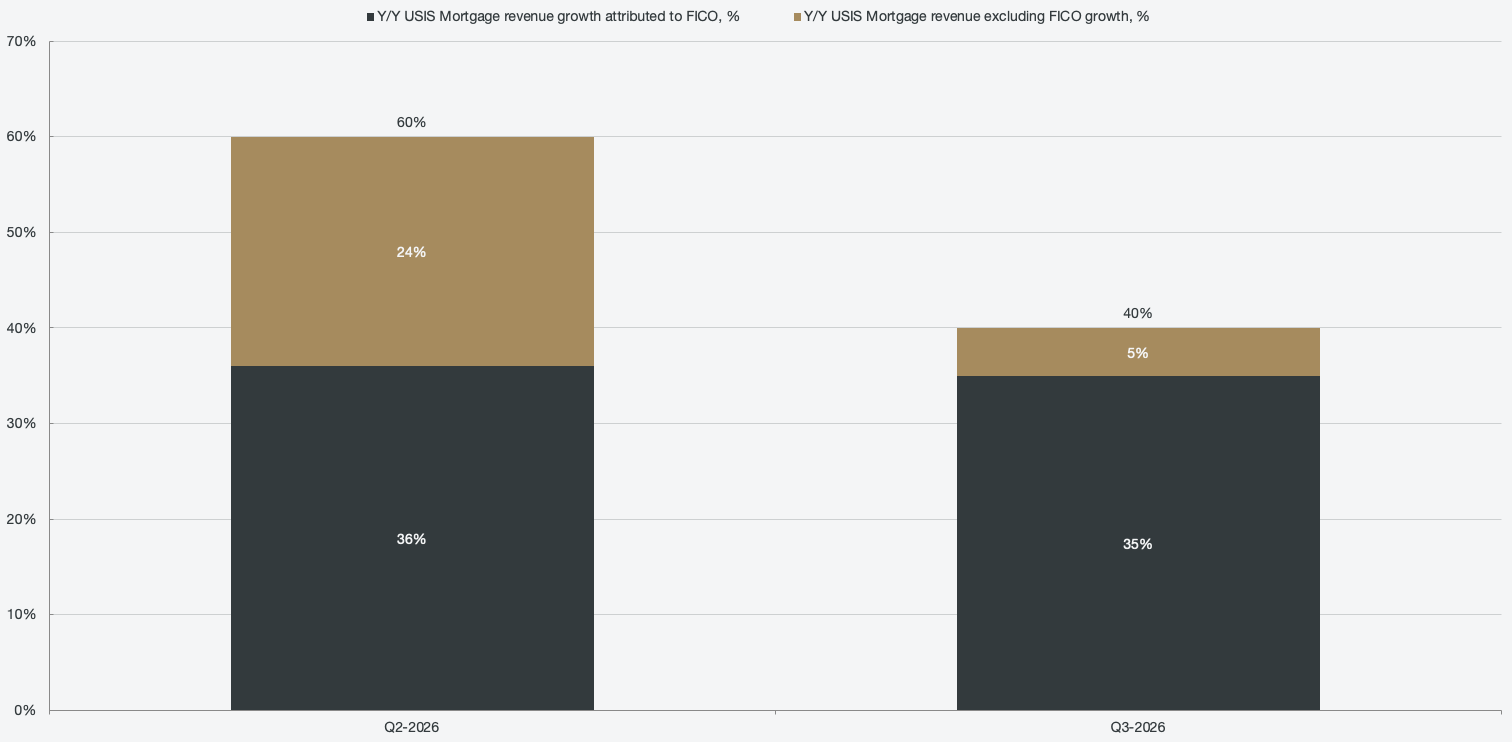
Note: CQ2 data assumes mid-point of 5% per Equifax Q2 earnings call: “USIS mortgage revenue was up 40% and up mid-single digits excluding FICO, with hard mortgage inquiries up only 1%.”
Equifax USIS Mortgage revenue and TransUnion’s mortgage revenue include the bureaus’ own products, which means that the ex-FICO revenue growth could come from sources other than VantageScore 4.0 adoption.
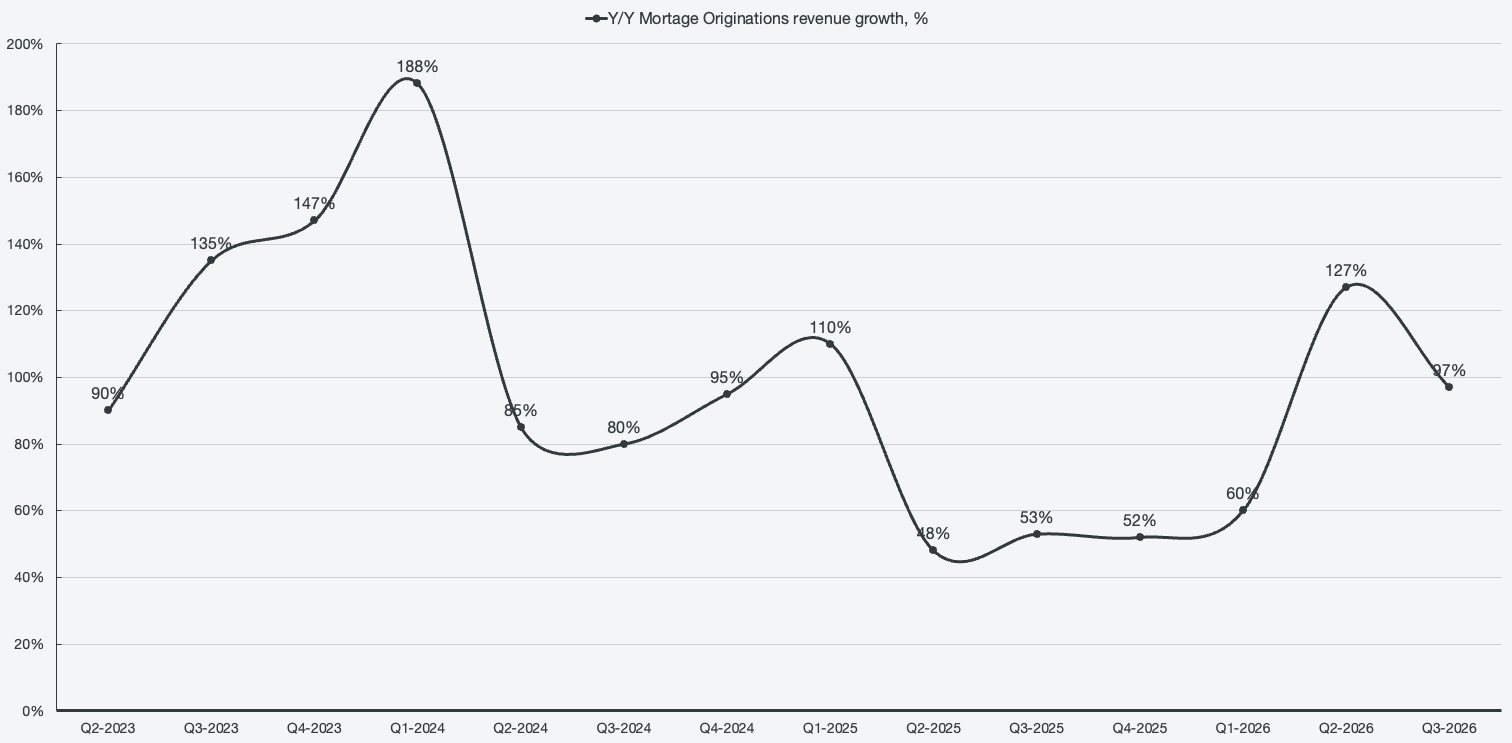
As a reference point, FICO does not disclose exact mortgage score volume growth, but noted in the Q3 earnings call that it grew “low single digit”. Against that backdrop, FICO still grew its mortgage originations revenue by 97% Y/Y, signalling that it still has immense pricing power. VantageScore has waited years for permission, but it turns out to be worth surprisingly little, and that is simply because of who pays for the score pull.
Figure 2: FICO Mortgage originations revenue growth
The marginal cost of pulling a score is passed to the borrower, meaning they don’t feel the impact of exercised pricing power. What they do feel, however, is the risk of a loan failing to qualify, which turns into scores becoming gamed. Lenders pull a free VantageScore next to a paid FICO because it is available, and pulling both means that the lender increases the chances of qualifying a borrower. The data shows that almost no one seems to be paying for VantageScore 4.0.
The CHLA puts the all-in credit report cost at an average of $540 in 2026, and they assume a $10 flat FICO take at a tri-merge rate of $30; it means that bureaus and resellers charge 17 times the FICO take, a 1600% markup. The $540 figure is up from ~$50 in 2022, branding FICO as the villain due to FICO’s price increases.
From another angle, FICO’s DLP performance model that charges a $33 funding fee for classic FICO, or $65 for FICO 10T, reflects a 50-90% reduction in average per-score fees compared to what resellers paid for FICO scores in 2025. This takes the markup out of the bureaus’ hands and lowers the all-in cost to lenders, and simultaneously defuses the political backlash FICO has been facing without cutting FICO’s own take.
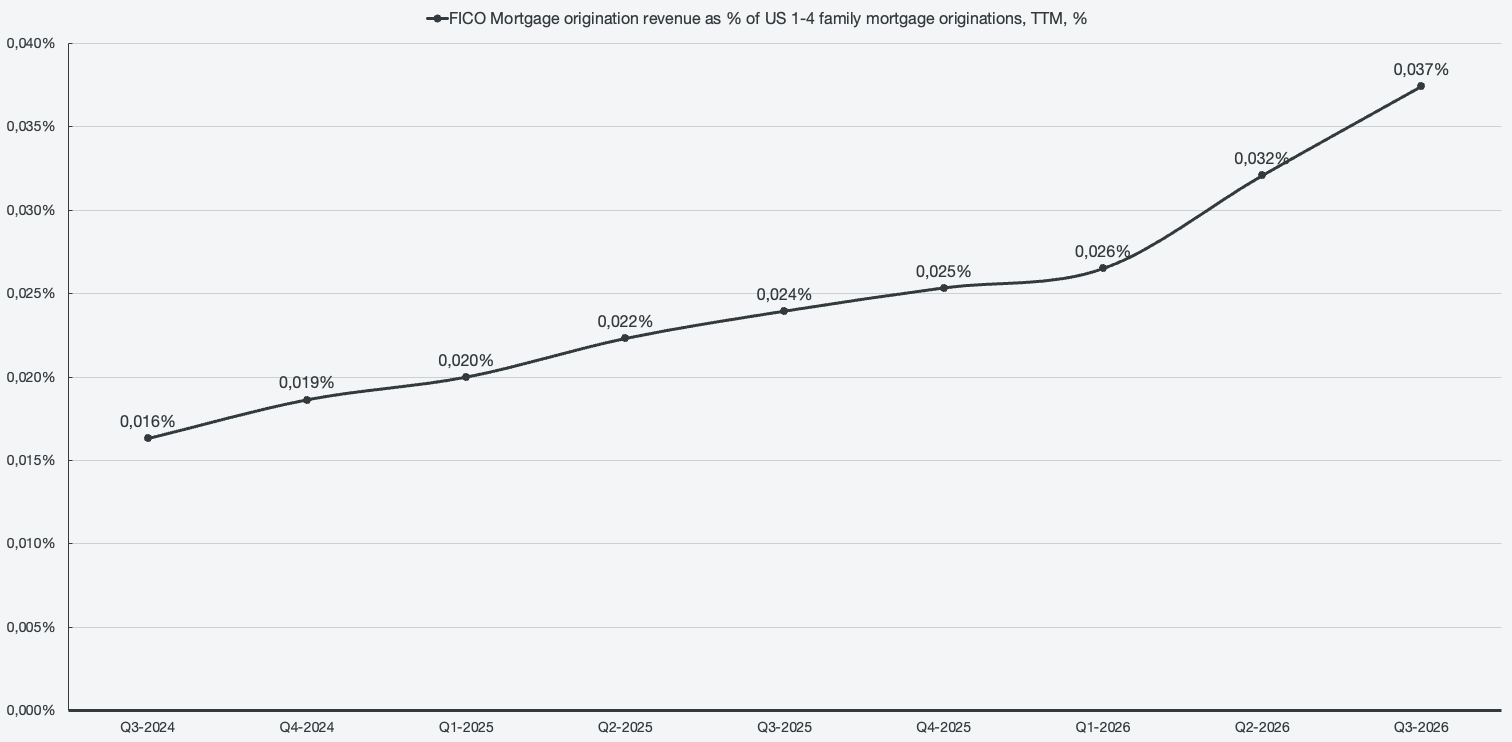
The data suggests that FICO is capturing more mortgage dollars, not less, and it is accelerating rapidly. No data point that I can find supports the narrative that FICO is losing share to VantageScore.
Figure 3: Implied U.S. mortgage originations revenue share, TTM
It also seems that the fears of FICO being regulated further may be easing, as the FHFA Director Pulte signals that he is satisfied with recent developments in the credit scoring market.
FICO and Vantage Score are both doing very well. I appreciate the leadership of each company. Likely to have some new news on each soon. Exciting times ahead for the consumer.
- FHFA Director Bill Pulte on X, 21 August, 2026