


Palantir has been shocking analysts, investors, and the broader stock market with what it has achieved over the past several quarters. While this quarter didn't accelerate growth rates across the board as much as we're used to, Palantir still hit unthinkable new highs in key metrics.
Most importantly for the quarter, Palantir solidified its position to deliver value across the entire AI infrastructure layer, which now also includes large language models.
L3Harris noted that by fine-tuning open-source models on its own data, a sovereign model outperformed the frontier model it had been using in less than 48 hours and cut costs by 95% in preliminary results.
Ryan Taylor, Chief Revenue Officer
Palantir Technologies, Q3 2026 Earnings Conference Call
Company profile
November 7, 2026 Follow-up coverage
Direction: Buy
Previous fair intrinsic value: $356, as of August 4, 2026
Symbol: PLTR, Exchange: NASDAQ
Sector: Technology, Industry: Software - Infrastructure
Theme: AI Software
Fair intrinsic value: $327 (104%), as of November 7, 2026
Market capitalization: $412 806 million
Pricing data: P/S 57x, P/E 112x
Previous coverage:

TYPEFCAPITAL.COM
Consider following me on X and YouTube.
This article is for informational purposes only and does not constitute investment advice or an offer to buy or sell securities.
Note: Type-F sells an aggregated Excel sheet of Palantir’s historical financial data, containing ~1000 rows of both company-reported metrics, but also calculated KPIs, contract data, and more. The sheet also includes my valuation model, a charting tool (internal in Excel and on the web), and a dashboard overview of the business.
Available at: https://typefcapital.com, with free quarterly sheet updates.
Ambitious targets
Last quarter, Alex Karp made claims that positioned the company to generate more free cash flow in 2028 than Wall Street consensus for total revenue ($15-18 billion in FCF; Wall Street consensus revenue in 2028 was $16 billion).
During the earnings conference call, he noted that through 2028, the whole business will grow “at or above” the pace of its U.S. commercial segment, which was 150% Y/Y. This quarter is no exception; we have a new bold statement by CEO Alex Karp that has large implications for the business, and it comes from an interview with CNBC:
We have to scale because it's our kind of obvious goal that we're going to get to $15 billion run rate in U.S. commercial in 2028.
Alex Karp, Chief Executive Officer
CNBC Interview with Morgan Brennan, 3 November
When Alex Karp set a $15 billion run rate goal for the U.S. commercial business in 2028, Wall Street consensus estimates for 2028 total revenue were $18 billion. Most impressive is that Palantir is delivering toward those goals each passing quarter.
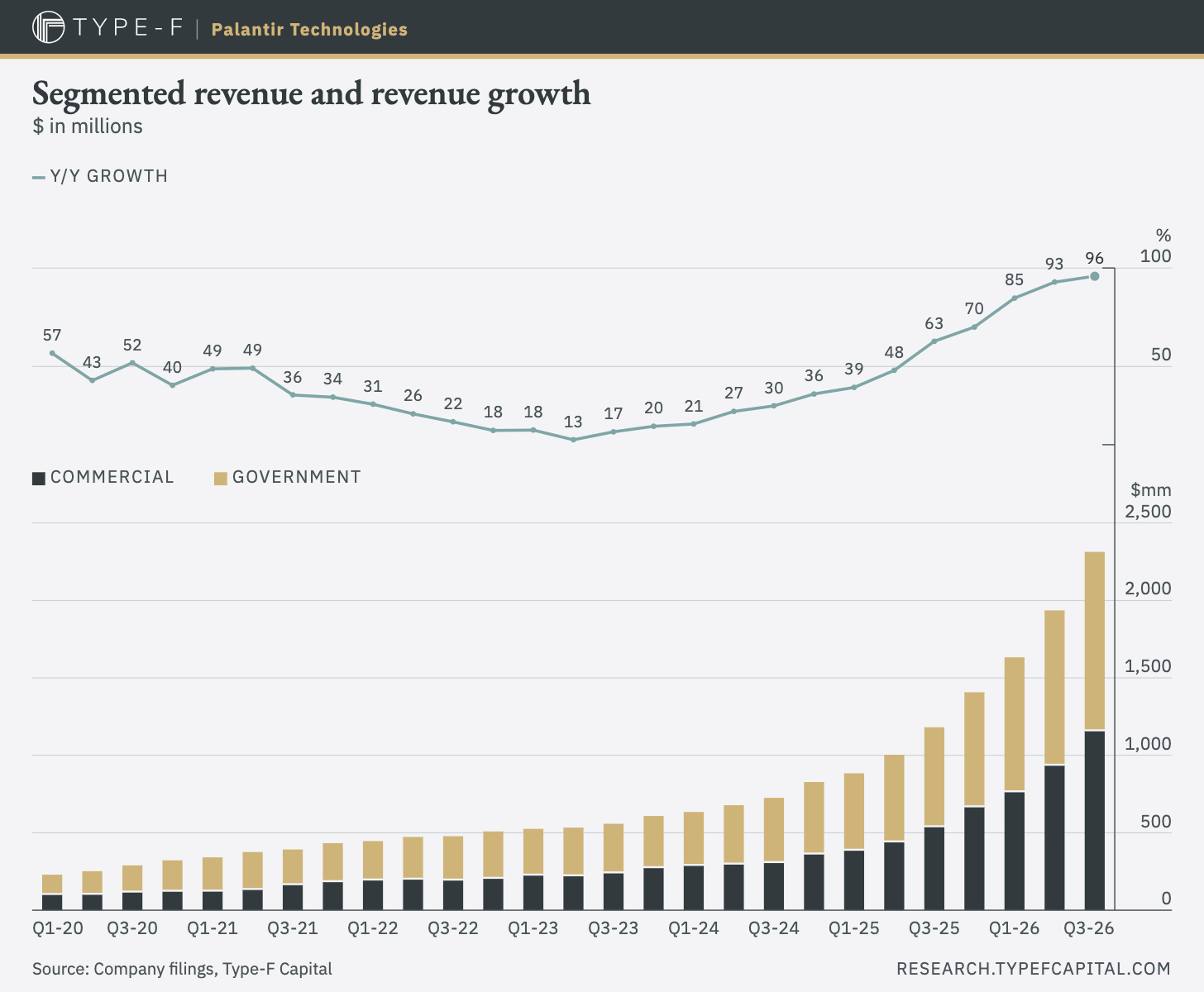
Q3 2026 was the first quarter where commercial revenue surpassed government revenue since Palantir went public, and only the second time in disclosed history. It is impressive that it took this long for commercial to surpass government revenue, given the rapid growth we’ve seen in U.S. commercial, and it’s not like government made up 80% of the business at the start of the disclosed history. In Q3 2019, each part of the mix was roughly 50%. That in itself serves as a testament to how strong the government part of the business is, a segment that is often overlooked in favor of the commercial segment in the headlines.
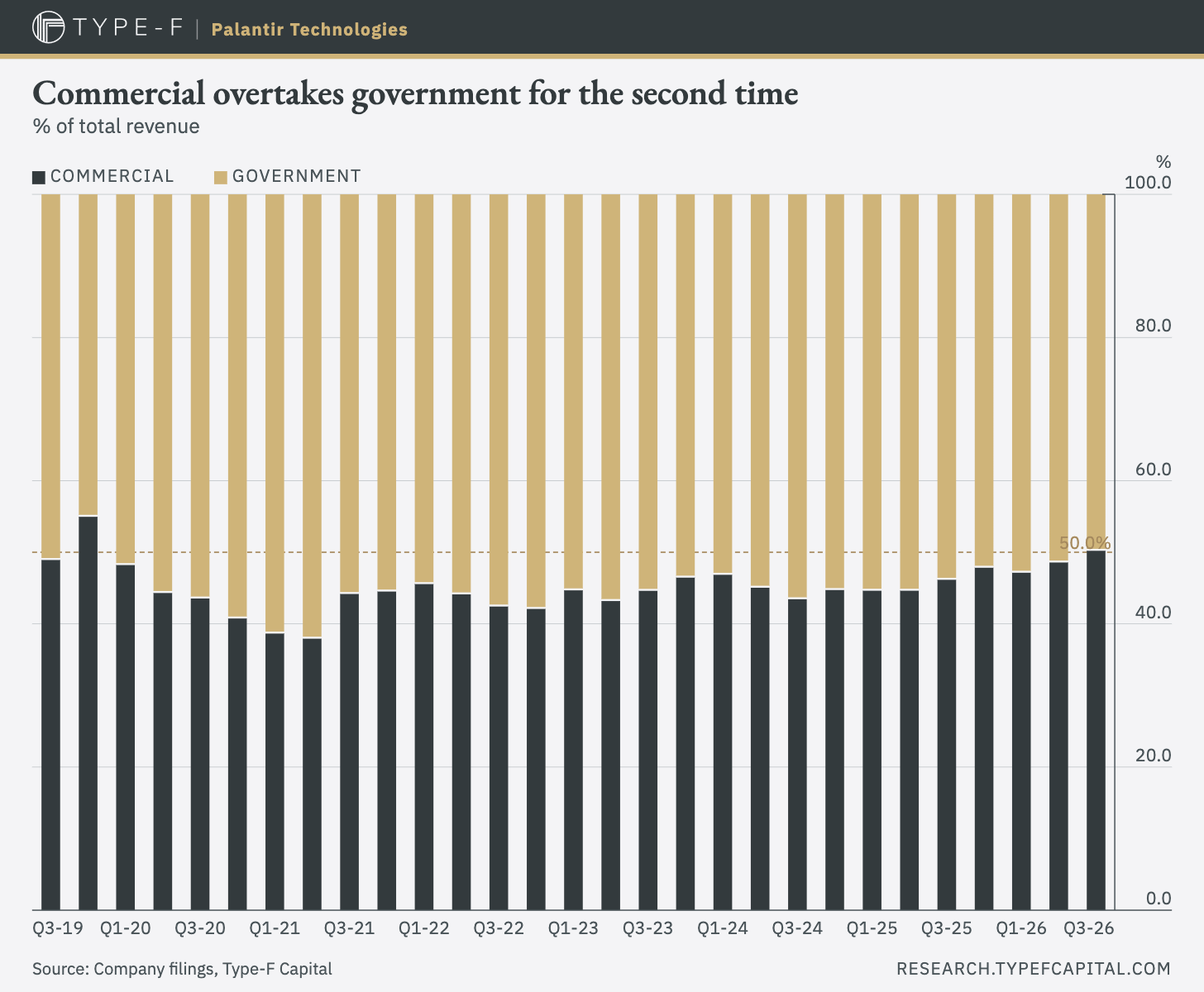
Government is the unsung hero, and unlike the commercial segment, it also has a growing international business. If Palantir only had a government segment, and an investor looked at the growth rate, it would still look mighty impressive. In 2026, Government has grown above 75% each quarter, and it’s only overlooked because commercial is so much more impressive.
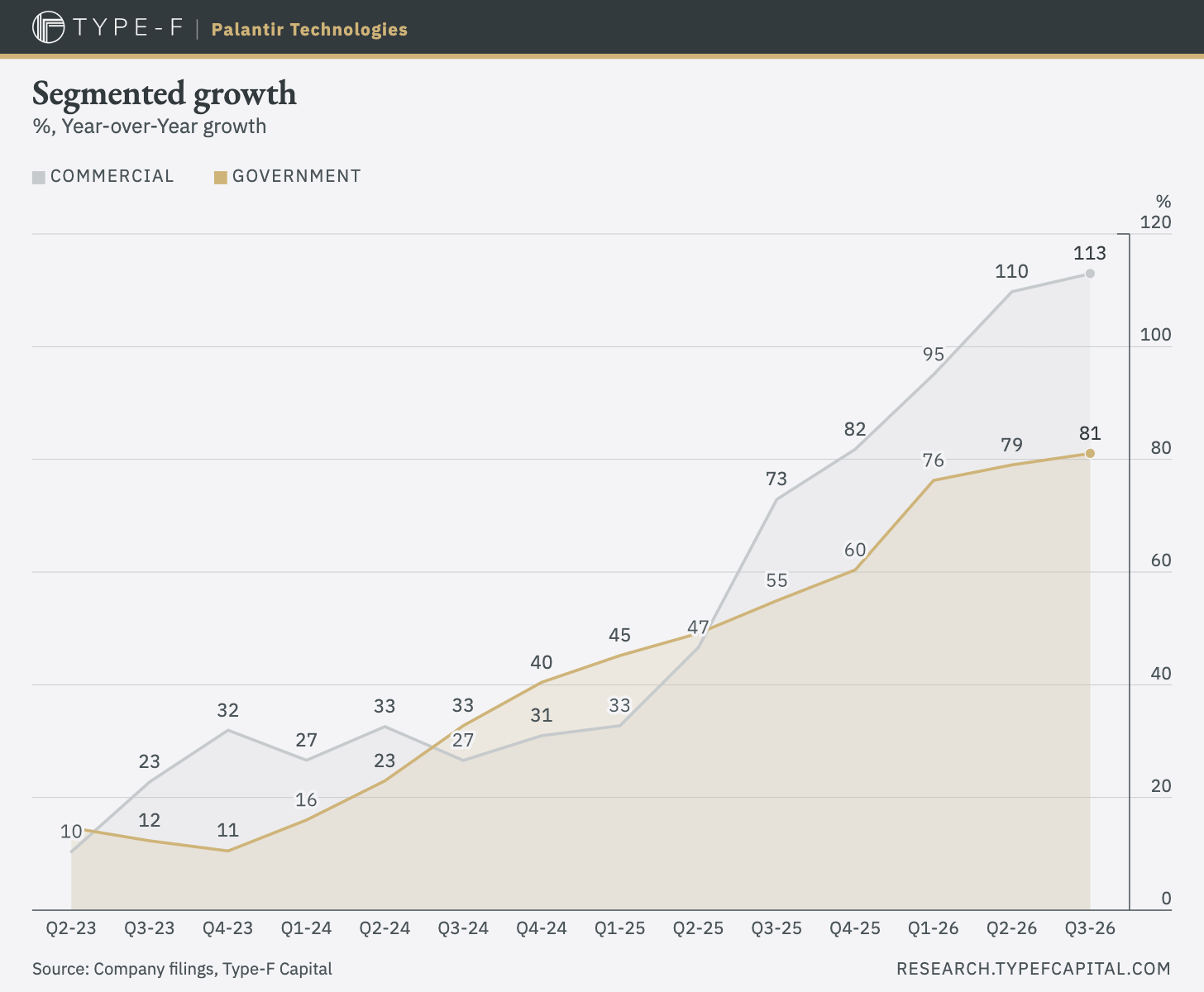
In particular, U.S. government revenue has grown rapidly, now approaching 100% Y/Y. Palantir is deployed across more than 18 agencies, which makes the TAM the whole fiscal budget, and not just the Department of War budget as some investors might believe, only associating Palantir with the military.
The number of contracts Palantir has secured domestically in 2026 warrants a report on its own. In September alone, there was a big breakthrough in the US Army: TITAN is moving to production, with an award covering eight systems to be delivered over 18 months. In addition, the Army expects another production order next year. There was also a contract in September with the US Army for ammunition management software, consolidating 9 separate legacy platforms. That is the key to expanding within government, replacing legacy systems as it is brimming with them.
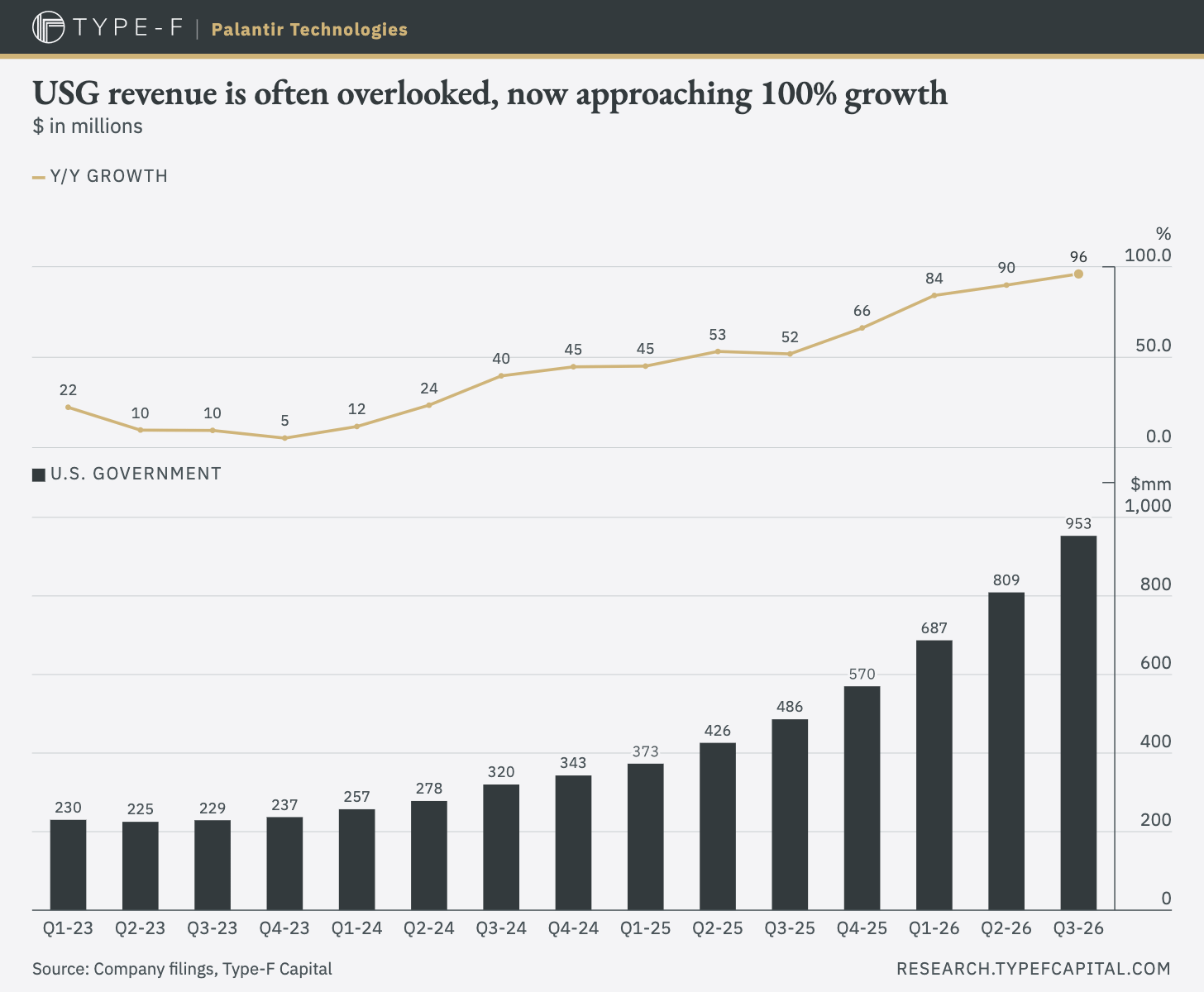
International Government is gaining traction as well, growing 50%, 43%, and 31% in Q1-Q3 2026, respectively. In other, less exciting news, International Commercial is finally starting to move as well. For the longest time since going public, the International Commercial segment has been rangebound, with no revenue gains or losses. However, what I believe is mainly due to South Korea and Japan, it is finally exhibiting some growth. It’s only when charting out the revenue that one realizes just how stale the segment has been.
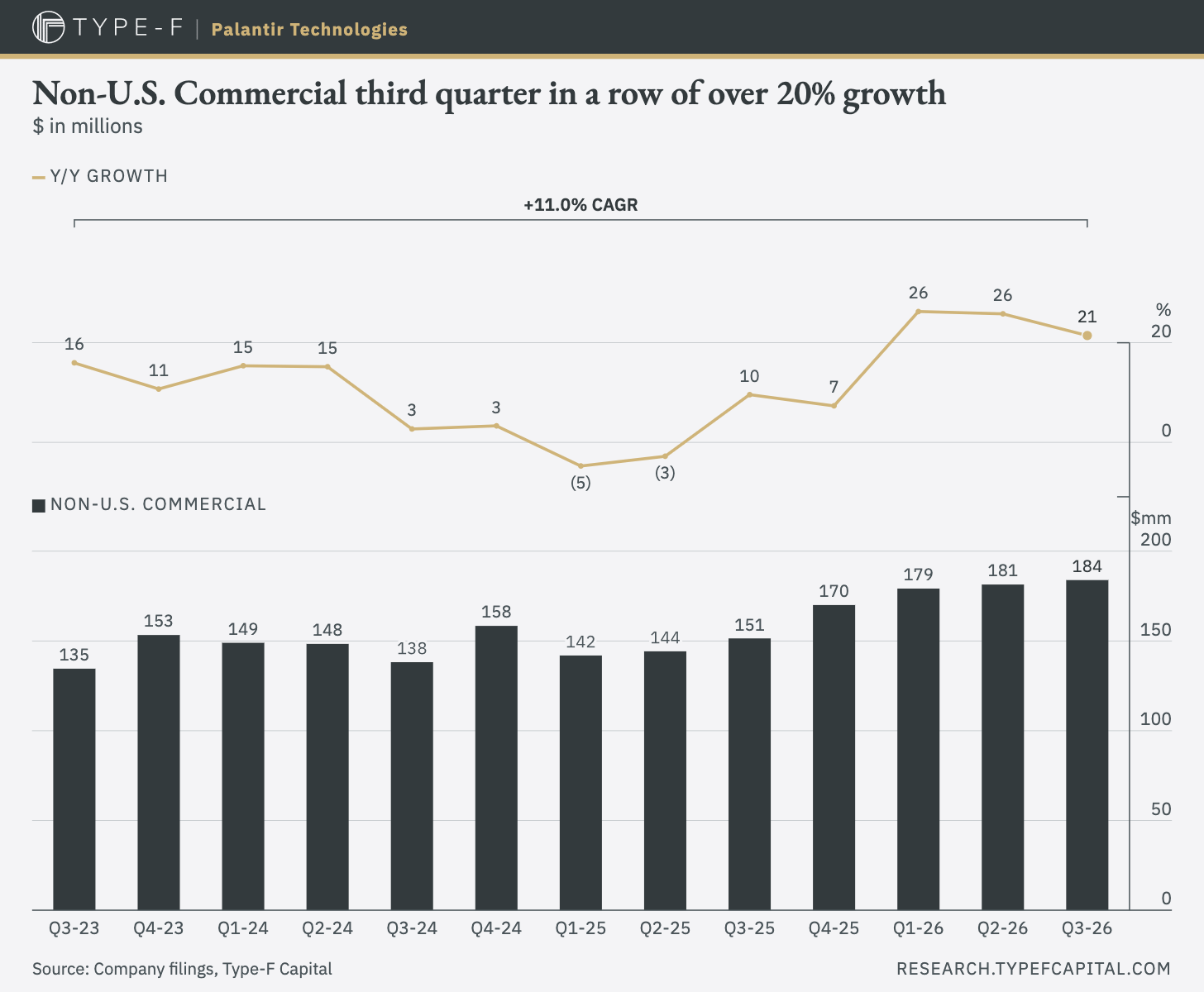
The crown jewel, U.S. Commercial, keeps compounding, and Palantir has been running Sovereignty Bootcamps throughout the second half of 2026. In essence, AI sovereignty is about organizations controlling their data, models, AI infrastructure, and insights (alpha). The primary reason for sovereignty is to ensure that IP is not transferred to third-party frontier model providers like Anthropic and OpenAI, or hyperscalers. In addition, Palantir customers using AI sovereignty can drastically reduce AI costs while increasing output and accuracy.
Another part of sovereignty that deepens relationships and further strengthens Palantir’s moat is its unique ability to fine-tune models. Because of Palantir’s Ontology, as explained in my previous Palantir research report, the company is uniquely positioned to understand each customer’s business, which is pivotal to tuning a model to specific use cases. As the quote at the start of this article notes, L3Harris used an open-source model, fine-tuned it, outperformed a frontier model, and reduced costs by 95%. These efficiencies matter in an environment where businesses are wary of how much they spend on frontier models, which are quickly becoming commoditized. The Q3 earnings conference call detailed some more pilot-to-deal examples:
Pilot to deal details:
$3 million pilot in Q2 converted to a $29 million ACV deal in Q3.
$1.6 million pilot in Q1 converted to a ~$21 million ACV deal in Q3.
$1 million pilot expanded to a $15 million ACV deal in Q3.
$2.5 million pilot converted to a $11.5 million ACV deal in Q3.
- Palantir Technologies, Q3 2026 Earnings Conference Call