


As per Palantir’s usual fashion, each new quarter brings many developments, and that is the case in Q2 2026 as well.
Palantir has always championed the concept of creating value through its software, and then charging its customers a portion of that value. In a sense, that concept is infinitely scalable: Create $100 million for a business, charge them $30 million for the software. Create $10 billion for a business, charge them $3 billion.
What has been transpiring outside of the Palantir context has been the opposite: charge customers for tokens, without caring about the value the token spend results in. The term associated with this is “tokenmaxxing”, which CEO Karp has mentioned in relation to how the AI labs conduct their business.
In addition, the results have once again surpassed analyst expectations, my own expectations, and Palantir’s own guidance, by quite a margin. The financial results are in a class of their own.
We grew 115% (in the U.S.). The first thing that any normal person does is spit out their dentures. And after they spit out their dentures, they churn the numbers to see if the numbers are even possible.
[…]A business unlike any other, that is poised to grow with these margins, and with this revenue growth, for another 18 months.
Alex Karp, Chief Executive Officer
CNBC, 3 August, 2026
Company profile
August 4, 2026 Follow-up coverage
Direction: Buy
Previous fair intrinsic value: $268.5, as of May 9, 2026
Symbol: PLTR, Exchange: NASDAQ
Sector: Technology, Industry: Software - Infrastructure
Theme: AI Software
Fair intrinsic value: $356 (124%), as of August 4, 2026
Market capitalization: $409 039 million
Pricing data: P/S 66x, P/E 135x
Previous coverage:

TYPEFCAPITAL.COM
Consider following me on X and YouTube.
This article is for informational purposes only and does not constitute investment advice or an offer to buy or sell securities.
Note: Type-F sells an aggregated Excel sheet of Palantir’s historical financial data, containing ~1000 rows of both company-reported metrics, but also calculated KPIs, contract data, and more. The sheet also includes my valuation model, a charting tool (internal in Excel and on the web), and a dashboard overview of the business.
Available at: https://typefcapital.com, with free quarterly sheet updates.
Stop tokenmaxxing
In a research note, I broke down a recent statement made by CEO Alex Karp in regard to the business being poised to hit $15-18 billion in FCF in two years. The implications from that statement would see Palantir grow its revenue by at least ~520% from its FY 2025 base by 2028, a massive undertaking which no one has even begun imagining (Wall Street consensus for 2028 is a mere $16 billion).

That statement implies an ~83% CAGR, and comes with massive implications for the intrinsic value of the business. Even more impressive, during a CNBC interview in relation to the Q2 earnings result, Karp stated that they are on a trajectory to grow at “this” pace over the next 18 months. During the Q2 earnings call, Karp clarified that the pace that he is referring to is the U.S. Commercial growth, which is 150% Y/Y.
I am driving the business to grow at a rate equal or above to what we have in U.S. commercial for the next 18 months.
Alex Karp, Chief Executive Officer
Palantir Technologies, Q2 2026 Earnings Conference Call
Figure 1: Segmented revenue
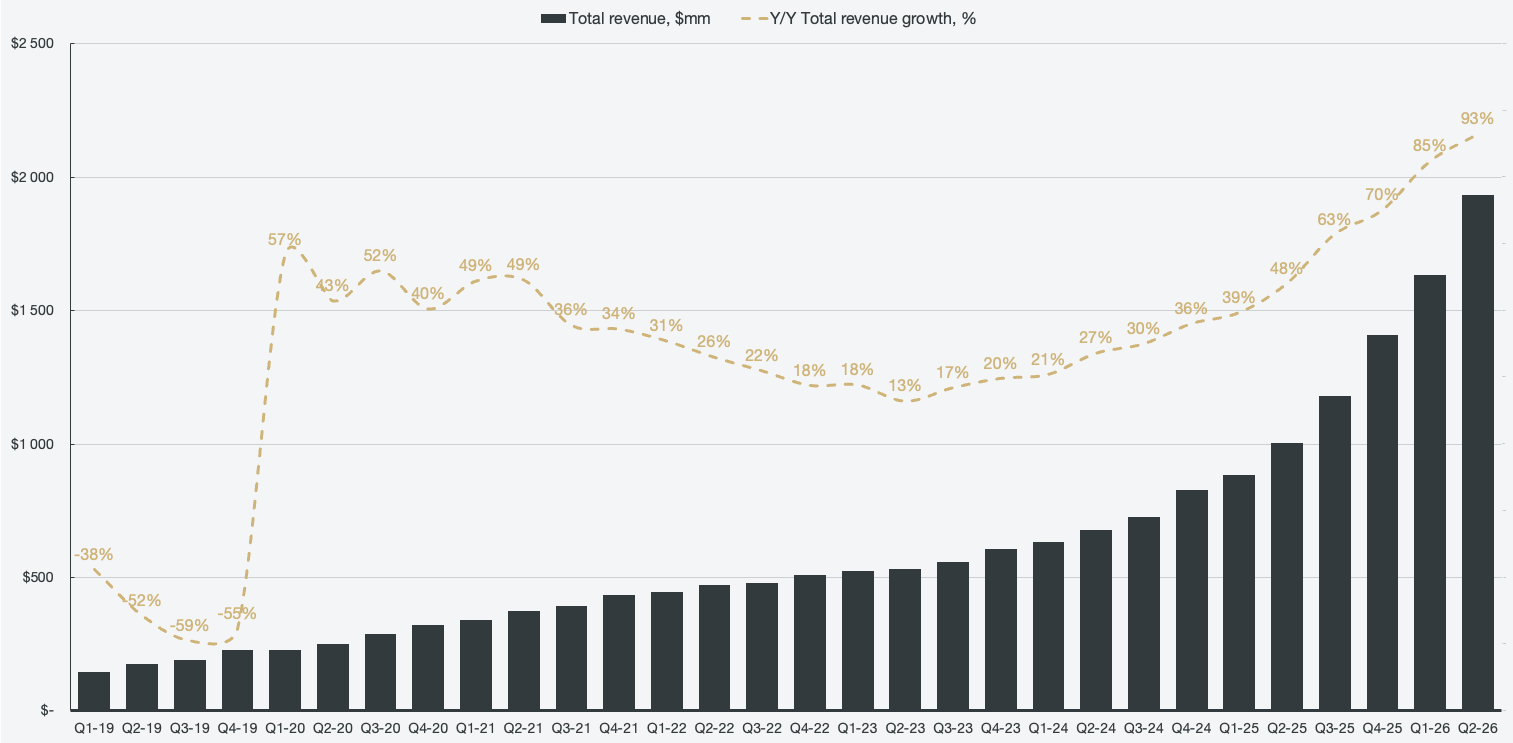
The total revenue growth pace that Palantir showed in Q2 is what is required of the business to be able to live up to the statements made by the CEO in recent interviews. A trajectory of >150% growth across the business would far surpass any previous revenue assumptions derived from the FCF target of $15-18 billion in two years.
As investors and analysts, it is important to understand where that growth is coming from. For example, U.S. commercial revenue growth has accelerated for every passing quarter since Q1 of 2024, a feat which many thought would not be possible once that growth started exceeding 100% Y/Y. Now, Palantir has a full year of >100% Y/Y U.S. commercial revenue growth, and each quarter has managed to push the growth further and further.¹
Figure 2: U.S. Commercial revenue and revenue growth
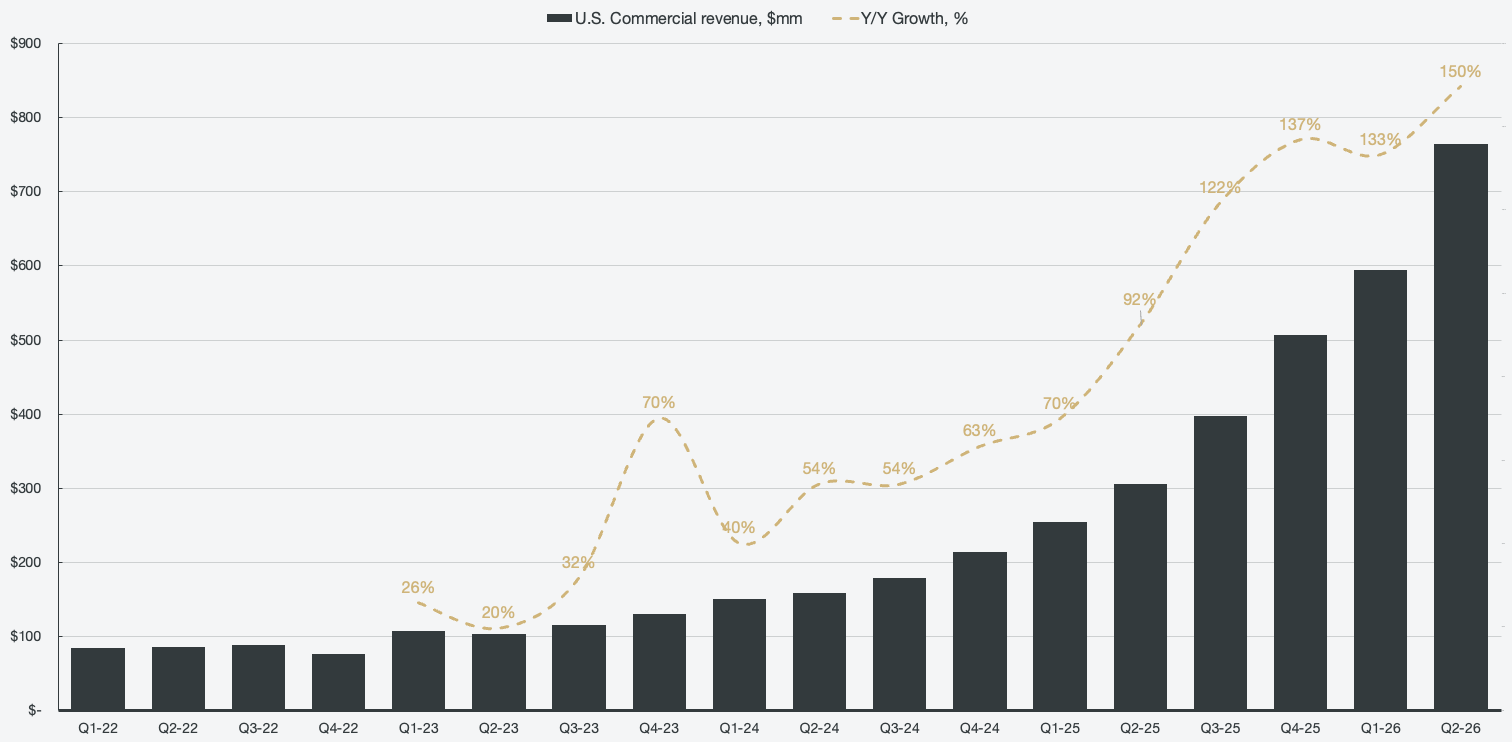
¹ Q1 2026 saw a customer get reclassified from U.S. Commercial to U.S. Government. Without that impact, revenue growth would have been 143% for the segment during the period.
In order to achieve sustainable and robust growth for an extended period of time, there has to be scalability to the revenue. That ties directly to the notion of Palantir creating value for its customers, and as value is unlocked, so too should the contract value per customer increase. Net dollar retention has been consistently accelerating each passing quarter since the launch of AIP, which has usage-based pricing. If AIP is creating value, the use of the product should increase among existing customers (>12 months with Palantir), thus creating scale.
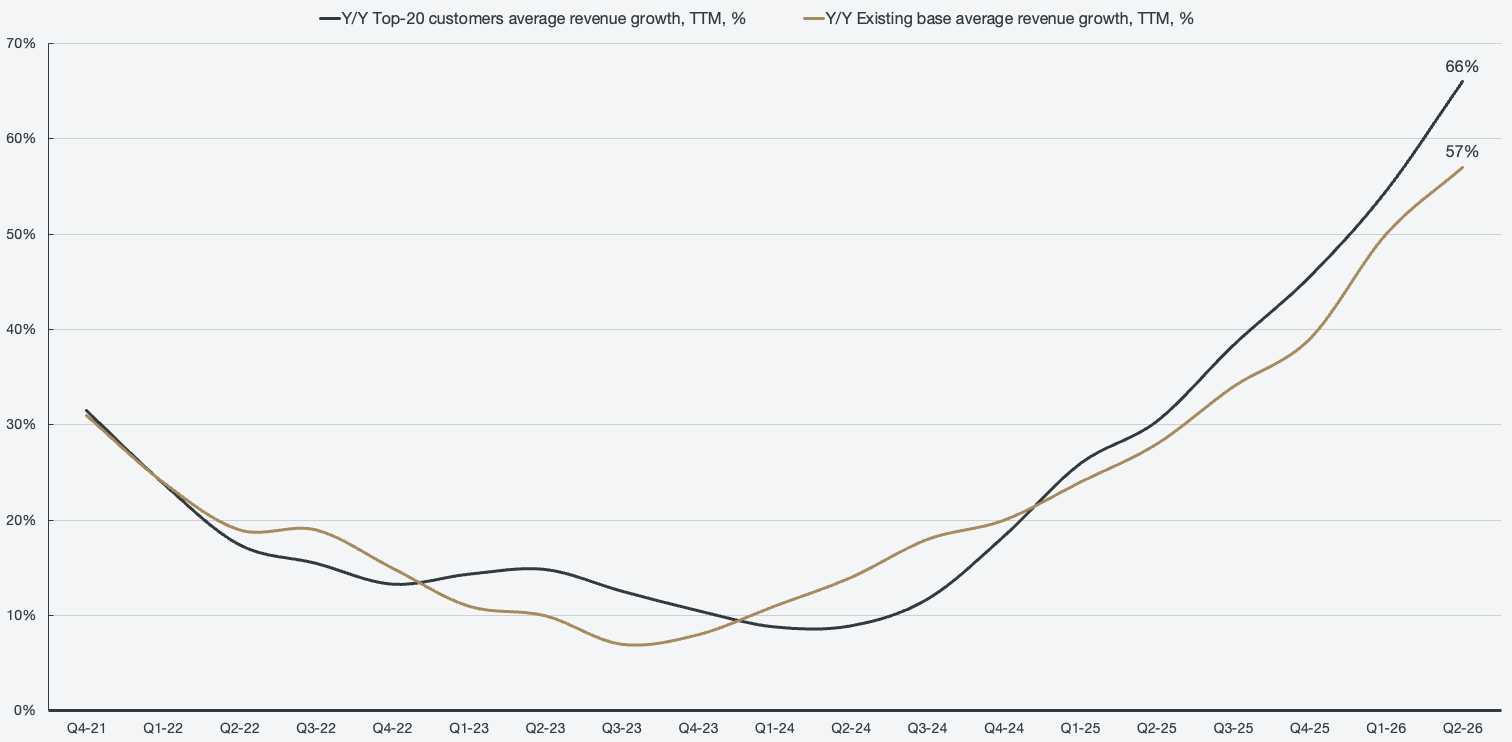
While the average customer is increasing their spend, as evident by NDR rising every quarter, so too is the cohort of Palantir’s largest customers. 2% (top 20) of customers account for 40% of total revenue, each providing >$120 million in annual revenue. That is over 3400%(!) more in annual revenue compared to the average customer outside of the top 20. For a year and a half, this massive cohort, which is already paying massive amounts to Palantir annually, is outgrowing the average customer base that has been with Palantir for over a year. That is strong evidence for the scalable nature of Palantir’s software.
Figure 3: Top-20 cohort and existing customer base average revenue growth (TTM)
Michael Burry has been one of the prominent voices criticizing Palantir for not being an AI company due to not having their own large language model (LLM), while CEO Karp made it clear from the very beginning that models are going to be commoditized.
We have been seeing evidence of the commoditization of LLMs at an alarming pace as of late, where open-source models distill frontier models (which also appear to be distillations to some degree) and replicate them at a fraction of the cost. In many cases, these distilled models, like Kimi K3, score better benchmark results than the frontier models.
At the same time, frontier AI Labs have been criticized for stealing IP with partners; a recent example includes Figma partnering with Anthropic, upon which Anthropic launched a competing product and Anthropic’s CPO, who was a Figma board member, resigned from the board.
The way it ties back to Karp’s criticism of tokenmaxxing is obvious in hindsight, but still caught investors and analysts off-guard. Palantir launched a partnership with Nvidia to deliver sovereign AI infrastructure, meaning that enterprises and governments can run models inside secure environments, with no risk of labs stealing IP. In addition, Palantir has started fine-tuning models for use in an enterprise context.
Palantir engineer Chad Wahlquist comments on the following observations from enterprise customers across the country:
Customers are frustrated with having to assume risk for software products not working, while locking in the customers.
Customers don’t want to subsidize AI labs that will ultimately launch a competing product.
Customers are frustrated with having to exhaust tokens without receiving value in the output. For example, a PhD is overkill on a factory line where things are merely placed in a box. There is a need for task-specific models that are trained on the craft.
Customers want to own the guardrails in their own environments; otherwise, the company risks not operating.
While models are being commoditized, and which frontier model reigns as king of the hill changes intermittently, Palantir has found a different approach to solve customer issues, provide value, and escape commoditization. They are fine-tuning models for enterprise-specific use cases, and their fine-tuned models outperform frontier lab equivalent models.
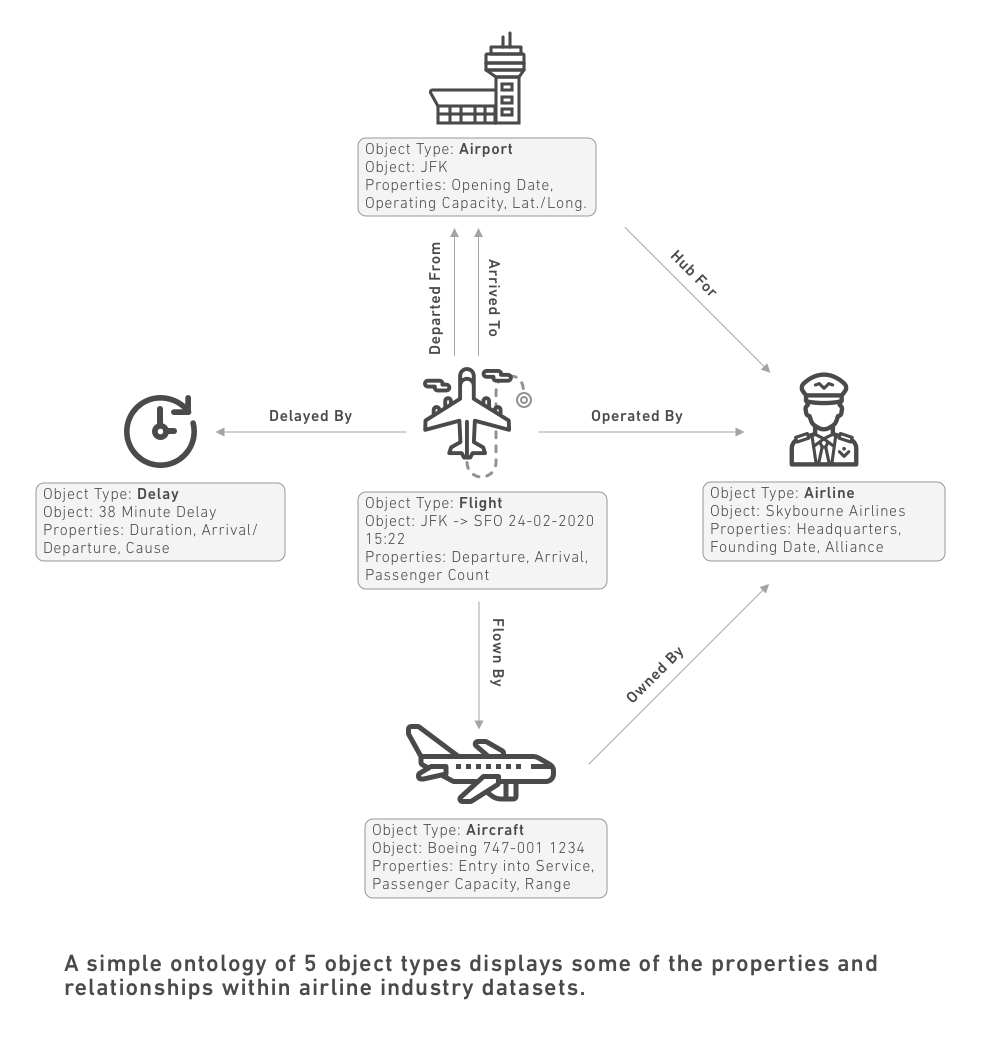
Palantir is uniquely positioned to fine-tune models because their software platform features Ontology, which is Palantir’s operational layer for the whole organization. Within the Ontology, the data of the organization is turned into objects, properties, links, and actions. The goal is to create a complete picture of the organization, and as such, provide an accurate context of the business to models.
Figure 4: Simplifed Ontology example
While the fine-tuning approach is rather new, through commentary, the demand for such solutions seems massive. Palantir’s software is model-agnostic, and it has already differentiated itself as a business that puts customer value-creation first, as evident by the sheer growth in existing customers. The fine-tuning approach is a smart way to build further on top of an already superior AI business.