Type-F Capital Equity Research

Type-F Capital Equity Research

PayPal Holdings: The Value Trap Unfolded

Equity research follow-up coverage, rating downgrade

Emir M's avatar
Emir M
Mar 11, 2026
∙ Paid

PayPal has misled investors with grandiose promises of being at the frontier of adapting to the next era of finance, financial timelines, and product launch scale. I see it as a large wasted opportunity, as PayPal truly had all the tools required to do all of the aforementioned feats, and retain its dominance in the digital payments space.

The stock has cratered from an already extremely cheap quote, the CEO has been fired, and uncertainty is the highest it has ever been. However, the stock is not the only thing that has cratered; so has the intrinsic value. Is there any reason remaining to own PYPL 0.00%↑ stock as of right now?


Company profile

March 12, 2026, Follow-up coverage
Direction: Hold
Previous fair intrinsic value: $145.90, as of November 2, 2025

Symbol: PYPL, Exchange: NASDAQ
Sector: Financials, Industry: Credit Services
Theme: Deep value
Fair intrinsic value: $68.73 (+52.66%), as of March 12, 2025
Market capitalization: $43 219 million
Pricing data: P/S 1.30x, P/E 8.26x

Previous coverage:

PayPal Holdings: Days of "PainPal" are soon history

PayPal Holdings: Days of "PainPal" are soon history

Emir M
·
November 2, 2025
Read full story

TYPEFCAPITAL.COM
Consider following me on X and YouTube.

This article is for informational purposes only and does not constitute investment advice or an offer to buy or sell securities.

Uncertainty gets punished

On a surface level, PayPal was truly set up to capitalize on the agentic wave that we are seeing across the AI industry. They have partnerships with OpenAI, Google, Mastercard, Perplexity, and just about every other major player in the space in order to enable user purchases within AI platforms. In addition, they have the single greatest source of actual purchase data relating to e-commerce, so why has the ads business not been launched and been a success yet? The questions relating to execution have been piling on, and investors’ patience has seemingly run out.

In my coverage of PayPal, I have deemed it a deep value opportunity, since the stock quote implied that the stock would not only stop growing, but actually decline. Where the stock quote is currently trading, it implies about a -7% CAGR at 13% FCFF margins over the next 10 years. Such a narrative has not materialized, and PayPal, while not as undervalued as I initially thought, is still trading very undervalued. However, the undervaluation could be justified given that they are quickly decelerating the business in an overall industry outlook that is set to grow in the mid-teens.

Consider becoming a free or paid subscriber to help support Type-F Capital and drive more frequent equity research.

Former CEO Alex Chriss took over a sinking ship, and famously mentioned that PayPal was going to “shock the world” in January of 2024, and with a solid track record at Intuit, many investors believed him. What followed was two years of no material progress towards the goals of capturing the AI commerce market, launching a successful and prominent ads business, or meaningful innovation.

Our execution has not been where it needs to be, particularly in branded checkout.

Jamie Miller, Interim Chief Executive Officer
PayPal Q4 2025 Earnings Release

What followed in the Q4 2025 results was a fired CEO and horrific guidance for the fiscal year 2026 of declining transaction margin dollars and EPS. PayPal pulled their revenue guidance several periods ago, and instead, they give us transaction margin dollars guidance as a way to track their path towards “profitable growth”. To reach profitable growth, they sacrificed the performance of core drivers to exit the race to the bottom that all payment solution providers are participating in (resulting in a decline in take rate for all participants). Now, they’re still losing take rate, but even worse, there’s no trade-off in rapid payment volume growth. It’s a lose-lose situation in that regard.

Searching for a positive note with a lantern

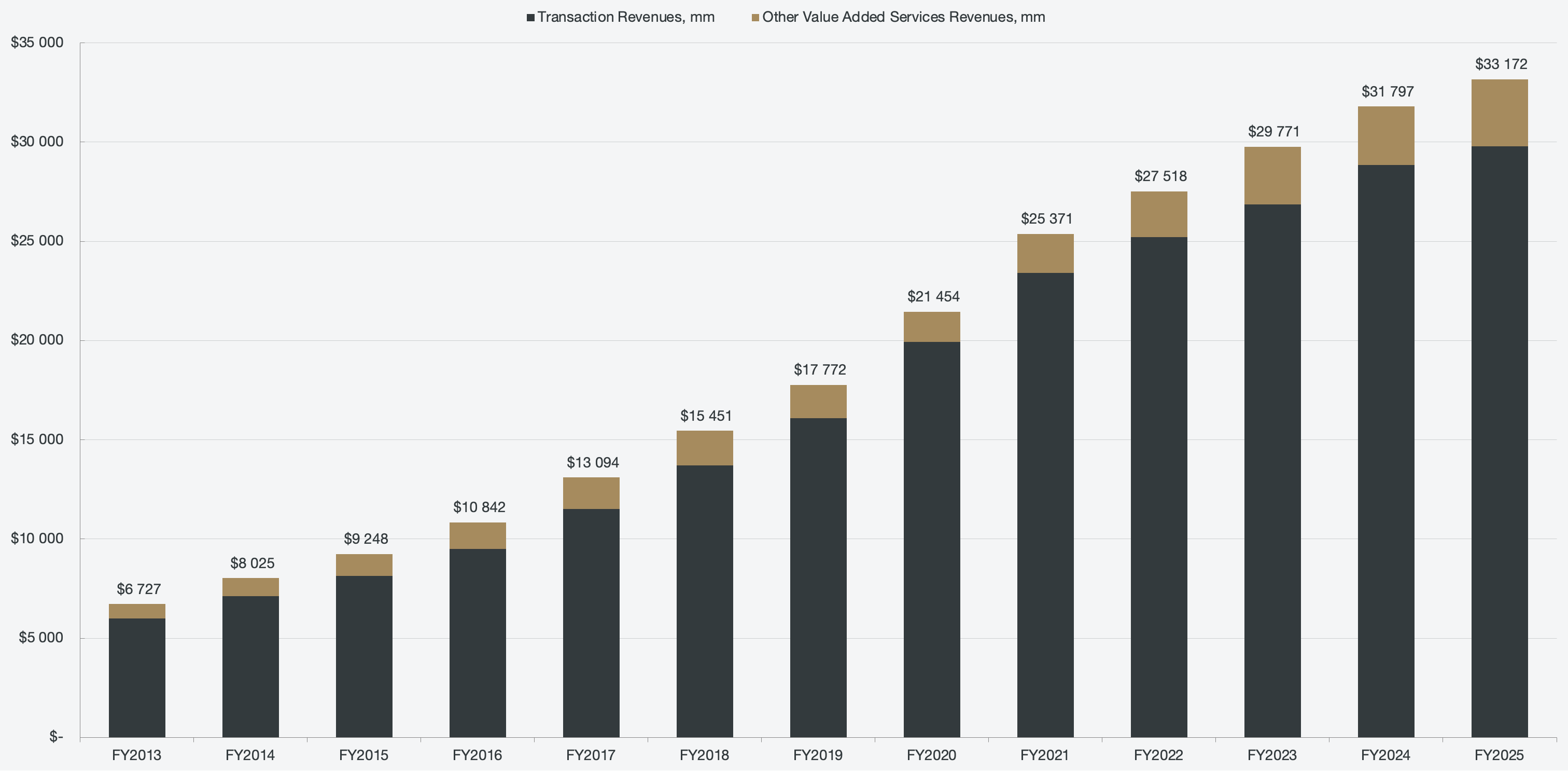
While PayPal didn’t make material progress towards becoming the premier commerce orchestrator as promised, not all is doom and gloom. As mentioned, the company still has growth, and is not showing indications of ~8% annual declines as the quote implies. However, the growth in revenue for FY2025 was a mere 4.3% Y/Y, while being participants in a digital payments market that grew ~20% Y/Y, and is expected to compound annually at a rate of ~20% over the coming 7-10 years.

Figure 1: Segmented revenues
Source: Company filings, Type-F Capital

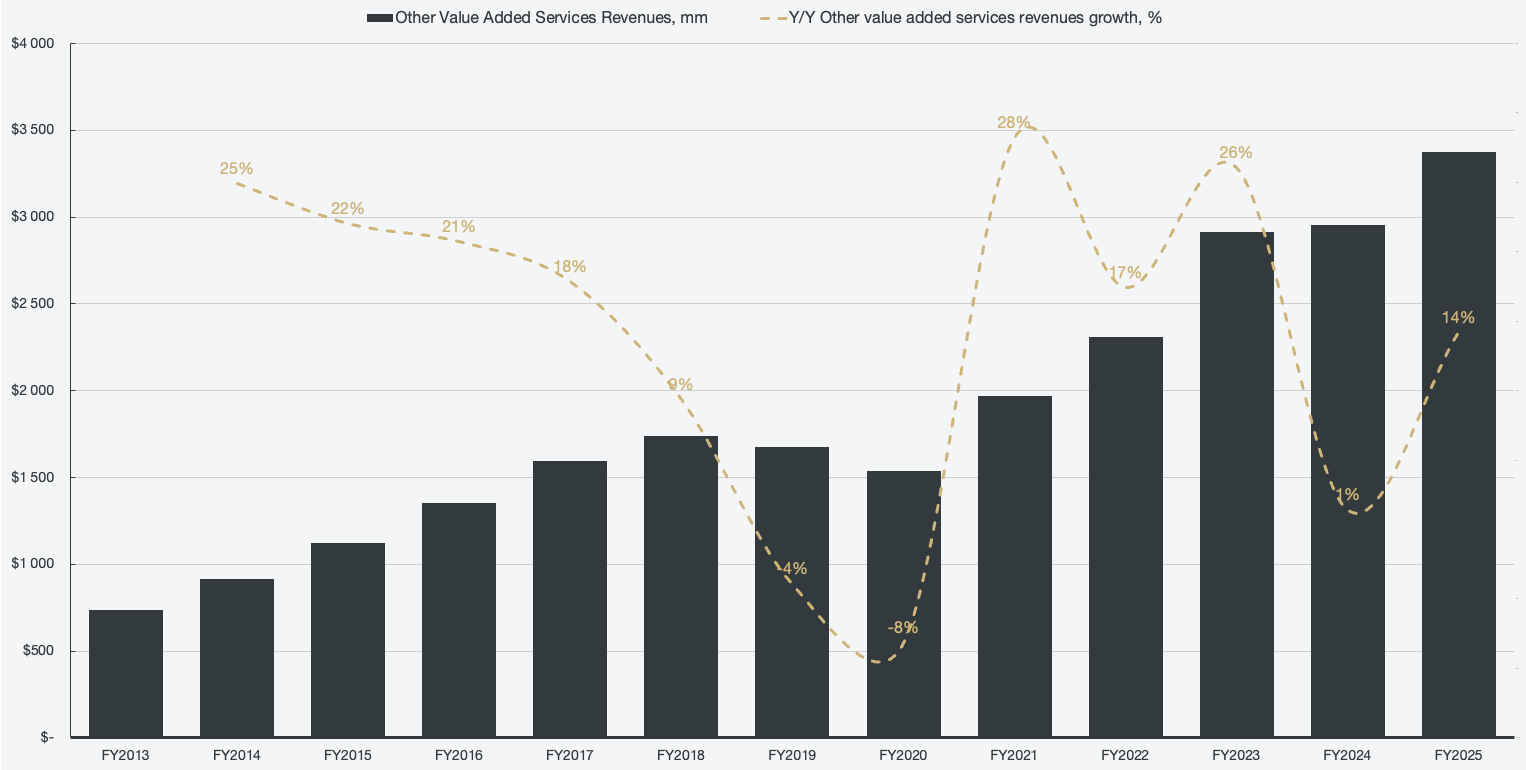
The core segment, transaction revenues, only grew 3.3%. The other value-added services (OVAS) grew 14.2%, showing signs of life after a flat 2024. The 14.2% increase signals that the business is gaining traction across credit and interest products, as well as subscription and partnership fees.

Figure 2: Other value-added services revenues
Source: Company filings, Type-F Capital

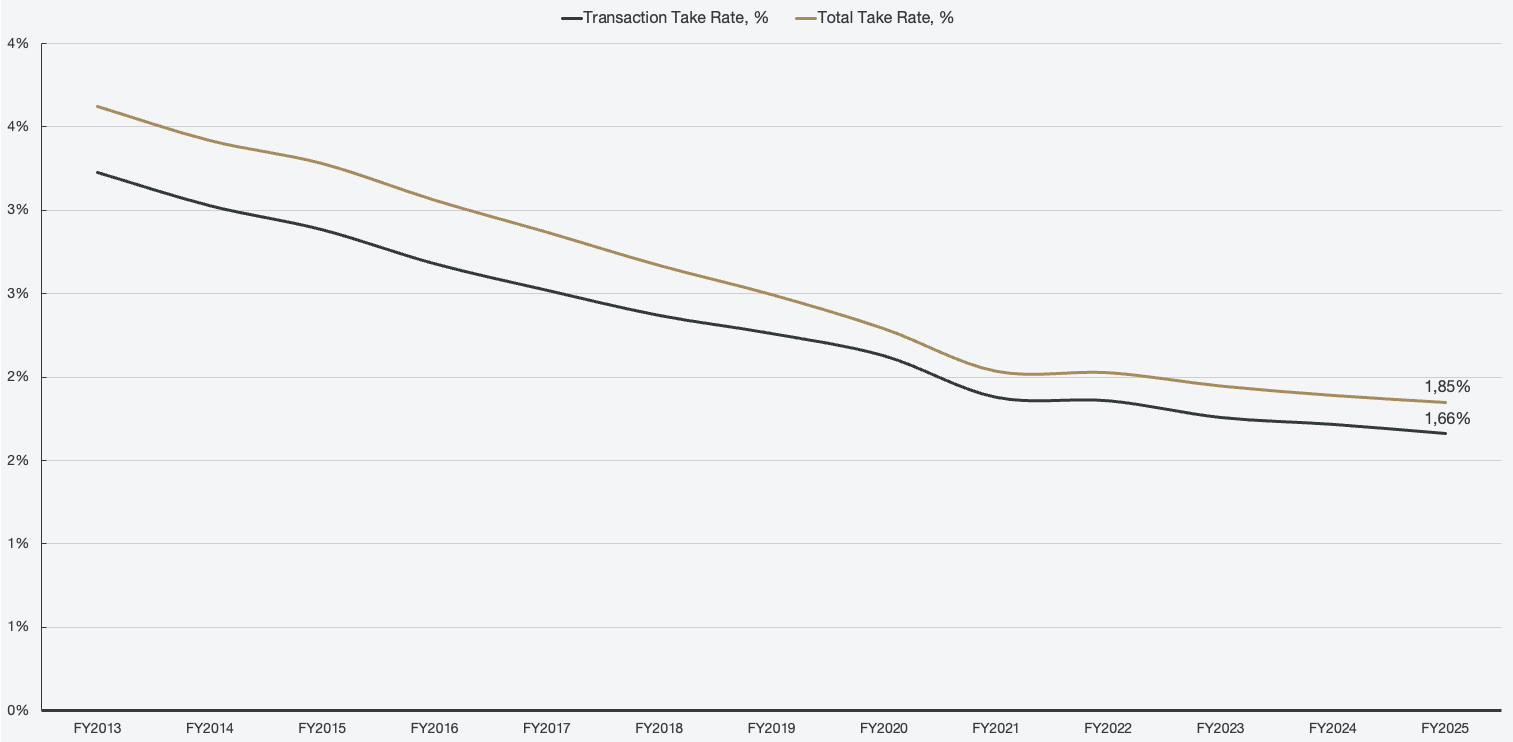
All the segmented total payment volume segments grew more than 3.3%, which means that the take rate decreased for the transactions. The whole purpose of having an off-year to reposition the business was to stop the bleeding take rate at the expense of growth, but as mentioned, PayPal lost on both ends.

Figure 3: Take rates
Source: Company filings, Type-F Capital

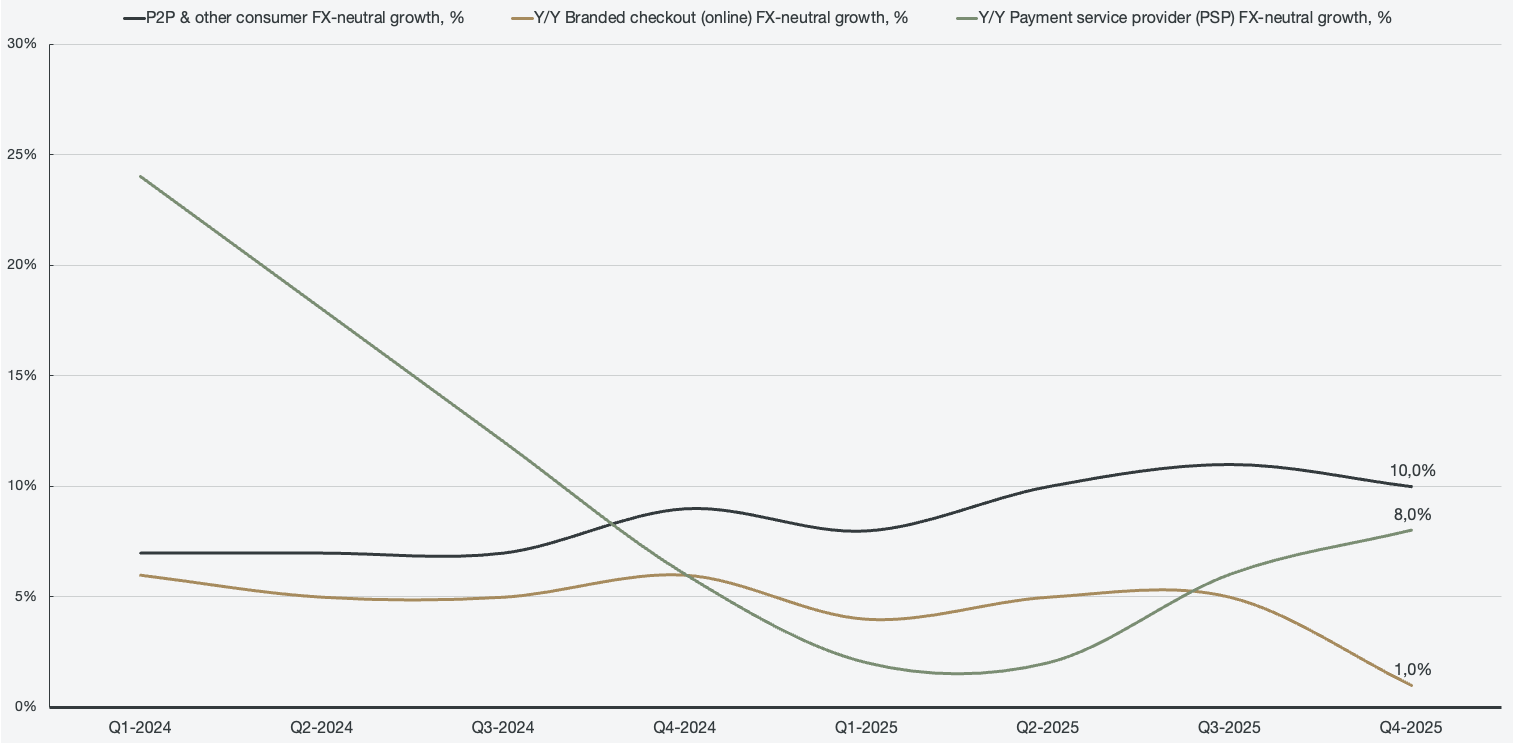
The highest margin segment, branded checkout, only increased 4% on a currency-neutral basis for the year, and 1% in Q4 2025. Peer-to-peer (P2P) is accelerating as a result of Venmo’s growth, but the real pain is felt in the payment service provider (PSP) solution, which accounts for a majority of the TPV.

Figure 4: Segmented TPV growth rates
Source: Company filings, Type-F Capital

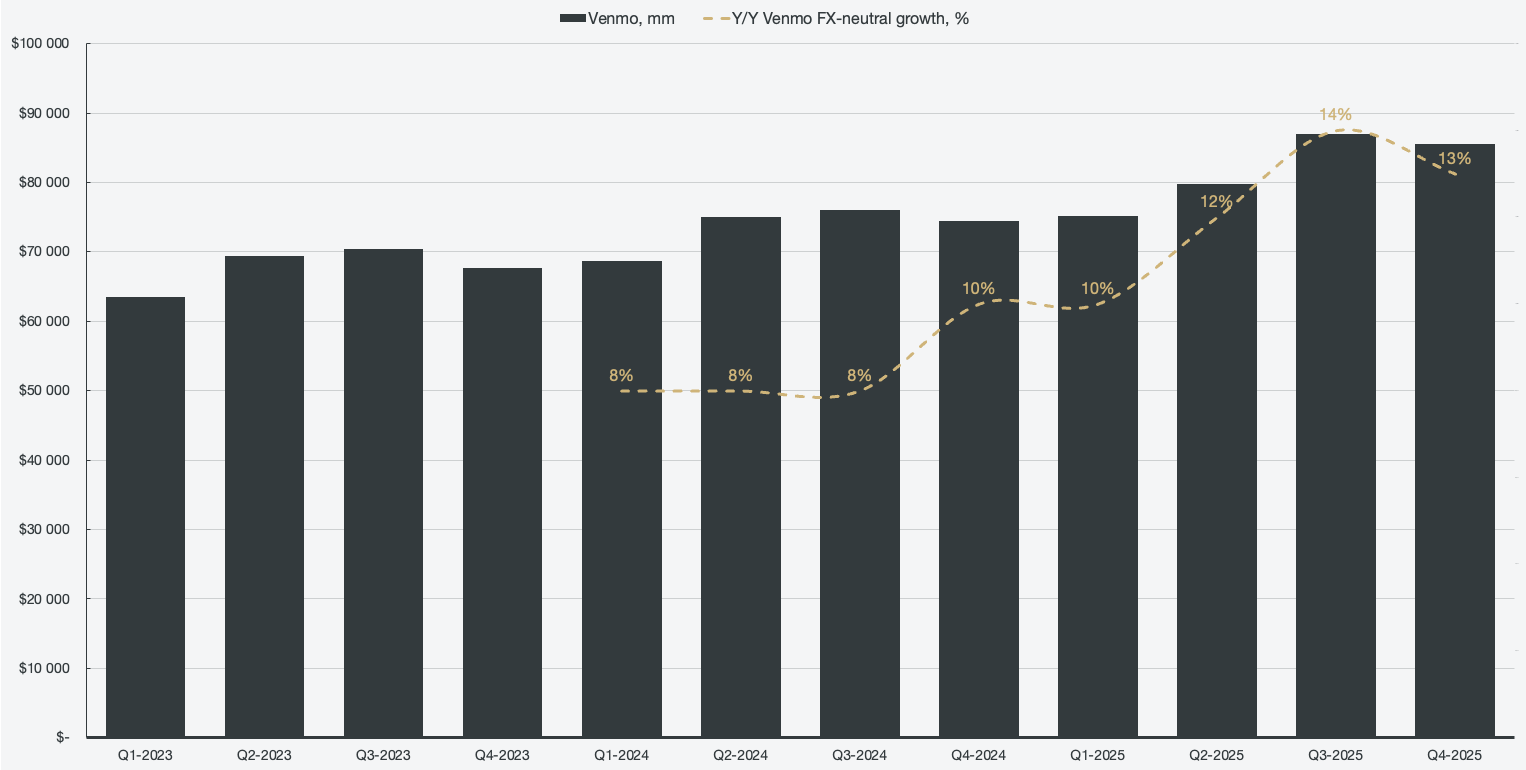
Venmo is one of the strongest financial services in the U.S., and is consistently at the top of most downloaded apps in the Apple and Android app stores. However, for a long time, it has not been properly monetized or given enough attention. One of the few developments under Alex Chriss’s management was improved substantially. Historically, even though Venmo was owned by PayPal, the two operated in silos without communication, essentially operating independently. That has changed, and Venmo is now starting to see innovation, growth, and monetization. However, even Venmo, while gaining traction as of late, is still stuck at where it was three years ago. In Q1 of 2023, Venmo made up 18% of total TPV. In Q4 of 2025, it makes up 18% of total TPV; essentially, there hasn’t been any progress.

Figure 5: Venmo TPV
Source: Company filings, Type-F Capital

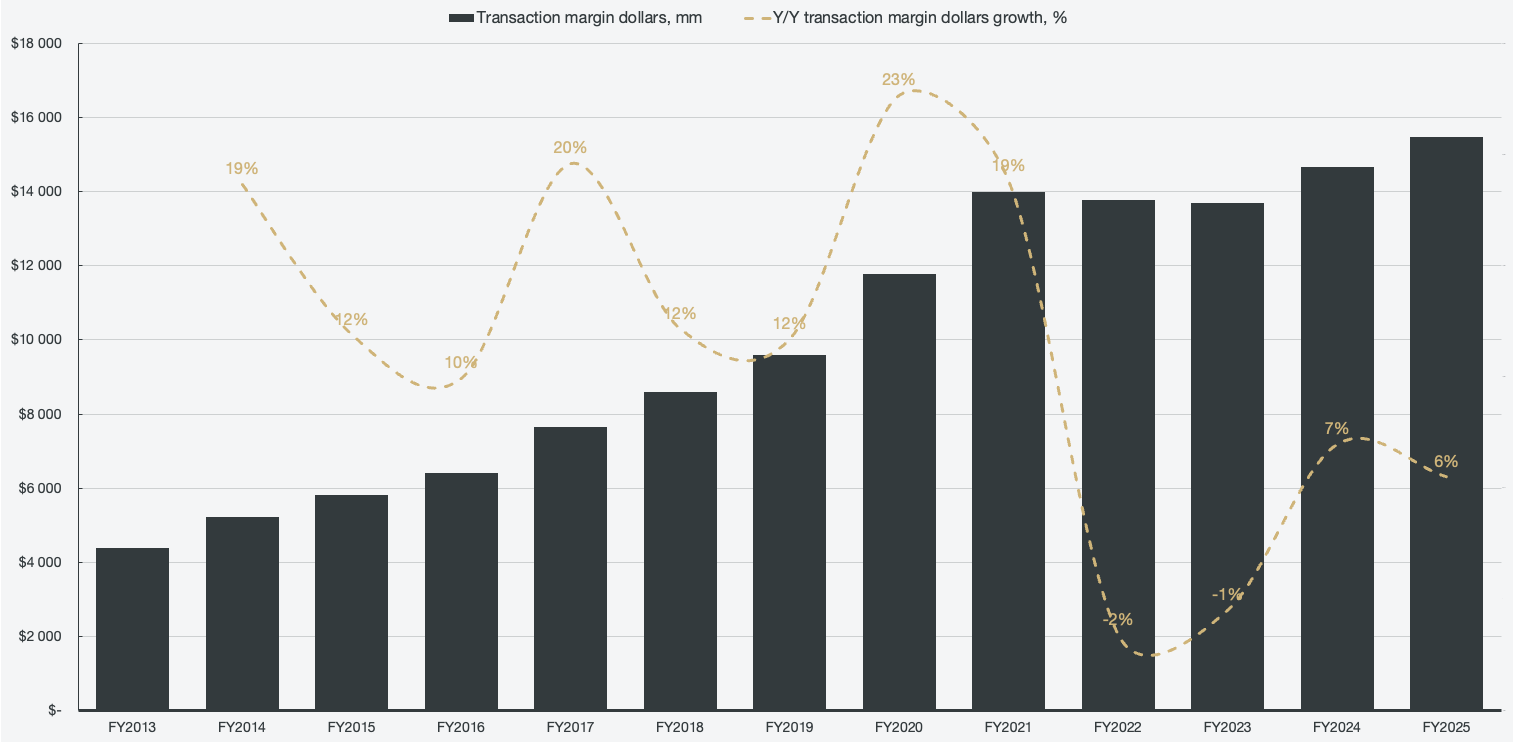
Looking at the core focus for 2025, transaction margin dollars, we saw an increase of 6%. This is expected to decrease in 2026, per management guidance as of Q4 2025. On a positive note, the transaction margins have been increasing for two years in a row, after dropping from 65.26% in 2013 to a low of 46.03% in 2023. As of 2025, the transaction margin is 46.62%, implying that the bleeding has ceased for the time being.

Figure 6: Transaction margin dollars
Source: Company filings, Type-F Capital

Looking at the operational statistics, it is a bit of a mixed bag. For the first time since 2022, PayPal managed to grow the average active accounts by ~7 million, representing 1.8% growth Y/Y.

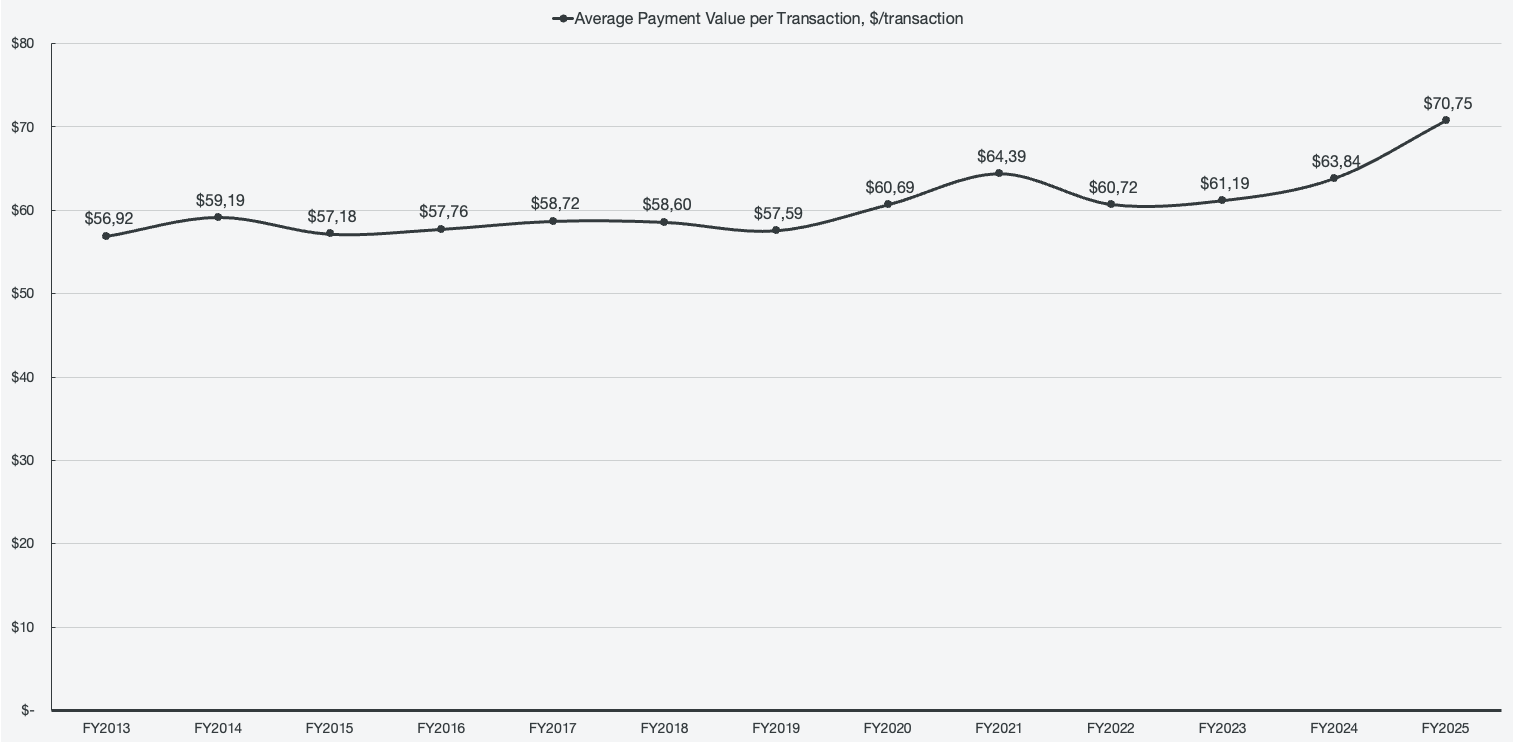
Despite 7 million additional active accounts, the number of payment transactions decreased by ~1 million compared to 2024. For reference, it is the first time in reported history that PayPal failed to grow the number of payment transactions Y/Y. Historically, payment transactions have been growing on average by ~20% CAGR since 2013, and that includes the -3.7% in 2025.

Since total TPV grew by 6.7% Y/Y (10% FXN) while total payment transactions decreased, it means that the average payment value increased, crossing $70 for the first time (~11% growth).

Figure 7: Average payment value per transaction
Source: Company filings, Type-F Capital

The saving grace and investment thesis

The rest of the research report is for paid subscribers only.
Please consider becoming a paid subscriber to help me do this full-time. That would allow me to deliver more frequent as well as higher-quality research.

PayPal has misled investors with grandiose promises of being at the frontier of adapting to the next era of finance, financial timelines, and product launch scale. I see it as a large wasted opportunity, as PayPal truly had all the tools required to do all of the aforementioned feats, and retain its dominance in the digital payments space.

The stock has cratered from an already extremely cheap quote, the CEO has been fired, and uncertainty is the highest it has ever been. However, the stock is not the only thing that has cratered; so has the intrinsic value. Is there any reason remaining to own PYPL 0.00%↑ stock as of right now?


Company profile

March 12, 2026, Follow-up coverage
Direction: Hold
Previous fair intrinsic value: $145.90, as of November 2, 2025

Symbol: PYPL, Exchange: NASDAQ
Sector: Financials, Industry: Credit Services
Theme: Deep value
Fair intrinsic value: $68.73 (+52.66%), as of March 12, 2025
Market capitalization: $43 219 million
Pricing data: P/S 1.30x, P/E 8.26x

Previous coverage:

PayPal Holdings: Days of "PainPal" are soon history

PayPal Holdings: Days of "PainPal" are soon history

Emir M
·
November 2, 2025
Read full story

TYPEFCAPITAL.COM
Consider following me on X and YouTube.

This article is for informational purposes only and does not constitute investment advice or an offer to buy or sell securities.

Uncertainty gets punished

On a surface level, PayPal was truly set up to capitalize on the agentic wave that we are seeing across the AI industry. They have partnerships with OpenAI, Google, Mastercard, Perplexity, and just about every other major player in the space in order to enable user purchases within AI platforms. In addition, they have the single greatest source of actual purchase data relating to e-commerce, so why has the ads business not been launched and been a success yet? The questions relating to execution have been piling on, and investors’ patience has seemingly run out.

In my coverage of PayPal, I have deemed it a deep value opportunity, since the stock quote implied that the stock would not only stop growing, but actually decline. Where the stock quote is currently trading, it implies about a -7% CAGR at 13% FCFF margins over the next 10 years. Such a narrative has not materialized, and PayPal, while not as undervalued as I initially thought, is still trading very undervalued. However, the undervaluation could be justified given that they are quickly decelerating the business in an overall industry outlook that is set to grow in the mid-teens.

Consider becoming a free or paid subscriber to help support Type-F Capital and drive more frequent equity research.

Former CEO Alex Chriss took over a sinking ship, and famously mentioned that PayPal was going to “shock the world” in January of 2024, and with a solid track record at Intuit, many investors believed him. What followed was two years of no material progress towards the goals of capturing the AI commerce market, launching a successful and prominent ads business, or meaningful innovation.

Our execution has not been where it needs to be, particularly in branded checkout.

Jamie Miller, Interim Chief Executive Officer
PayPal Q4 2025 Earnings Release

What followed in the Q4 2025 results was a fired CEO and horrific guidance for the fiscal year 2026 of declining transaction margin dollars and EPS. PayPal pulled their revenue guidance several periods ago, and instead, they give us transaction margin dollars guidance as a way to track their path towards “profitable growth”. To reach profitable growth, they sacrificed the performance of core drivers to exit the race to the bottom that all payment solution providers are participating in (resulting in a decline in take rate for all participants). Now, they’re still losing take rate, but even worse, there’s no trade-off in rapid payment volume growth. It’s a lose-lose situation in that regard.

Searching for a positive note with a lantern

While PayPal didn’t make material progress towards becoming the premier commerce orchestrator as promised, not all is doom and gloom. As mentioned, the company still has growth, and is not showing indications of ~8% annual declines as the quote implies. However, the growth in revenue for FY2025 was a mere 4.3% Y/Y, while being participants in a digital payments market that grew ~20% Y/Y, and is expected to compound annually at a rate of ~20% over the coming 7-10 years.

Figure 1: Segmented revenues
Source: Company filings, Type-F Capital

The core segment, transaction revenues, only grew 3.3%. The other value-added services (OVAS) grew 14.2%, showing signs of life after a flat 2024. The 14.2% increase signals that the business is gaining traction across credit and interest products, as well as subscription and partnership fees.

Figure 2: Other value-added services revenues
Source: Company filings, Type-F Capital

All the segmented total payment volume segments grew more than 3.3%, which means that the take rate decreased for the transactions. The whole purpose of having an off-year to reposition the business was to stop the bleeding take rate at the expense of growth, but as mentioned, PayPal lost on both ends.

Figure 3: Take rates
Source: Company filings, Type-F Capital

The highest margin segment, branded checkout, only increased 4% on a currency-neutral basis for the year, and 1% in Q4 2025. Peer-to-peer (P2P) is accelerating as a result of Venmo’s growth, but the real pain is felt in the payment service provider (PSP) solution, which accounts for a majority of the TPV.

Figure 4: Segmented TPV growth rates
Source: Company filings, Type-F Capital

Venmo is one of the strongest financial services in the U.S., and is consistently at the top of most downloaded apps in the Apple and Android app stores. However, for a long time, it has not been properly monetized or given enough attention. One of the few developments under Alex Chriss’s management was improved substantially. Historically, even though Venmo was owned by PayPal, the two operated in silos without communication, essentially operating independently. That has changed, and Venmo is now starting to see innovation, growth, and monetization. However, even Venmo, while gaining traction as of late, is still stuck at where it was three years ago. In Q1 of 2023, Venmo made up 18% of total TPV. In Q4 of 2025, it makes up 18% of total TPV; essentially, there hasn’t been any progress.

Figure 5: Venmo TPV
Source: Company filings, Type-F Capital

Looking at the core focus for 2025, transaction margin dollars, we saw an increase of 6%. This is expected to decrease in 2026, per management guidance as of Q4 2025. On a positive note, the transaction margins have been increasing for two years in a row, after dropping from 65.26% in 2013 to a low of 46.03% in 2023. As of 2025, the transaction margin is 46.62%, implying that the bleeding has ceased for the time being.

Figure 6: Transaction margin dollars
Source: Company filings, Type-F Capital

Looking at the operational statistics, it is a bit of a mixed bag. For the first time since 2022, PayPal managed to grow the average active accounts by ~7 million, representing 1.8% growth Y/Y.

Despite 7 million additional active accounts, the number of payment transactions decreased by ~1 million compared to 2024. For reference, it is the first time in reported history that PayPal failed to grow the number of payment transactions Y/Y. Historically, payment transactions have been growing on average by ~20% CAGR since 2013, and that includes the -3.7% in 2025.

Since total TPV grew by 6.7% Y/Y (10% FXN) while total payment transactions decreased, it means that the average payment value increased, crossing $70 for the first time (~11% growth).

Figure 7: Average payment value per transaction
Source: Company filings, Type-F Capital

The saving grace and investment thesis

The rest of the research report is for paid subscribers only.
Please consider becoming a paid subscriber to help me do this full-time. That would allow me to deliver more frequent as well as higher-quality research.

The top-line does not really inspire much excitement, but investors should have already been aware. Given the development of the business, a slowdown was expected, but perhaps not to the degree of what has transpired. Revenues grew 4.3% in 2025, marking the fourth year in a row of single-digit revenue growth. The key part here is that there is still growth, considering that the quote implies a decline in revenue; the question is, are we approaching that decline?

Looking at free cash flow to the firm, it has been declining for four years in a row as well, both in FCFF and FCFF margins. This is while company-reported FCF has been increasing, and net and operating margins have actually increased.

Figure 8: Free cash flow - firm
Source: Company filings, Type-F Capital

The cash generation is important because it correlates to the downside limit in the quote, as the company is aggressively repurchasing shares. A low stock quote serves as an accelerator for the repurchase program, and if the stock is too low, the company will be taken private. However, that dynamic only works if the company’s ability to generate large amounts of cash is sustainable, which it has been so far.

Figure 9: Net margins and operating margins
Source: Company filings, Type-F Capital

It’s a very bloated company in general, and addressing it is an easy way to improve margins further. Currently, there are ~24,000 employees, and about $1.7 billion is being spent on customer support. For those who have experience dealing with customer support at PayPal, it is not an impressive customer service that would warrant such a high cost. We are in 2026, and the era of AI is upon us; there are easy efficiency gains to be made at PayPal. Simply reducing the customer support expenses results in a ~5% increase in operating margins.

The new CEO, Enrique Lores, performed major job cuts at HP, which was his previous commitment. When Alex Chriss was let go, the stated reasons were slow execution, which implies that the new CEO will accelerate things at the company. As long as that acceleration doesn’t incinerate the cash generation at PayPal, there is still a built-in downside hedge through share repurchases. Even if the growth causes an increase in investments, unbloating the business should hopefully offset large parts of it.

Figure 10: Customer support expenses
Source: Company filings, Type-F Capital

Management has guides for $6 billion in share repurchases in 2026, and extrapolating that assumption, the company would be taken private in less than 6 years at the current pace and quote. Realistically, a buyout would occur earlier than the math suggests. If the stock were to drop further, that would only accelerate, which is why there is an implied downside limit.

Figure Table 1: Share repurchase exercise
Source: Company filings, Type-F Capital

While I did not anticipate such a weak year in my forecasting, the stock is still seemingly undervalued. Running a reverse DCF, we can see that the current stock quote implies -7% revenue CAGR at 13% FCFF margins, which is a lower margin than 2025. For the reverse DCF, since we are looking at what the market is implying with the current stock quote, we also only use market-implied assumptions for the rates. That means using the implied ERP for March (4.38%), and the 10-Year U.S. Treasury yield (4.13%) to compose the discount rate, and using the risk-free rate as a proxy for the terminal rate.

That means, by 2035, the market is implying $16 billion in revenue (down from 33.2 billion in 2025), and $2.1 billion in FCFF (down from $4.8 billion in 2025). That does not currently seem like a plausible scenario, but it is possible.

Figure Table 2: Reverse discounted cash flow model
Source: Company filings, Type-F Capital

Intrinsic valuation and fair value

The negative developments have led to a massive revision of my forecasts. Intrinsic value has been cut by more than half, and I still do not include any forecasts for an ad business. The current narrative that I see is a continued deterioration of the business, where PayPal continues to lower its take rate, loses market share, and only grows at a 3.7% CAGR.

I have a hard time justifying a margin collapse, since there are so many obvious cost savings for the business to employ. Despite that, I don’t see any material margin expansion from 2025 through 2034.

In general, we don’t know what to expect from the newly appointed CEO. He has been on the board for a long time and should be familiarized with the overall business, but I wonder how much is to be blamed on Alex Chriss and how much is due to the overall culture at PayPal. One could speculate that Alex Chriss was hindered and was not given the proper reins to steer the company towards all the promised goals. This uncertainty warrants a high business-specific risk in the discount rate.

Despite the pessimistic outlook, the implied fair intrinsic value is $69 per share, which implies an upside of 53%.

For my personal portfolio, PayPal was a position that I held for several years due to valuation. In a sense, the thesis is still intact from the perspective of being undervalued, but the narrative is significantly worse than anticipated. That means that I misunderstood the business and did not foresee the poor execution. The lowered quality and my lowered faith in a reacceleration means that I do not want to hold this company, especially while actual high-quality, fortress-like businesses have traded down as well. However, I have $65 leap call options, which I will hold on to for now as I think there are genuine opportunities to position the company as the premier orchestrator of this next era of finance.

Table 3: Intrinsic valuation model
Source: Company filings, Type-F Capital
The coverage sees a rating downgrade to hold.
© 2026 Type-F Capital · Market data by Intrinio · Privacy ∙ Terms ∙ Collection notice
Start your SubstackGet the app
Substack is the home for great culture