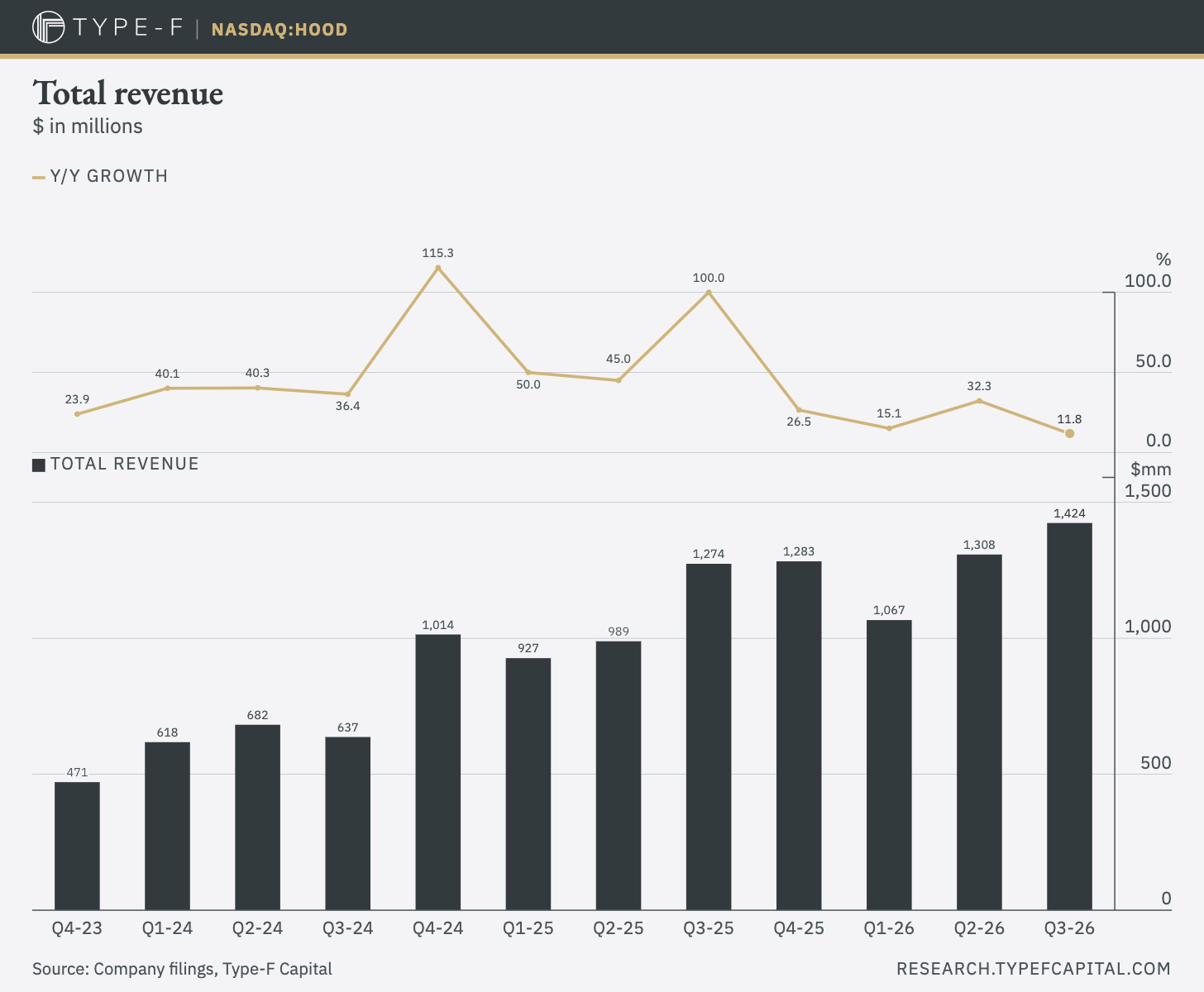
Another record quarter in many ways, but cyclicality rears its head as revenue growth slows considerably. I recall being asked why my valuation model normalizes growth over a 10-year forecasting period, because at the time, revenue was growing 100% Y/Y. To some, it was unfathomable that revenue would slow down considerably, and my approach was harshly criticized. Robinhood has highly cyclical components to its business, even though it is actively diversifying its lines of business each quarter and year. However, trying to forecast Robinhood’s revenue accurately while most of it is tied to trading activity is akin to timing the market, which is why I always used a normalized approach to the inputs. And even on a normalized basis, Robinhood is undervalued.
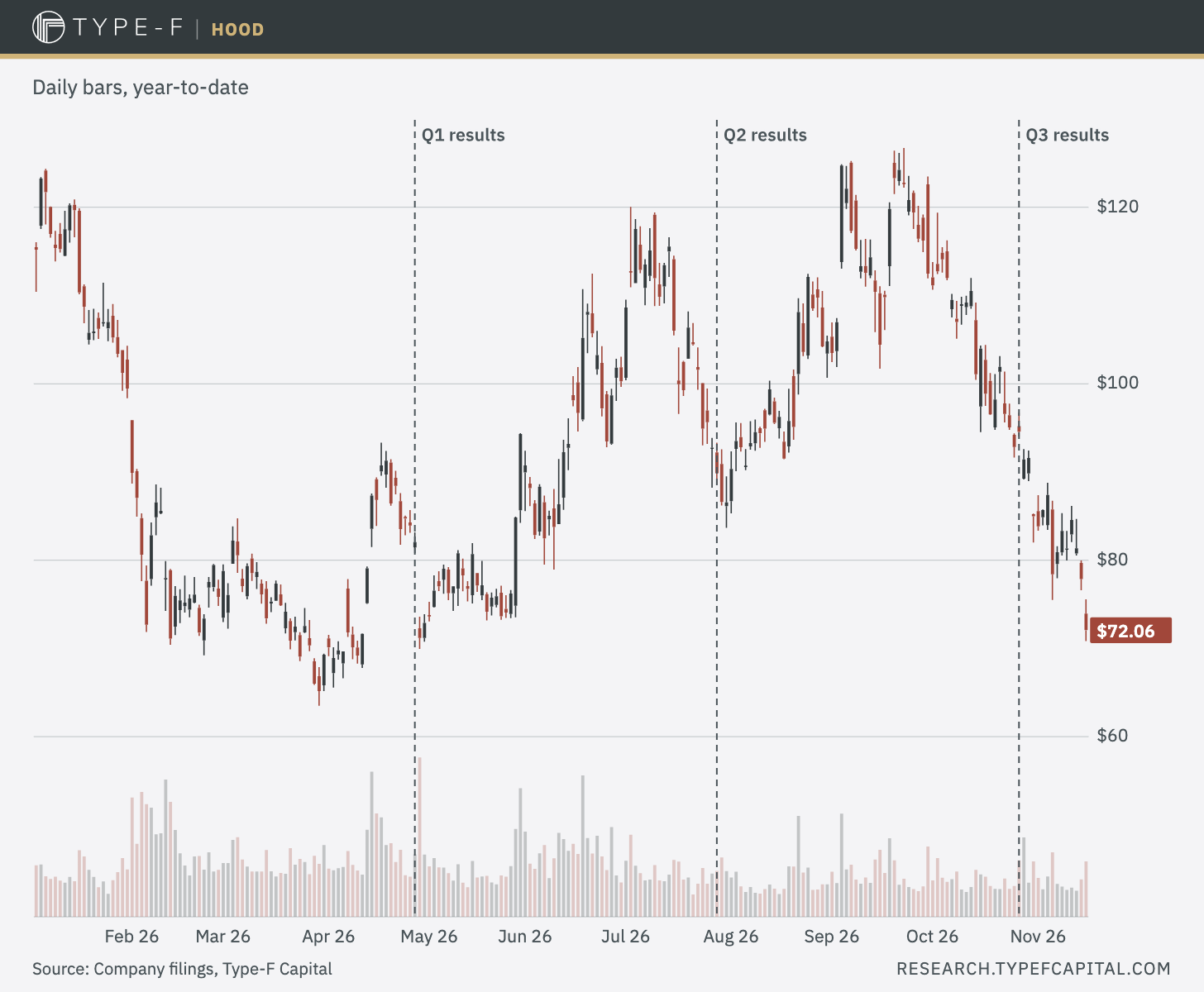
Cryptocurrencies are at the bottom of their cycle, which is why the stock has been so volatile all year, since they make up a key component of Robinhood’s transaction-based revenue. However, cycle bottoms tend to be the best time to buy cyclical businesses, especially considering that Robinhood is gaining market share in crypto, as well as equities and options. In addition, each passing quarter has shown us that Robinhood is actively diversifying its revenue streams to lessen the cyclical impact some components of its revenue can have.
Company profile
November 17, 2026 Follow-up coverage
Direction: Buy
Previous fair intrinsic value: $160.99, as of August 10, 2026
Symbol: HOOD, Exchange: NASDAQ
Sector: Financial Services, Industry: Capital Markets
Theme: Growth
Fair intrinsic value: $117.87 (70%), as of November 17, 2026
Market capitalization: $65 647 million
Pricing data: P/S 13x, P/E 30x
Previous coverage:

TYPEFCAPITAL.COM
Consider following me on X and YouTube.
This article is for informational purposes only and does not constitute investment advice or an offer to buy or sell securities.
Crypto caused the sell-off
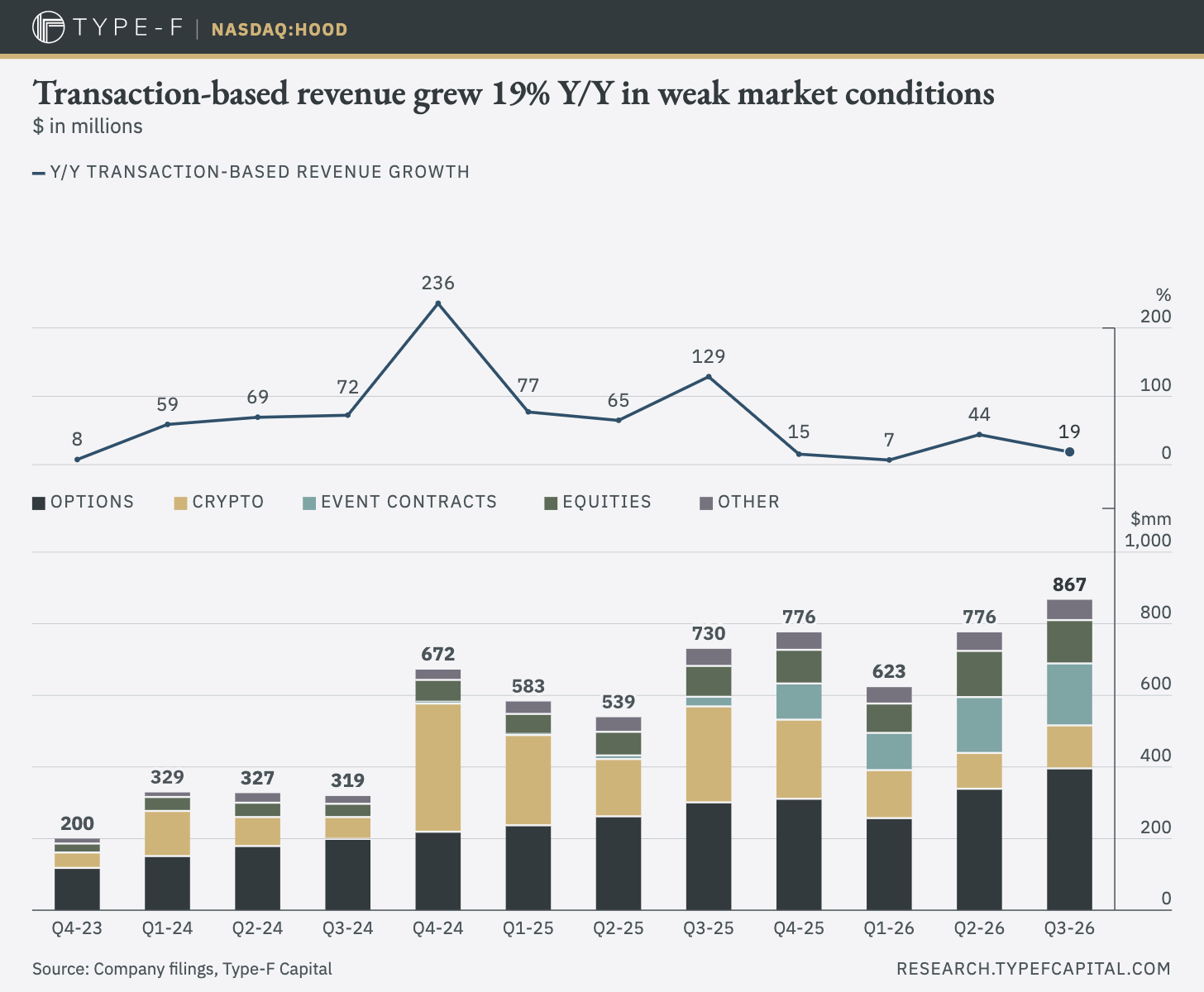
Y/Y growth for the business came in at the lowest figure since 2022, four years ago, and for investors who look at the results at a glance, I can see why they would want to be wary. Cryptocurrencies more than halved Y/Y, and they accounted for 21% of total revenue last year. That is considerable overhang, and it highlights Robinhood's concentration risk. Despite that, other segments have expanded, resulting in 12% Y/Y growth in total revenue in Q3 2026.
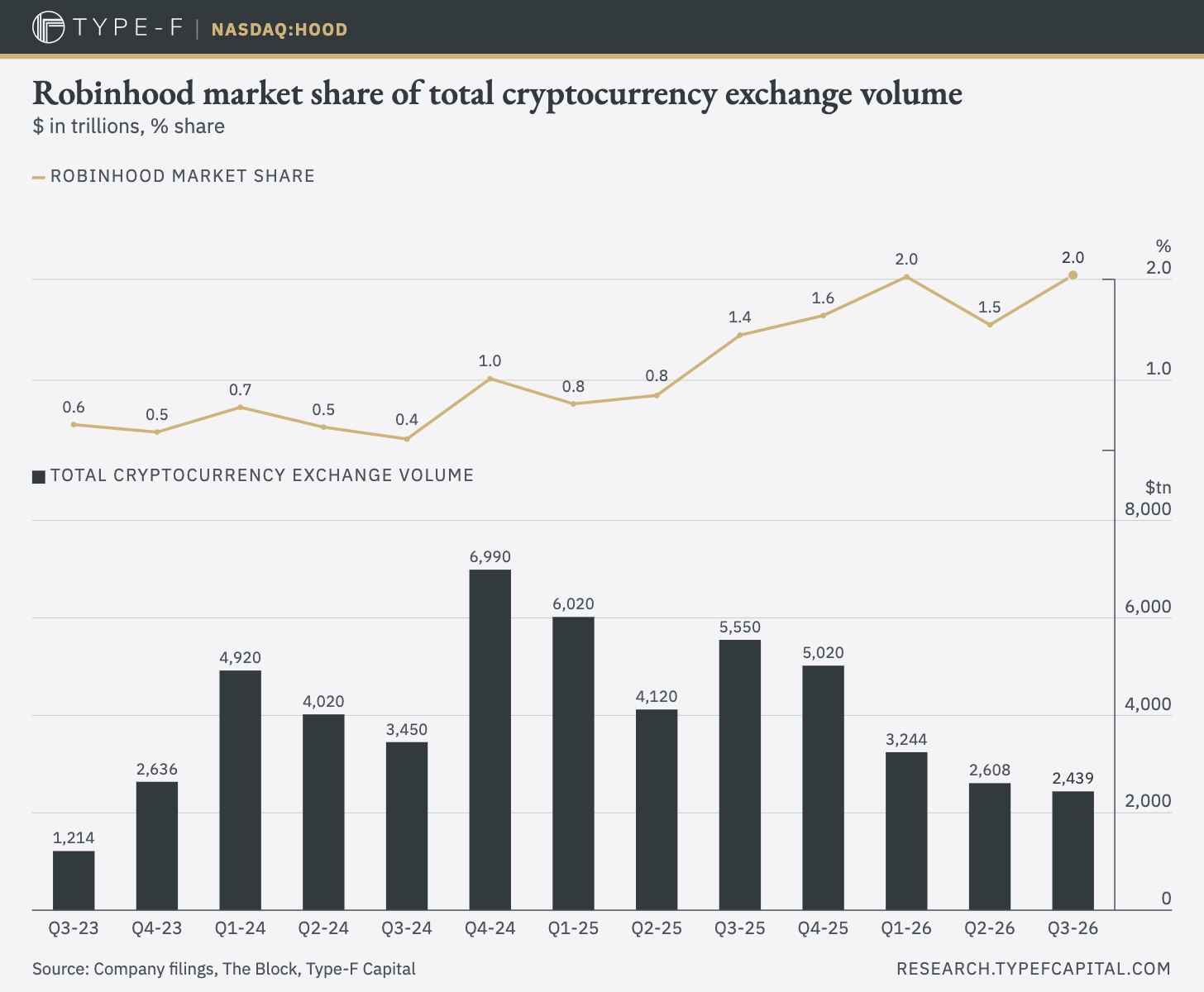
To highlight the cyclical nature of the results, Robinhood actually increased its market share of the total cryptocurrency exchange volume Y/Y, from 1.4% to 2%. The cryptocurrency market has been declining for a year straight as it cools off, which it has done many times historically. Zooming out to 2023, cryptocurrency volume hit another multi-year low in Q3 2023 before accelerating 476% to another cycle peak by Q4 2024.
To further make the point that Robinhood has been executing well under the circumstances, main cryptocurrency competitor Coinbase decreased consumer spot volume 59% Y/Y, while Robinhood’s app volume only dropped 48%. Crypto hype cycles come and go, and for the time being, Robinhood stock seems to trade highly correlated with the cryptocurrency market, which has been the narrative throughout the year.
Robinhood Chain, which went live on July 1st, generated over $80 billion in decentralized exchange volume and about $50 million in gross fees. Per management, that puts it in the top five among chains by revenue and volume in its first quarter alone. Those fees are shared with Arbitrum at roughly 50/50, meaning Robinhood booked $26 million as revenue. That annualizes to ~$100 million, but management hasn't called it a business line yet and said it could earn a couple of basis points on notional volume in a normalized environment. I also treat the Robinhood chain as optionality: I don’t derive intrinsic value from it and get it for free when purchasing shares below fair intrinsic value.
I have little doubt another crypto craze is around the corner, but while we wait, Robinhood is firing on all cylinders across the other main transaction types as well. Robinhood not only increased its market share in cryptocurrencies, but it also rose to a new all-time high in U.S. equities market share, surpassing the height of meme-trading during COVID for the second time. More notably, the most profitable and most important transaction type, options, surpassed a 10% market share for the first time in the company’s history. Increasing its options share is especially important for Robinhood, as spreads are still high in the category and options make up 46% of all transaction-based revenue.
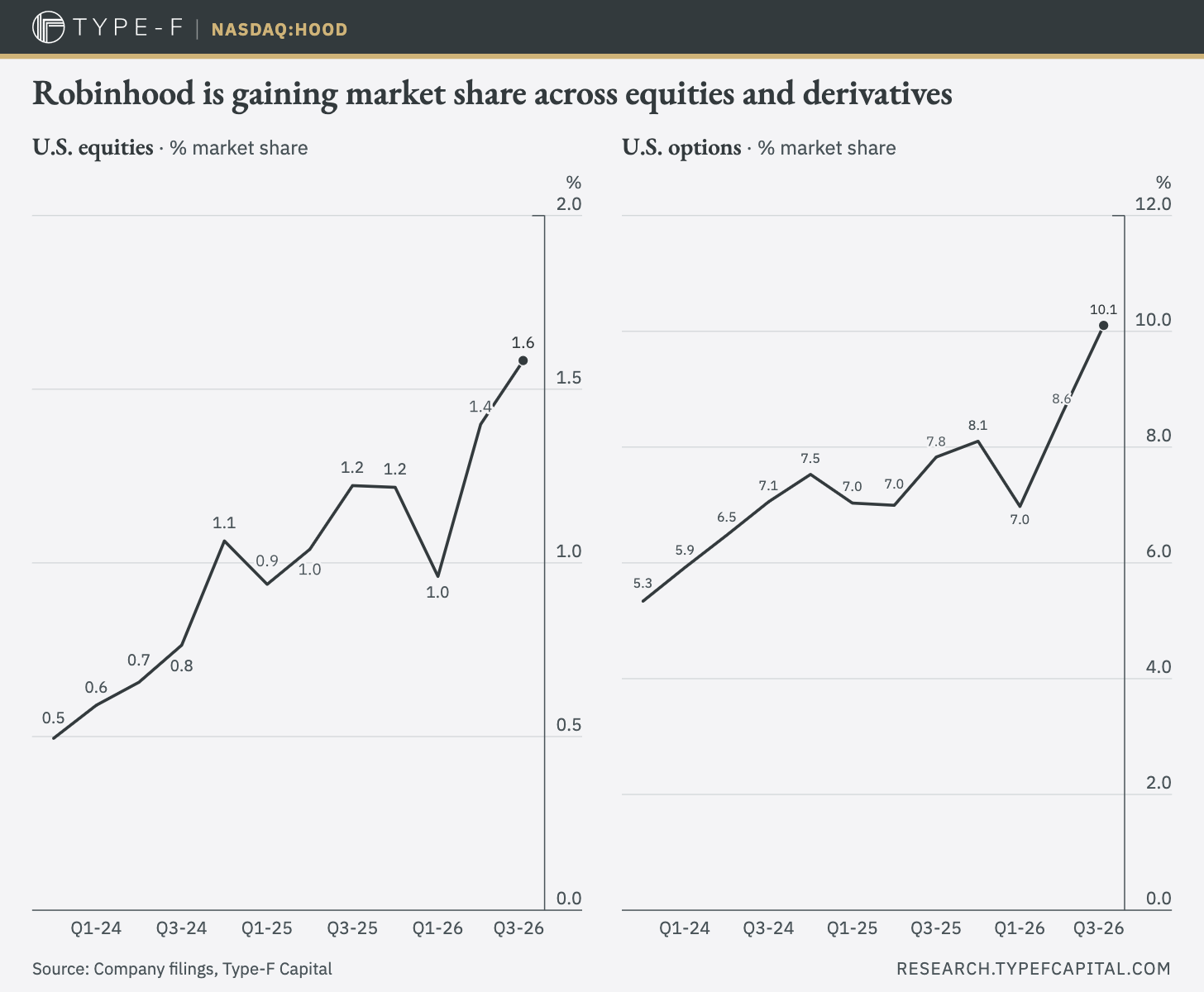
The only line of trading that didn’t actively increase its total market share is prediction markets, and while it didn’t increase its overall share, it still grew 541% Y/Y. The reason for not gaining market share in the prediction market space likely relates to Robinhood not offering prediction markets outside of chosen events, while platforms like Kalshi offer markets for just about anything.
I believe being stringent about which prediction markets Robinhood offers to customers is the smartest move. Prediction markets are still in their infancy, and some platforms are really pushing the limits on what they offer, which is an open invitation for regulatory action. A more prudent approach and sticking to major sporting and economic events is going to hurt revenue generation slightly, but over the long term, it’s the more sensible choice in my opinion. However, that does mean that Robinhood is missing out on growth in one of the fastest-growing segments in the market.
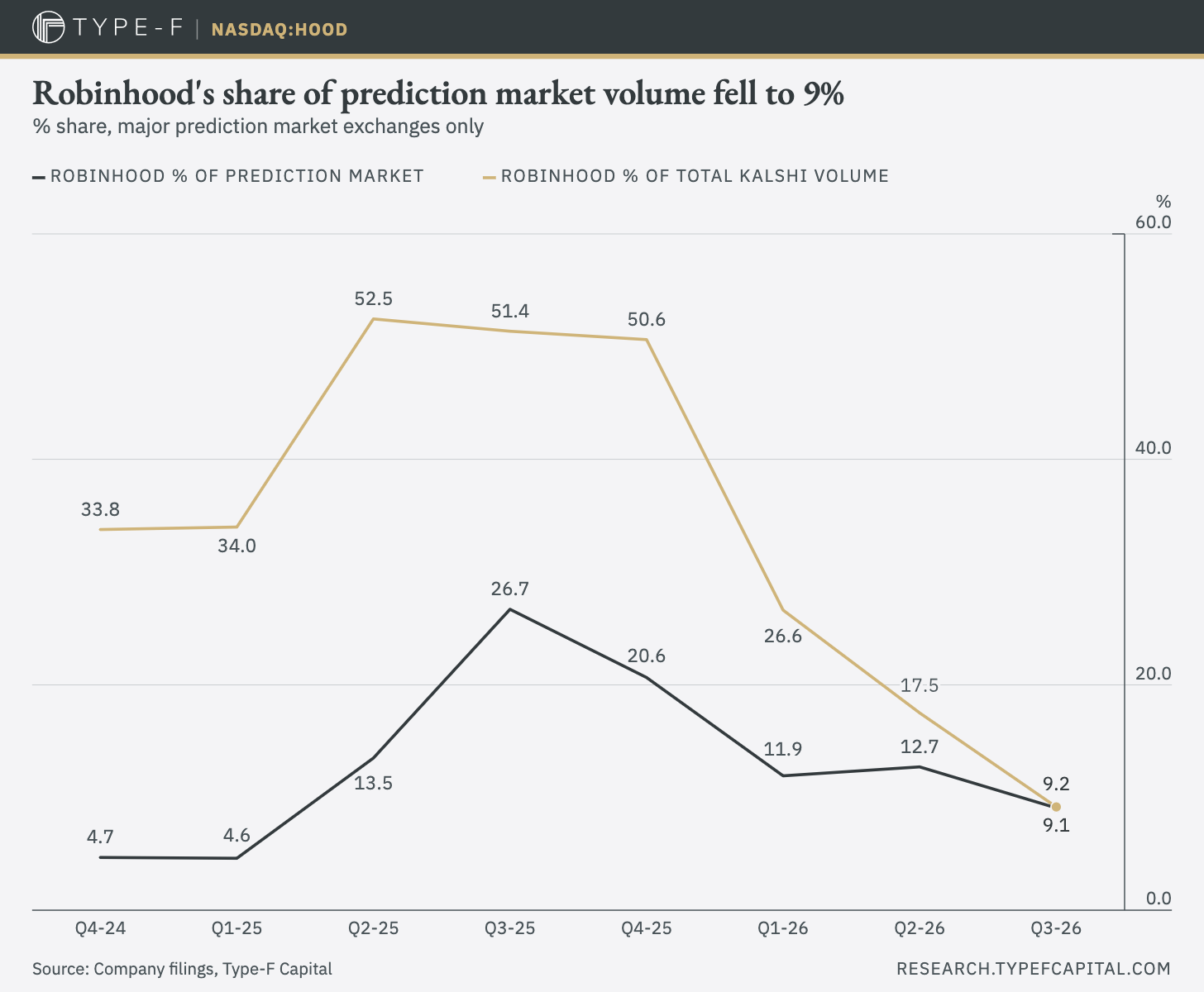
Major exchanges: Kalshi, Polymarket, Polymarket US, Opinion, Predict, Limitless, Hyperliquid.
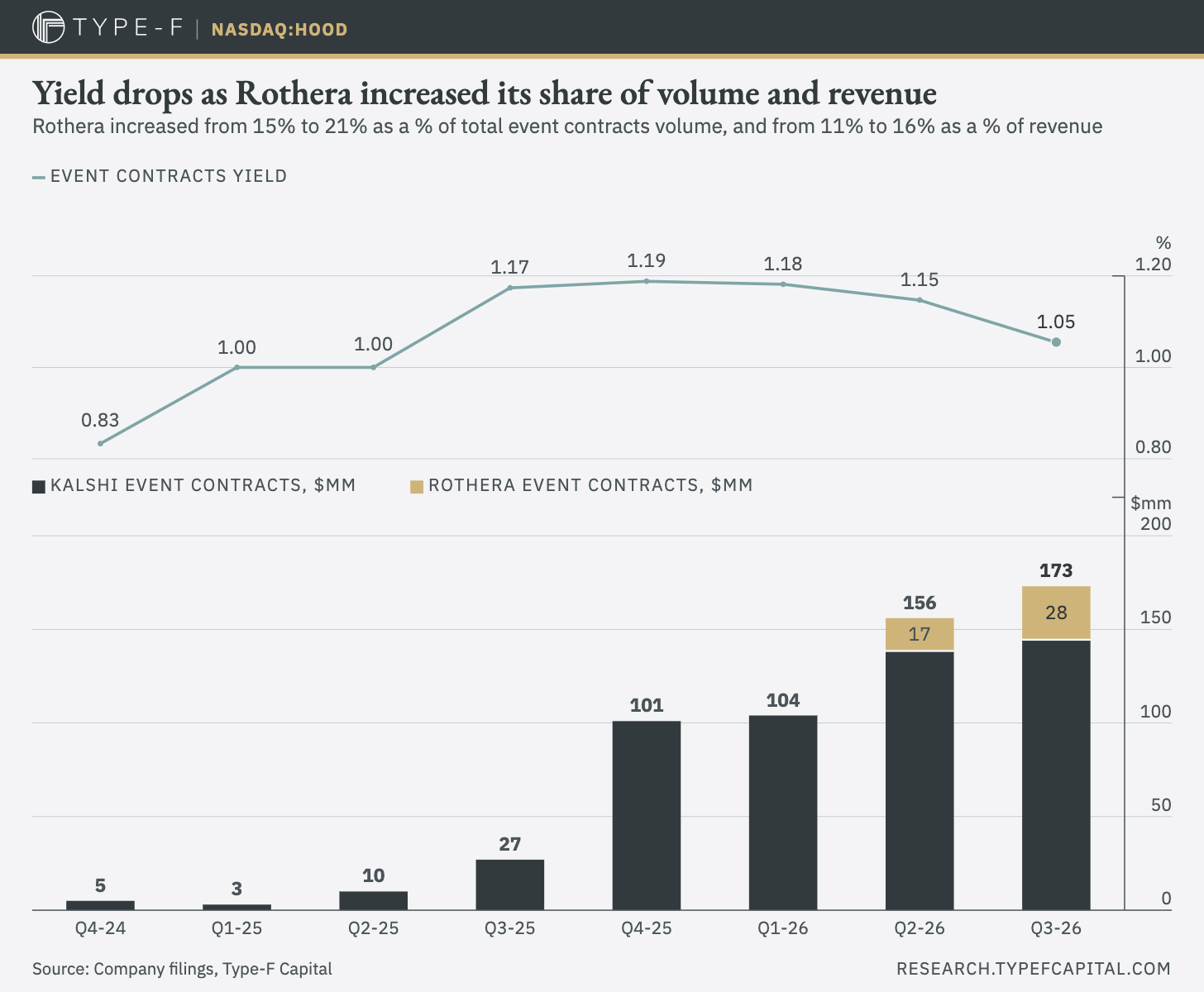
This quarter, a larger share of event contracts moved from Kalshi to Robinhood’s Rothera exchange, from 15% to 21% of total contract volume. Management noted during the earnings call that the goal is to move off Kalshi in 2027, and that there are financial incentives to do so. However, as Rothera gained a larger share of the mix, overall event-contract yield decreased from 1.15% to 1.05%. That implies that revenue conversion is worse on Robinhood’s own exchange. Additionally, Robinhood took equity stakes in both OG.com and Crypto.com in September, and has agreed to route event contracts to OG.com.
When Robinhood routes to Rothera, Robinhood books a commission, and the exchange economics accrue to the JV rather than Kalshi, which Robinhood’s shareholders get through an equity stake rather than pure revenue. As the flow migrates, we expect that revenue per contract will keep decreasing.
What matters for Robinhood’s narrative is that all transaction-based revenue lines gained share while the underlying market was flat or shrinking. One of the main fears investors have about Robinhood is that its growth is cyclical beta and thus has to rely on the underlying markets growing to grow. Robinhood has shown it is increasingly eating away at market share and eking out growth during downcycles, meaning growth will be even better when markets are up.
However, it was at the expense of take rates. Options revenue per contract slipped down to $0.44 from $0.50 a year ago. The drop is mainly due to index options and ETFs making up more of the mix, as they carry thinner spreads compared to single-stock options. CFO Shiv Verma commented during the earnings conference call that spreads are tight during the first month of Q4 as well, which indicates that we shouldn’t expect a recovery in yield (take rates) in the short term. However, the volatility index (VIX) has been spiking in November, and we are currently in a highly volatile market, which could widen spreads and, in turn, the amount market makers are willing to pay for order flow. That could provide upside in Q4.
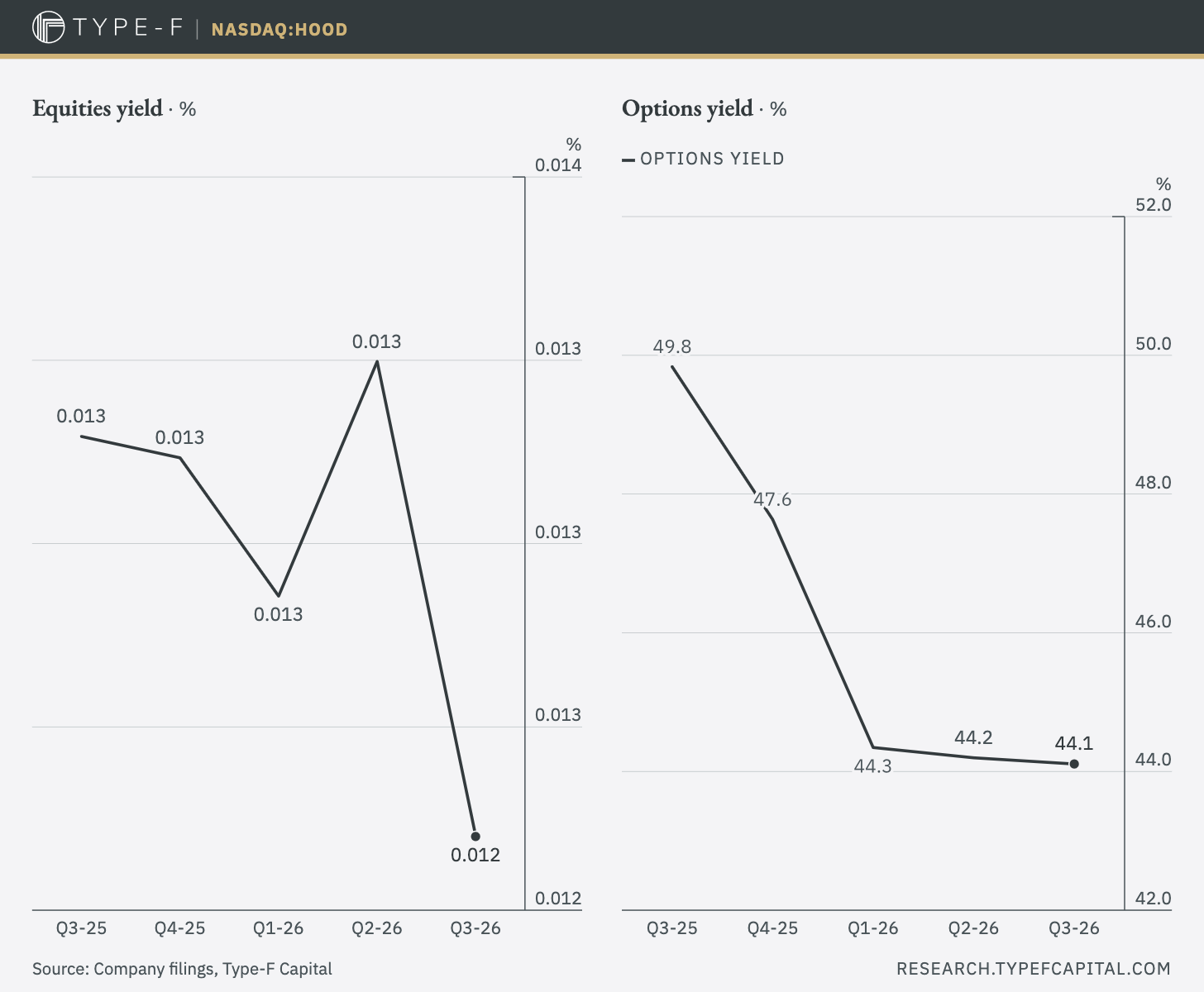
In general, given the market circumstances and the thin spreads, the quarter was decent for transaction-based revenue. Robinhood claimed market share across the board (except prediction markets, due to a conscious choice about what to offer) and managed to grow the segment 19% Y/Y. It is a far cry from the growth rates we have seen in more favorable conditions, but as with any cyclical segment, those come and go, which is why it is prudent to have normalized expectations when forecasting.