


A record quarter with a reacceleration of growth, record net deposits and assets under management, new major lines of business, customer growth, and record cash generation. Despite fantastic quarterly financial results with increases in market share in most categories, the stock traded down post-Q2 earnings.
The market can be quite generous at times to those who strive to understand businesses, and Robinhood at the time of writing is one such generous gift. What Robinhood has been busy doing has escaped surface-level investors, seeing the company as a mere brokerage that keeps adding products. The truth is a lot deeper, and a lot more exciting.
Company profile
August 10 2026 Follow-up coverage
Direction: Buy
Previous fair intrinsic value: $155.29, as of May 18, 2026
Symbol: HOOD, Exchange: NASDAQ
Sector: Financial Services, Industry: Capital Markets
Theme: Growth
Fair intrinsic value: $160.99 (73%), as of August 10, 2026
Market capitalization: $85 080 million
Pricing data: P/S 19x, P/E 45x
Previous coverage:

TYPEFCAPITAL.COM
Consider following me on X and YouTube.
This article is for informational purposes only and does not constitute investment advice or an offer to buy or sell securities.
The rotation in transaction revenue
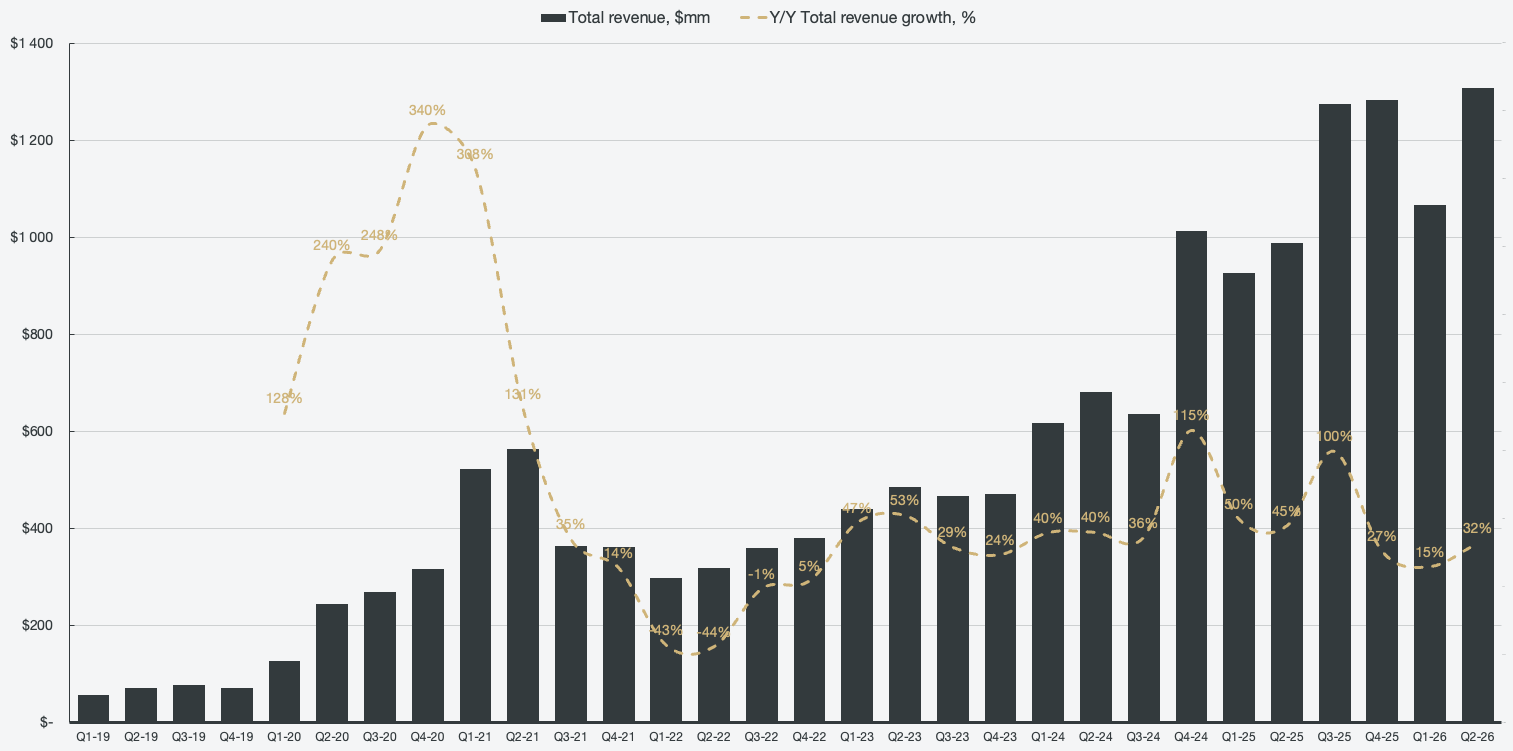
As we are all aware, Robinhood is still a cyclical business and still primarily relies on customer activity in the markets to generate a majority of its revenue and profits. Q1 was a particularly weak quarter for Robinhood, and it traded down substantially after posting a mere 15% Y/Y revenue increase, after growing 100% just two quarters prior. However, Q2 sees a reacceleration to record revenue, and Robinhood grew its total revenue by 32% Y/Y, more than double the rate of Q1.
Figure 1: Total revenue
Over the past quarters, Robinhood has been on a systematic campaign to own the venue layer rather than just routing through third parties. MIAXdx was acquired in early 2026, which turned into Rothera, a CFTC-licensed exchange and clearinghouse through a joint venture with Susquehanna. Bitstamp became an owned cryptocurrency exchange, while Robinhood Chain became an owned settlement layer. Robinhood Banking is an owned deposit relationship in place of a sweep, and TradePMR and the related advisor network are an owned custody channel. Most recently, Robinhood Ventures became an owned issuance vehicle. We will cover all of these and their relevancy to the future of Robinhood in this report.
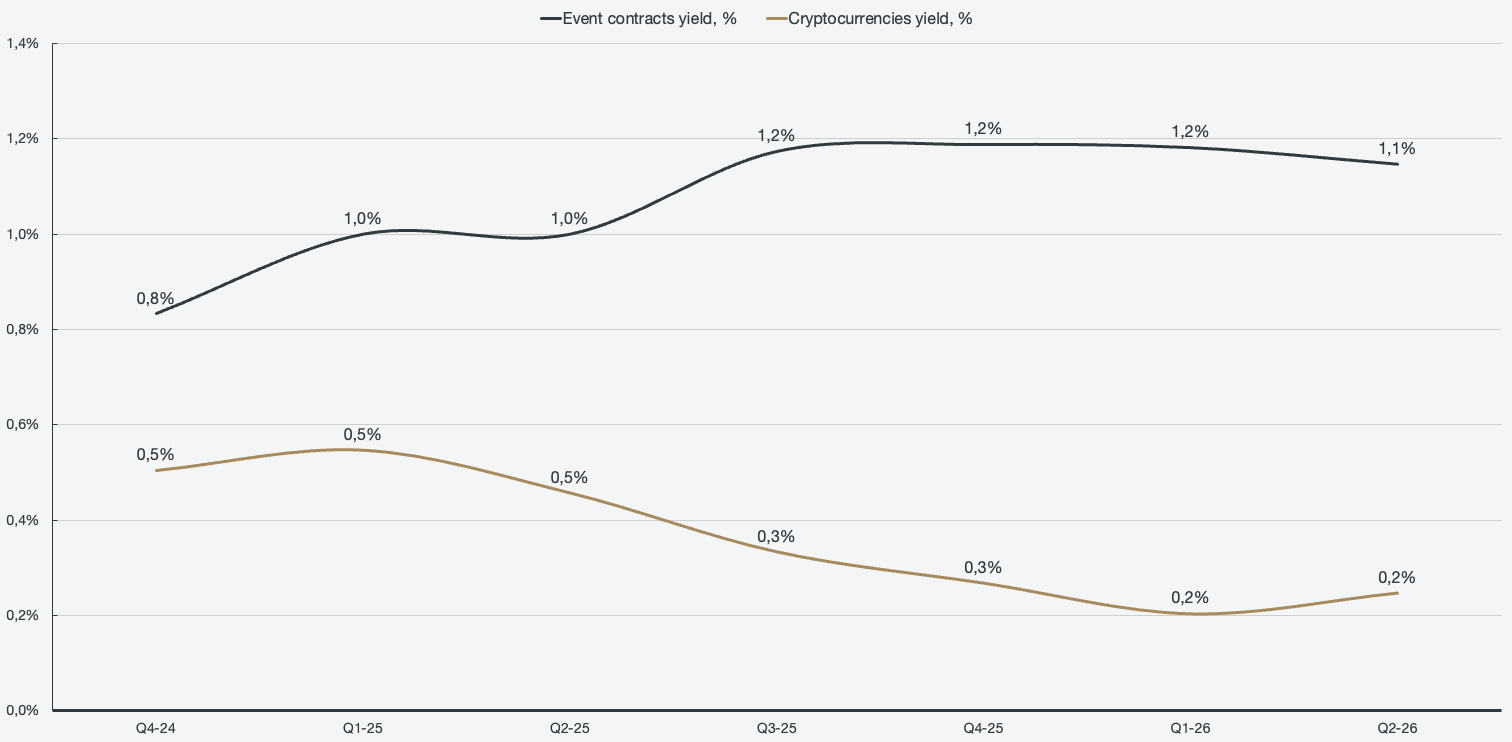
As most are aware, Robinhood discloses monthly results for two of three months in a quarter, which provides a lot of insight into what the earnings results might look like. I believe the primary cause for the stock quote’s recent collapse is the drop in cryptocurrency volumes. For a long time, crypto and options have represented the primary drivers of revenue and profits for the whole business, which is why a drop in activity can cause a lot of concern. However, crypto has been largely replaced by event contracts, an avenue with more impressive growth and way better take-rates.
Figure 2: Cryptocurrencies and event contracts yield
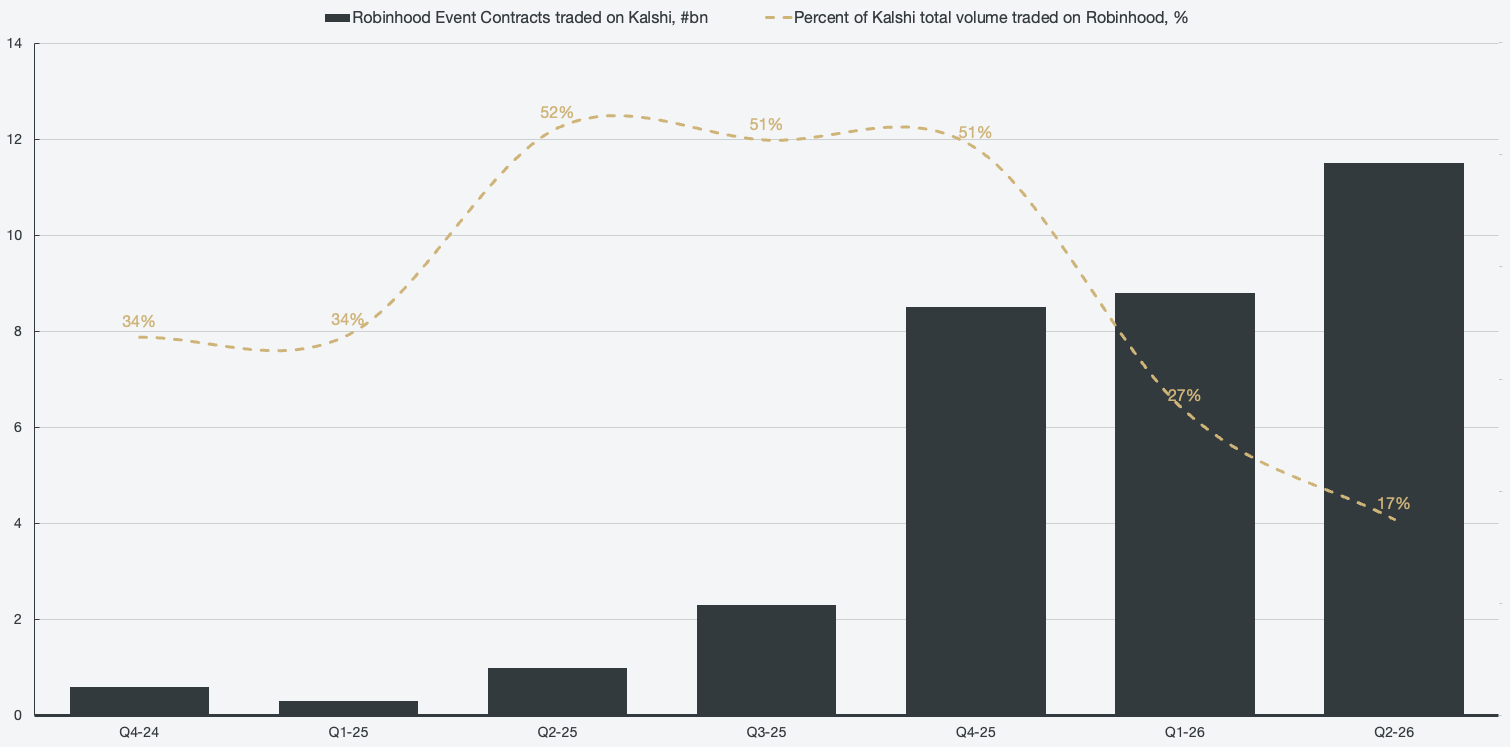
Robinhood entered prediction markets in Q4 of 2024 as a distributor by partnering up with ForecastEx, and then scaled the business from Q1 2025 with Kalshi. Robinhood provided the distribution channel, and Kalshi provided the platform; a partnership that quickly became a strategic vulnerability. By Q2 2025, more than half of all Kalshi volume was routed through Robinhood. As a response, in Q1 of 2026, Robinhood acquired MIAXdx, a CFTC-licensed designated contract market, derivatives clearing organisation, and a swap execution facility. Instead of going through the hoops of regulatory applications, Robinhood simply acquired it, which enabled the launch of Rothera in a short amount of time. Within a single month from its launch, Rothera became a top-three designated contract market.
Figure 3: Robinhood volume and share of Kalshi event contracts
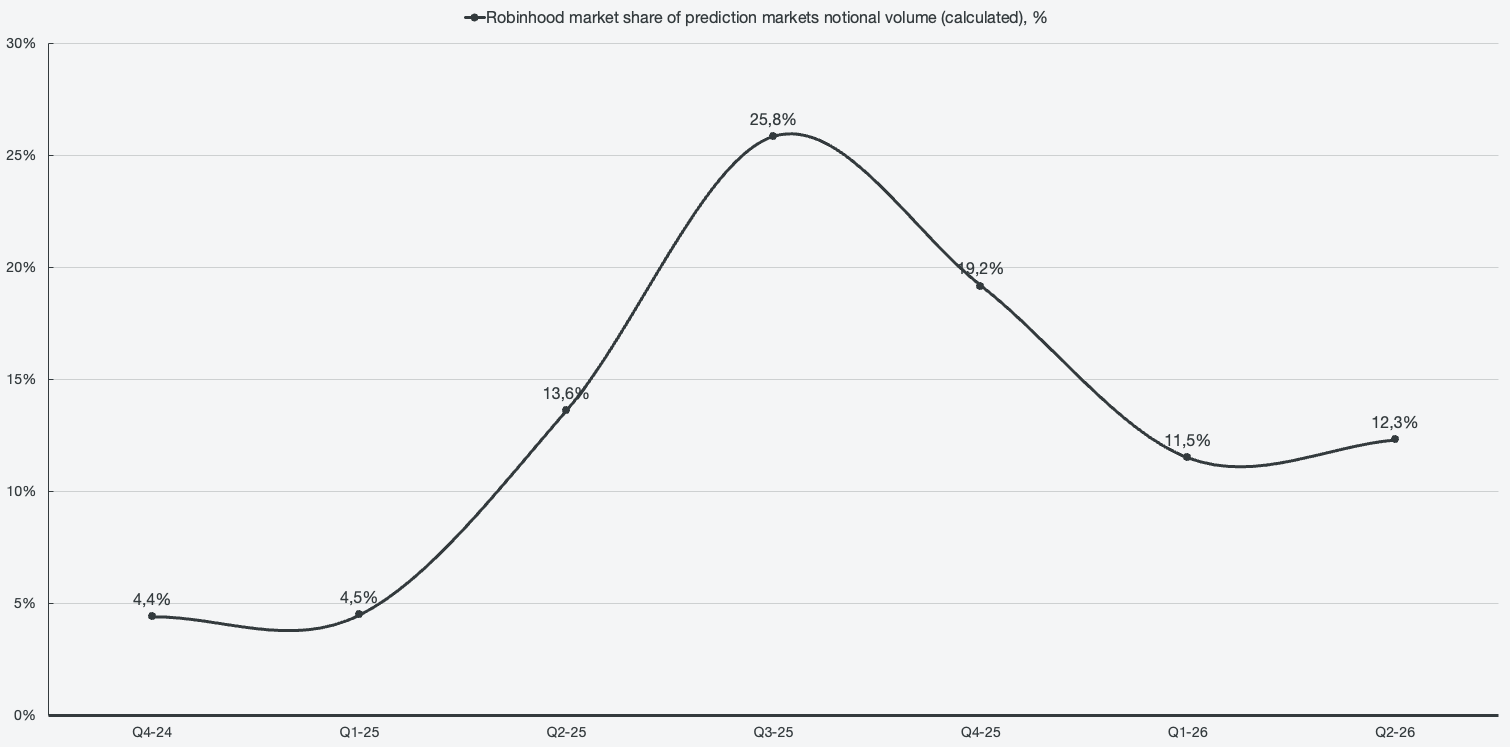
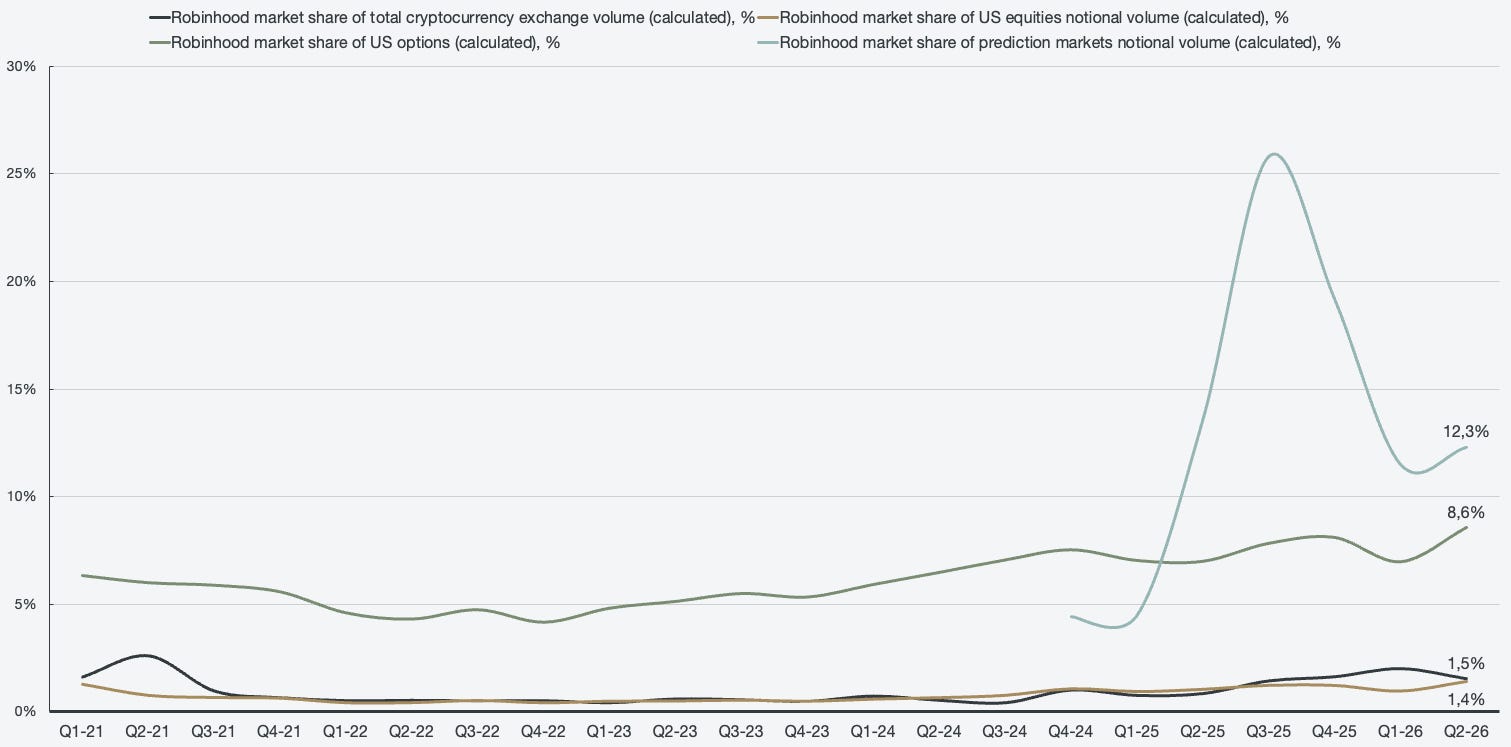
Of a total of $156 million from event contracts, $139 million was still Kalshi-routed and $17 million went through Rothera. Rothera is not controlled by Robinhood, so the economics accrue partly outside of consolidated revenue since it goes through the joint venture and non-controlling interests. The yield fell 10 basis points to 1.1%, hinting at the unit economics not necessarily being more favorable through Rothera. However, only 15% of total event contracts volume went through Rothera, making it too early to draw conclusions. Robinhood’s estimated market share of the prediction market is ~12%, down from its peak in Q3 2025 of 26%.
However, Robinhood does not participate in the wider categories of predictions that more open platforms do, and as such, will keep losing share. The upside of Robinhood’s strategy of only offering more serious prediction markets is that they will have far fewer regulatory issues down the line. Prediction markets are quickly becoming more and more obscure, with contracts being offered for events that are subject to heavy manipulation, and some are downright luck-based, such as predicting the number of cars that will pass a crossing in an allotted timeframe.
Figure 4: Prediction markets market share
There are now ~2 million customers cumulatively that have used prediction markets on the platform, up from 1.5 million in Q1 2026. The increase is likely due to the FIFA World Cup taking place in Q2, and as an event-driven segment by construction, active events matter a lot for growth. In Q3, the football season will be big, and in Q4, the U.S. midterm elections will play a big role in growth.
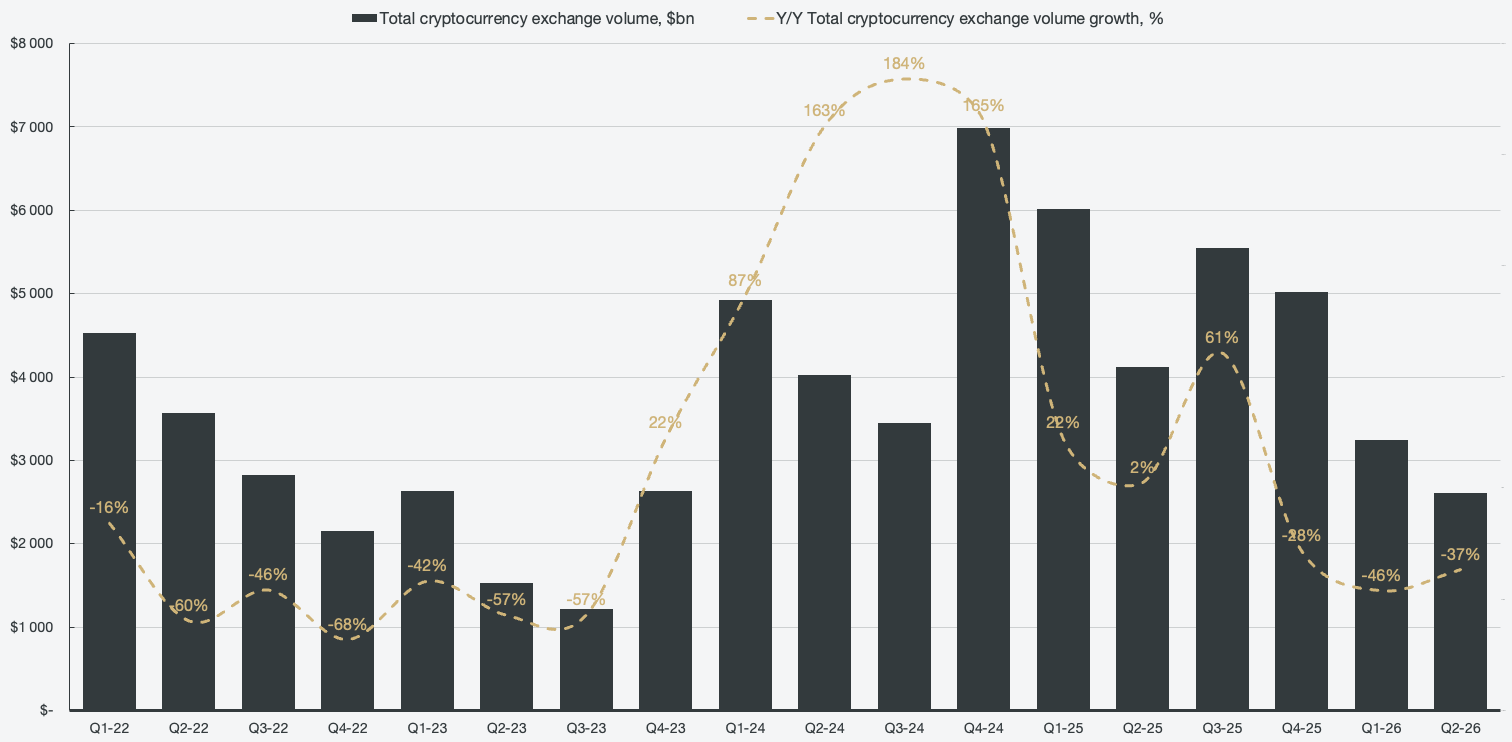
The headline could be read as Robinhood swapping a 0.25% take-rate asset for a 1.1% take-rate asset without having to win a single new customer. However, it’s not like Robinhood dropped the ball on cryptocurrencies. Total cryptocurrency exchange volume has fallen off a cliff since Q4 2024, and declined 37% Y/Y in Q2 2026. On the contrary, Robinhood nearly doubled its market share of total cryptocurrency exchange volume Y/Y, from 0.8% to 1.5%. It is not Robinhood underperforming so much as the asset class having fallen out of favor, as is the reality of a cyclical asset.
Figure 5: Total cryptocurrency exchange volume
Speaking of market share, Robinhood is on the rise in the segment that arguably matters the most: options. Options is the segment that offers the most spread, and as such, is the most profitable. Robinhood now has an 8.6% market share of total U.S. options volume, an all-time high. In addition, Robinhood grew its equity market share of U.S. equities notional volume to 1.4%, another all-time high, eclipsing even the meme-mania bubble of 2021 of 1.3%.
Figure 6: Segmented market shares
Q1 2026 showed signs of genuine cyclical pain, only growing transaction-based revenue by 7% Y/Y. However, Q2 is a massive rebound, recording 44% Y/Y growth, primarily driven by event contracts, a segment where Robinhood is gearing up to be a major player for a long time to come.