


Robinhood is far from the only stock seeing a brutal sell-off as of late. Still, it is among only a few that are severely undervalued yet among the highest-quality businesses in the market.
The last sell-off of a similar nature occurred in April of 2025, followed by a rally of ~415%. Robinhood is a better company than it was then, with greater prospects and better fundamentals. This is one opportunity we may not get many times in this stock, as the company diversifies across more lines of business and grows increasingly more dominant.
Company profile
February 27, 2026 Follow-up coverage
Direction: Buy
Previous fair intrinsic value: $172.50, as of November 25, 2025
Symbol: HOOD, Exchange: NASDAQ
Sector: Financial Services, Industry: Capital Markets
Theme: Growth
Fair intrinsic value: $158.88 (+108%), as of February 27, 2026
Market capitalization: $103 914 million
Pricing data: P/S 23x, P/E 55x
Previous coverage:

TYPEFCAPITAL.COM
Consider following me on X and YouTube.
This article is for informational purposes only and does not constitute investment advice or an offer to buy or sell securities.
2026 will be a crucial year for innovation
The execution has been unrelenting, and each new line of business has grown to be industry-leading in a relatively short time. Robinhood never seems to settle, and already has shared what the core drivers will be over the coming 10 years, as well as the priorities for 2026 in their Q4 2025 earnings presentation:
Legend: 10-year core driver
Legend: 2026 priority
Become the number one company in the active traders segment
Prediction markets
SuperApp design
Cortex, Social
Become the number one company in wallet share for the next generation
Family investing
Private markets
Global financial ecosystem
Tokenization and the Robinhood chain
Launch in new markets
In 2025, Robinhood had 55 major product and feature releases across its platforms. The narrative surrounding Robinhood is no longer that they are a mere broker; they are the fastest-shipping financial technology company in the public markets. That is also one of the main reasons that my interest in Robinhood was piqued.
Looking at prediction markets, it is remarkable how quickly Robinhood managed to become dominant. While they still do not have a majority market share across all prediction markets, they are quickly getting there. Robinhood is currently partnered with Kalshi for integrating prediction markets in the Robinhood ecosystem, and the first contracts were made available in Q4 of 2024, in relation to the presidential election. At that point, there were 300 million event contracts traded on the platform. A year later, in Q4 of 2025, there were 8,500 million contracts traded on the platform.
Figure 1: Event contracts traded on Robinhood
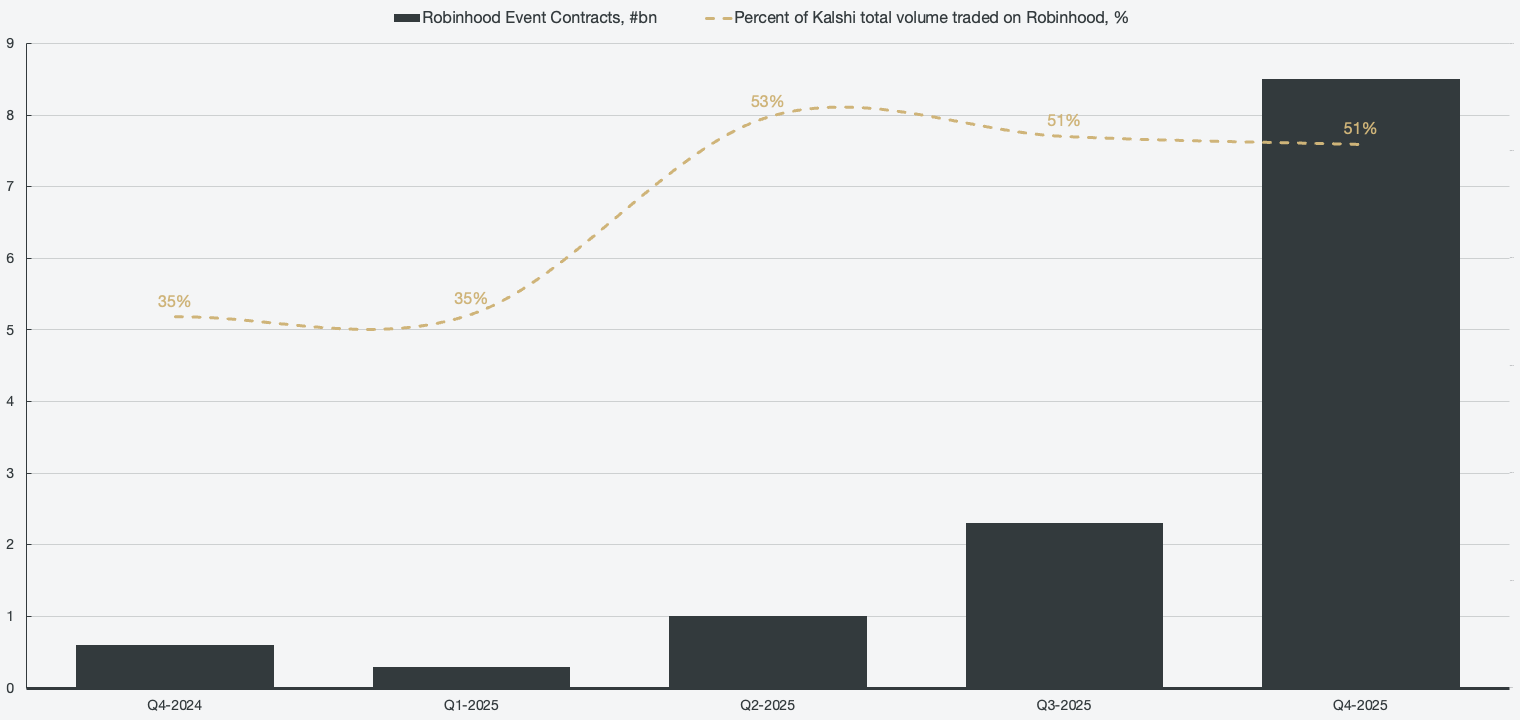
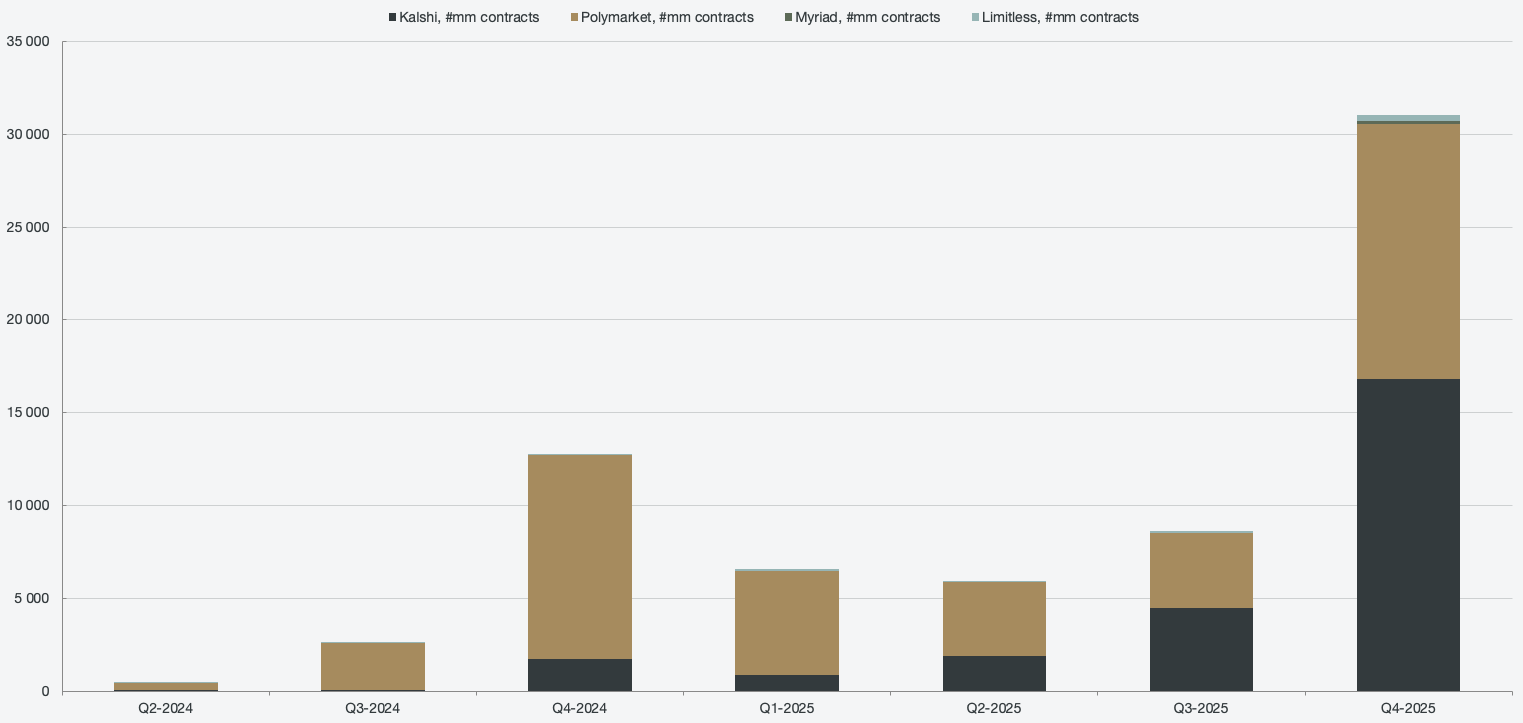
With the help of Robinhood, Kalshi has risen to become the largest prediction markets platform in the world with 54% market share. Over the past three quarters, Robinhood has accounted for a majority of the volume transacted on Kalshi. For reference, the quarter before Kalshi was integrated onto Robinhood, the platform had 2.88% market share. From Q3 2024 to Q4 2025, Kalshi has grown its notional volume by 22409%.
Figure 2: Prediction markets breakdown
With prediction markets being a core focus for 2026, Robinhood is already making major strides at the beginning of the fiscal year. On January 21 of this year, Robinhood closed a deal to acquire MIAX Derivatives Exchange (MIAXdx) through a joint venture with Susquehanna International Group (SIG). The joint venture purchased a 90% equity stake in the exchange, and I expect that most of the Kalshi back-end will be replaced through 2026. The target is a CFTC-licensed designated contract market (DCM), a derivatives clearing organization (DCO), and a swap execution facility (SEF).
MIAXdx will allow Robinhood to cut out the middleman and avoid a revenue share with Kalshi. Doing it through a joint venture with SIG provides day-one liquidity, which will help achieve reasonable spreads and reliable trade execution for the users.
Prediction markets are starting to transition from being purely retail-driven to having broader institutional adoption. Prediction markets can be used as tools for hedging macro and regulatory risks in ways previously not possible. There are other tailwinds for the markets as well; the increased adoption has triggered a cultural shift where any event is seen as a tradable opportunity. These now span across cultural events, sports, entertainment, technological advancements, and pretty much anything imaginable. Robinhood has been cautious of what type of contracts is offer, and rightfully so, as some market participants are really starting to push the limits in regard to what a prediction market can look like. Doing so is an open invitation to become regulated.
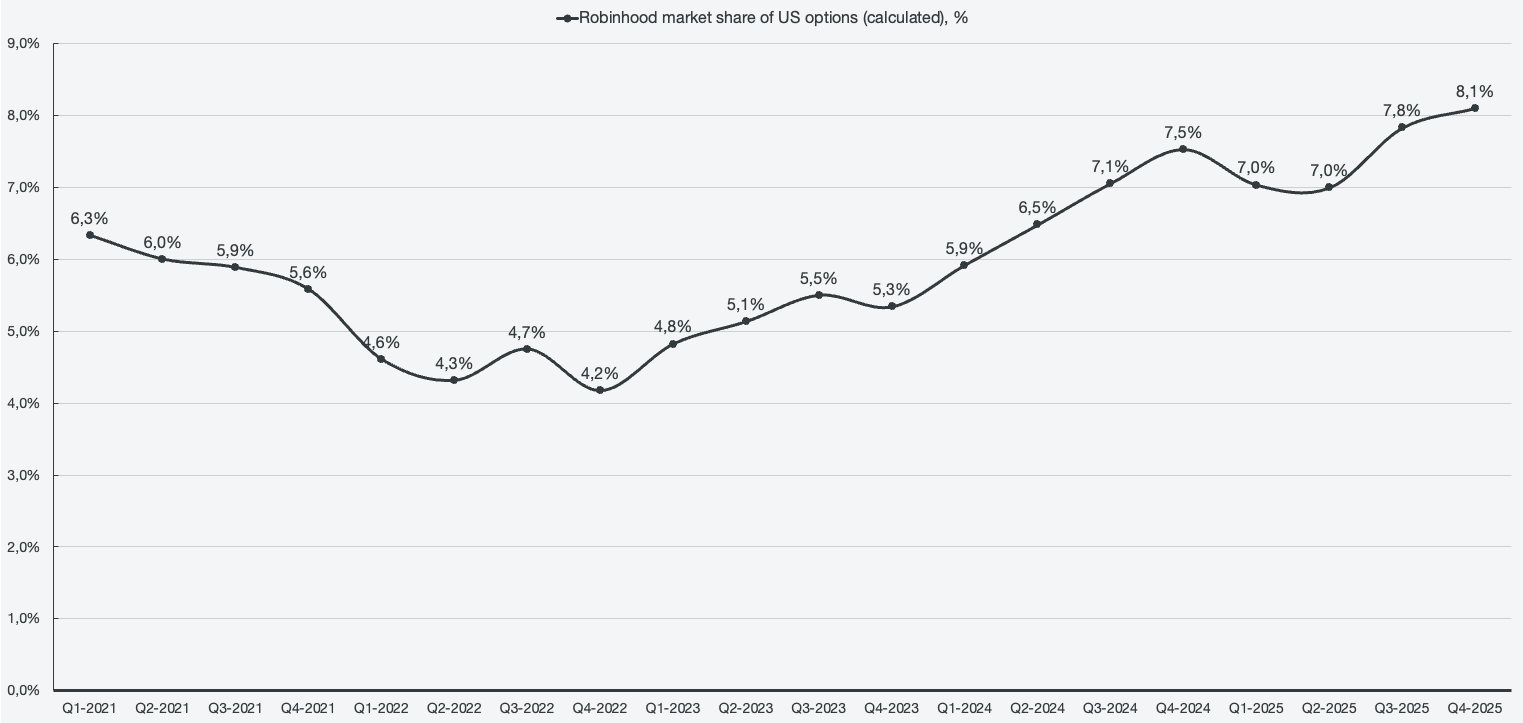
Prediction market was not the only segment in which Robinhood grew market share; it is up across the board. The two most important segments to grow market share in, however, are options and crypto, which are the two most profitable segments. The options market share grew from 6.8% in 2024 to 7.5% in 2025. The cryptocurrency share (volume measured against BTC, ETC and DOGE) rose from 0.63% to 0.78% over the same time period. Equities, while providing a lot lower yield due to the maturity of public markets, grew to above 1% for the first time in recorded history.
Figure 3: Segmented revenues
In regard to the priorities, prediction markets have been the core focus of management and investors alike, as Robinhood estimates that the PM volumes could potentially drive trillions in annual volume over time. The first year had over a $300 million run rate, making it the fastest-growing line of business in Robinhood’s history. However, the other 2026 priorities are just as exciting as the lifetime value of customers.
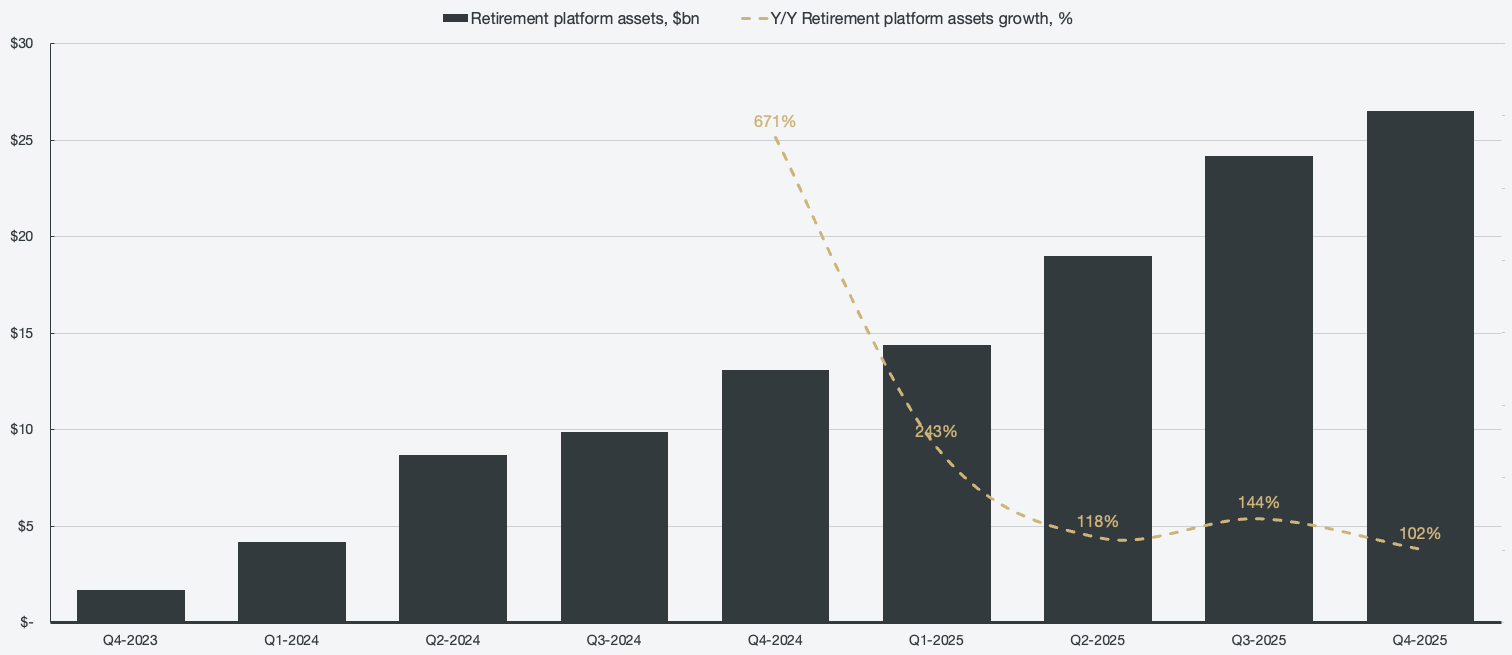
In pursuit of the SuperApp, it is important to bring on all of one’s financial needs, including the family. Robinhood has already introduced credit cards and banking, and with the start of Cortex as an assistant for financial needs, it is starting to look like customers can bring over all their assets to Robinhood’s platform. The 530A accounts, or “Trump accounts”, will allow every U.S. child born between January 1, 2025 and December 31, 2028, to be eligible to receive a $1000 contribution from the U.S. Treasury; a rollout which Robinhood is deeply involved in. Robinhood has offered technical and capital infrastructure to host these accounts, and the U.S. Treasury Department is considering Robinhood to be one of up to three initial trustees for the program. In addition, Robinhood offers retirement accounts, which have been growing at a triple-digit Y/Y growth rate every period.
Figure 4: Retirement assets under management
With the wide breadth of offerings across equities, crypto, options, and prediction markets, users have no reason to be on multiple platforms. Robinhood is also an early mover into tokenization, and currently has ~2000 stock tokens in Europe. The company has expressed a massive opportunity ahead of them where anything of value can be tokenized and traded, for example, art pieces, watches, and homes. Robinhood has already launched the Robinhood Chain on the public testnet. External developers are able to build, access, and transfer on the network without intermediaries or platform lock-in, which is a way to build out an early advantage as a first-mover as the world of finance moves towards blockchain technology. Over time, whole exchanges can exist on Robinhood’s chain.
The last incentive has a more immediate impact. Robinhood just launched a publicly traded closed-end fund, which has managed to secure shares in some highly sought-after companies like Stripe, Databricks and Revolut. The goal is to democratize venture capital, as these pre-IPO companies were historically inaccessible to average retail investors. Private placements typically come at pretty high fees and require accreditation, which Robinhood’s CEF doesn’t require. There is a flat 2% management fee, no carry, and no minimum, which makes it one of the most efficient ways to gain exposure to these kinds of companies.
