


FICO FICO 0.00%↑ has traded down 64% year-to-date, and only in yesterday’s trading session, it tanked over 25%. Yesterday’s move followed the release of a unified pricing grid for both FICO and VantageScore 4.0, which coincided with headlines that Rocket Mortgage is changing its default scoring model to VantageScore 4.0 for all eligible loans. That last part is especially important, and we will get into that shortly.
Before yesterday’s news, why has FICO been trading down for more than a year? Since FHFA Director Pulte's appointment, he has waged a crusade against FICO, which I believe is a search for a scapegoat for how the housing market weakness is perceived.
Company profile
Symbol: FICO, Exchange: NYSE
Sector: Technology, Industry: Software - Application
Theme: High quality
Fair intrinsic value: $2206 (263%), as of September 30, 2026
Market capitalization: $13 777 million
Pricing data: P/S 5.8x, P/E 16.9x
Previous coverage:

TYPEFCAPITAL.COM
Consider following me on X and YouTube.
This article is for informational purposes only and does not constitute investment advice or an offer to buy or sell securities.
Recap of events
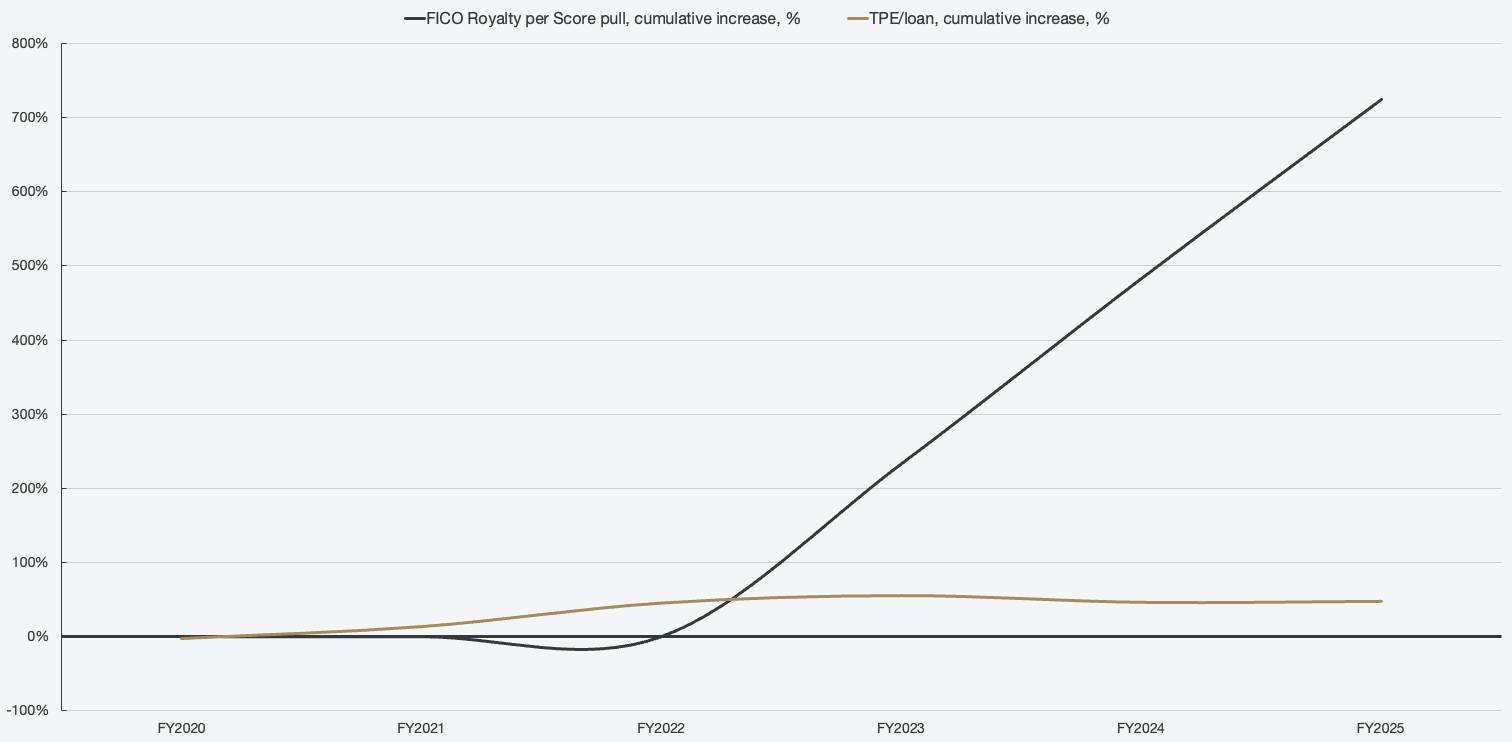
From 2020 through 2025, FICO increased the royalty per score pull by 725% cumulatively, making it ripe to frame FICO as evil in the public eye and win political points by targeting it. FICO has long enjoyed a monopoly among GSEs because of GSE eligibility requirements, and among private actors as they built financial ecosystems that relied on FICO. A summary of the timeline of announcements that have materially hurt the stock price is as follows:
October 2022: The FHFA approves both FICO 10T and VantageScore 4.0 for GSE loans with a planned multi-year implementation runway.
March 2025: Director Bill Pulte is sworn in as the FHFA director.
May 2025: Bill Pulte repeatedly targets FICO over cost increases.
Jul 2025: FHFA Director Pulte announces VantageScore 4.0 as an allowed model on all Fannie Mae and Freddie Mac loans.
End of Q4 2025 - Present: The credit bureaus lower VantageScore prices to ~$1 (Experian made it free for a limited period) as a response to FICO’s recently announced Direct License Program, which bypasses bureau markups.
March 2026: Senator Josh Hawley writes an oversight letter to FICO, citing concerns over pricing power hurting the consumer housing market.
April 2026: The FHFA launches a pilot with the 21 largest lenders for VantageScore 4.0.
April 2026: FICO changes the price of the DLP performance model from $4.95 per score in addition to a $33 funding fee, to $0.99 per score and a $65 funding fee to encourage 10T adoption.
July 2026: GSEs release historical data for both VantageScore 4.0 and FICO 10T.
September 2026: FHFA directs GSEs to accept VS4 from all approved lenders, with Pulte stating, “FICO has enjoyed a monopoly. No more.”
September 2026: GSEs publish VS4 LLPA grids with a 20-point offset.
September 2026: Pulte announced one unified LLPA grid, removing the offset.
Throughout my coverage of FICO, I have analyzed the narrative, rebuked it with data, and explained my perspective on what’s going on. In essence, I believe the following two things:
FICO’s price increases have no impact on the housing market booming or busting.
FICO was justified in increasing prices so aggressively.
The first point is the most important to clarify. FICO score pulls make up a microscopic part of mortgages. Rates, home prices, GSE fees, mortgage insurance, and closing costs are the real drivers of affordability, not FICO score pulls. Variables vary by state, lender, borrower, and other factors, but the overall consumer impact comes from loan production costs. Total production expense (TPE) also varies, and for a loan to be profitable, costs must be recouped through rates, direct up-front costs, or a mix of both. For example, if TPE is $10,000, $ 3,000 could be recouped through closing fees and the rest through rates, or it could all be through rates. The Mortgage Bankers Association (MBA) tracks production expense per loan, which can be used as a relative measure to see if FICO pricing increases affect the TPE per loan. It shows no correlation, since FICO Scores are a tiny input, and the data supports this. Cumulatively from 2020, TPE per loan increased by 45% in 2022, while FICO royalties still remained at $0.6 per pull. By 2025, TPE per loan was at 47%, while FICO had increased by 725%. In 2020, a FICO score pull was equivalent to 0.01% of TPE, and in 2025 after all the price increases, it was 0.04.
Figure 1: FICO royalty per score pull and total production expense per loan, cumulatively
I go into more detail on why FICO score royalties don’t materially impact mortgage borrowers as I dissected Senator Hawley’s oversight letter to FICO in this article.
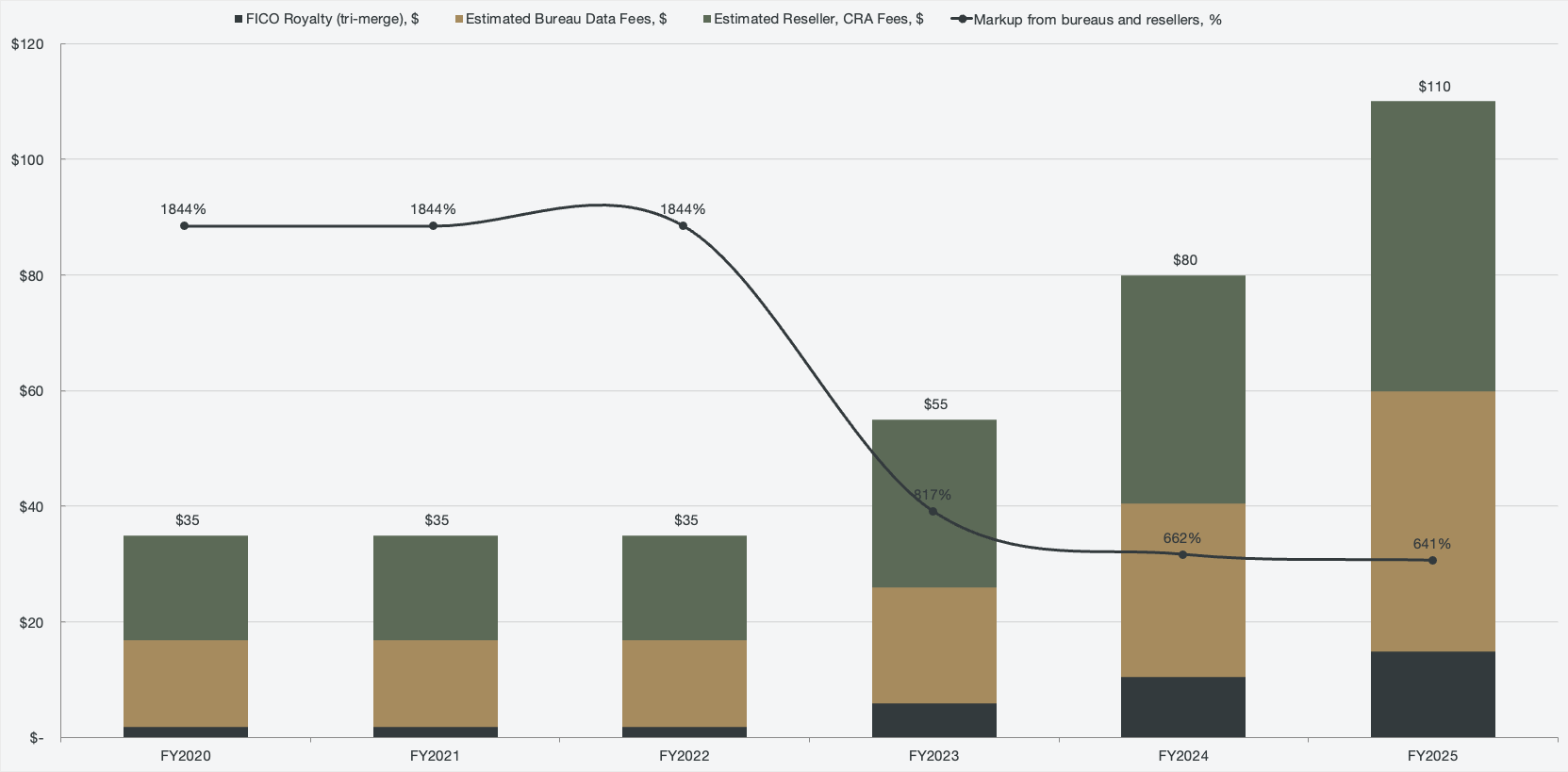
Next, why FICO was justified in increasing its prices. FICO received an estimated 5% royalty per tri-merge report. Given how central the score is to lending decisions, FICO was severely underpriced. The markup from bureaus and resellers was estimated 1850% from 2020 through 2023, when FICO first raised its price. Even after a 725% increase, FICO’s share of a tri-merge report was 14%, with bureaus and resellers having a 641% markup. Credit data from the bureaus and reseller services also have costs associated with them, so this isn’t an exact markup estimate, but it shows a directional share distribution. Since the costs are bundled and appear as a single item, it all appears like FICO is making out like a bandit, something the FICO DLP program changes. FICO was underpriced relative to its value, and the limit of its pricing power is not economic, but political.
Figure 2: Estimated costs per credit score pull and markup from bureaus and resellers
I believe the FHFA’s Director frequently targets FICO because it is easy to point to score-royalty increases for the public, rather than discussing the real drivers of mortgage affordability.
Present-day impact
Two news headlines tanked FICO's stock price in a single day by an amount not seen in decades. Before we dive deeper, it helps to understand how FICO earns score revenue, who is involved, and how a loan moves.
Players
Lender
Fronts money when a mortgage closes. Examples include Rocket Mortgage, UWM, and Wells Fargo.
Broker
A middleman service that introduces borrowers to lenders. Does not lend its own money, but gets paid a commission per loan that gets underwritten.
Credit bureaus
Equifax, Experian, and TransUnion hold separate files on borrowers’ debts and payment history. They use that data to score credit with a model.
FICO
Owns the formula, the mathematical model used to produce a FICO score using bureau borrower data. It owns no data.
VantageScore
A competing formula owned by the three credit bureaus.
Fannie Mae and Freddie Mac (the GSEs)
They buy loans from lenders, guarantee them against default, and package them into bonds (mortgage-backed securities), which are then sold to investors.
The lenders typically don’t keep mortgages. Once they lend the money, they sell the loan promptly to get their cash back and use that capital to lend more. They gain on the sale of the loan in addition to fees, and often keep loan servicing rights, where they collect payments for a fee.
The loan can be sold to different parties depending on the loan type. Loans that conform to GSE rules go to Fannie or Freddie; GSE loans make up roughly half the market and must meet a specific loan-size limit to qualify. FHA (Federal Housing Administration) and VA (Department of Veterans Affairs) loans go to Ginnie Mae, and Jumbo and non-standard loans stay with the bank or are sold to private investors. Each buyer has its own rules, including which credit scores it accepts. Until 2025, GSEs accepted only Classic FICO scores, which the FHFA has now targeted.
Loans reach a lender through either retail, wholesale, or a correspondent. Retail is direct-to-consumer, where the borrower applies straight to the lender, and the lender pulls the credit. That’s about 57% of Rocket’s volume. In wholesale, the borrower goes to a broker, who submits the loan to a wholesale lender such as UWM or Rocket Pro, and the broker runs the application while the wholesale lender still underwrites, funds, and sells the loan. Correspondent loans consist of smaller lenders making the loan themselves, then selling it to a bigger aggregator, which sells it to GSEs. Each channel has a different answer on who chooses the score, which is why Rocket Mortgage explicitly stated that VantageScore 4.0 is the default for eligible loans.
Step by step through a loan
The borrower applies for a loan, and the lender orders a tri-merge report. The bureaus run each file through FICO’s formula, and FICO charges a fee for each score (three per report).
Repeated pulls may happen at pre-qualification, at application, and again before closing. Most applicants never close, but every pull still pays FICO.
The score feeds the GSE’s automated underwriting system as long as minimum score values are met, alongside income, debt-to-income, loan-to-value, and assets.
The score and LTV put the loan in a cell on the GSE fee grid (the LLPA). A lower score or a higher LTV means a bigger upfront fee, which the lender passes on to the borrower as points or a higher rate.
The loan closes, and the lender sells it to Fannie or Freddie. The score is sent with the loan, and the GSE, the insurers, and the bond investors all use it.
When the GSEs started accepting VantageScore 4.0, lenders had no reason to switch because it would mean rebuilding their internal systems. Even though approved lenders could deliver VantageScore loans earlier this month, they had no incentive to do so as loans still paid a 20-point penalty on the GSE fee grid. Yesterday, the unified fee grid was released, and the 20-point penalty was removed. VantageScore averages ~13 points higher than Classic FICO for the same borrower, which puts the borrower in a cheaper price cell. Now, lenders have a reason to utilize VS, as cheaper loans win more borrowers.
This does not mean lenders use only VS or only FICO; using both increases the chances of underwriting a mortgage, which is in the lender's interest. They want to qualify as many borrowers as possible.
The problem
Rocket Mortgage did not choose VS4.0 as its default because it is cheaper than FICO scores; it is almost irrelevant. What matters is that VS4.0 often gives a higher number on the grid, which means lower fees. GSEs have to go along with it because they are not independent actors, and the FHFA director, Pulte, who is orchestrating this, appointed himself the chairman of both Fannie Mae and Freddie Mac’s boards.
Fannie and Freddie have been in government conservatorship since the 2008 mortgage crash. The single grid released is an FHFA policy decision, and its implications could cause problems for the economy as a whole. Lowering fees cuts the borrower’s costs immediately, without involving Congress or the Fed. It also suits the political narrative that FICO is the villain.
A unified grid invites gaming, where formulas are incentivized to qualify more people at higher grid brackets. As a result, the system introduces significant risk: a borrower may qualify for a loan using VS4.0 but not using Classic FICO. Credit losses won’t show up immediately, and if defaults escalate, taxpayers are the backstop. Using a grid that doesn’t differentiate or adjust for which score was used, the most optimistic score wins, not the most accurate one.
However, policy reversals can happen as quickly as they were introduced. GSEs set the fee grid themselves, and if VantageScore loans perform worse, they can act. If loans delivered on VS start defaulting worse than their price bucket implies, the offset between the formulas will likely be reintroduced. The FHFA also wants to IPO Fannie and Freddie, and giving away fees while taking on underpriced credit risk lowers the market value. Leadership changes at FHFA can also quickly reverse policies. The bureaus owning both the data and the scoring model may raise eyebrows for regulators as well, especially if per-loan optimization starts showing up in the data.
The FHFA essentially makes the current policy decision, not because VantageScore is better or because royalty prices matter. I believe it is because optics look good in the public eye if they are acting, and a good target is FICO, even though FICO’s impact on mortgage affordability is irrelevant.
Rocket’s decision to default to VS4.0 for eligible loans is a small hit to FICO on its own, but it highlights the real problem, which is the single pricing grid. Rocket will use VS 4.0 by default for direct-to-consumer loans sold to GSEs. However, it still uses FICO for FHA, jumbo, second-home, investment-property, and home-equity loans. Rocket Pro, its broker channel, still offers both and lets the broker choose. The decision can be reversed; it is just more favorable to default to VS4.0 currently, and a default doesn't mean it's exclusive either. An average increase in points doesn't mean it will always score higher than FICO on the grid, so it makes sense to pull FICO as well, which means FICO still gets paid.
FICO 10T is not approved for GSE delivery yet, only Classic FICO. When 10T lands, it might score more favorably on the grid, reversing Rocket’s decision and making VS4.0 obsolete.
FICO, the gold standard.
When lenders are free to choose a model, they have picked FICO for over 20 years. In credit cards, auto, and personal loans, no regulator is forcing FICO. VantageScore has been cheaper or even free for two decades, and still has a 1-5% share. The GSE shift isn’t lenders suddenly preferring VS, it’s the GSEs paying them to use it through the fee grid. That only lasts while the subsidy does. In addition, lenders often pull credit before the loan type is known, so whether a borrower ends up FHA, jumbo, conventional, etc. is often decided after the credit pull. So even though Rocket has chosen VS4.0 as its default, many still order FICO for most applicants.
Cards, auto, personal loans, FHA, jumbo, bank-held mortgages, second homes, investment properties, and home equity all stay on FICO. These models have been built around FICO for decades. I saw a comment stating that VS4.0 is just the beginning, and that more models are coming through AI and other incumbents. These suggestions severely undermine the ecosystem built specifically for FICO, even while competition was available for free. Portfolios would have to be re-rated, regulators would have to get involved, and all players would have to align. That is a very unlikely and costly scenario.
Even in the worst case, if VantageScore takes away not only half of GSE revenue from FICO but half of all score revenue, FICO is still undervalued at these levels ($1125 fair intrinsic value).