


Note: This follow-up equity research report won’t dive deep into every segment of the business; instead, it will discuss the narrative looming over FICO and what has caused the stock to sell off dramatically. For more detailed research on each segment of FICO’s business, please see my previous FICO research reports.
Everyone already knows what a fantastic business FICO is; at least you would know if you’ve been reading my coverage or glanced at the company's financials. That is not a surprise to anyone. The stock is dropping like a rock not because FICO hasn’t been putting up the numbers, but because it has been relentlessly targeted politically, for what I believe is a public scapegoat for unsustainable housing.
Looking at the stock chart, the drops have been directly correlated with political interference. For a detailed history of each event, please refer to my previous coverage on FICO.
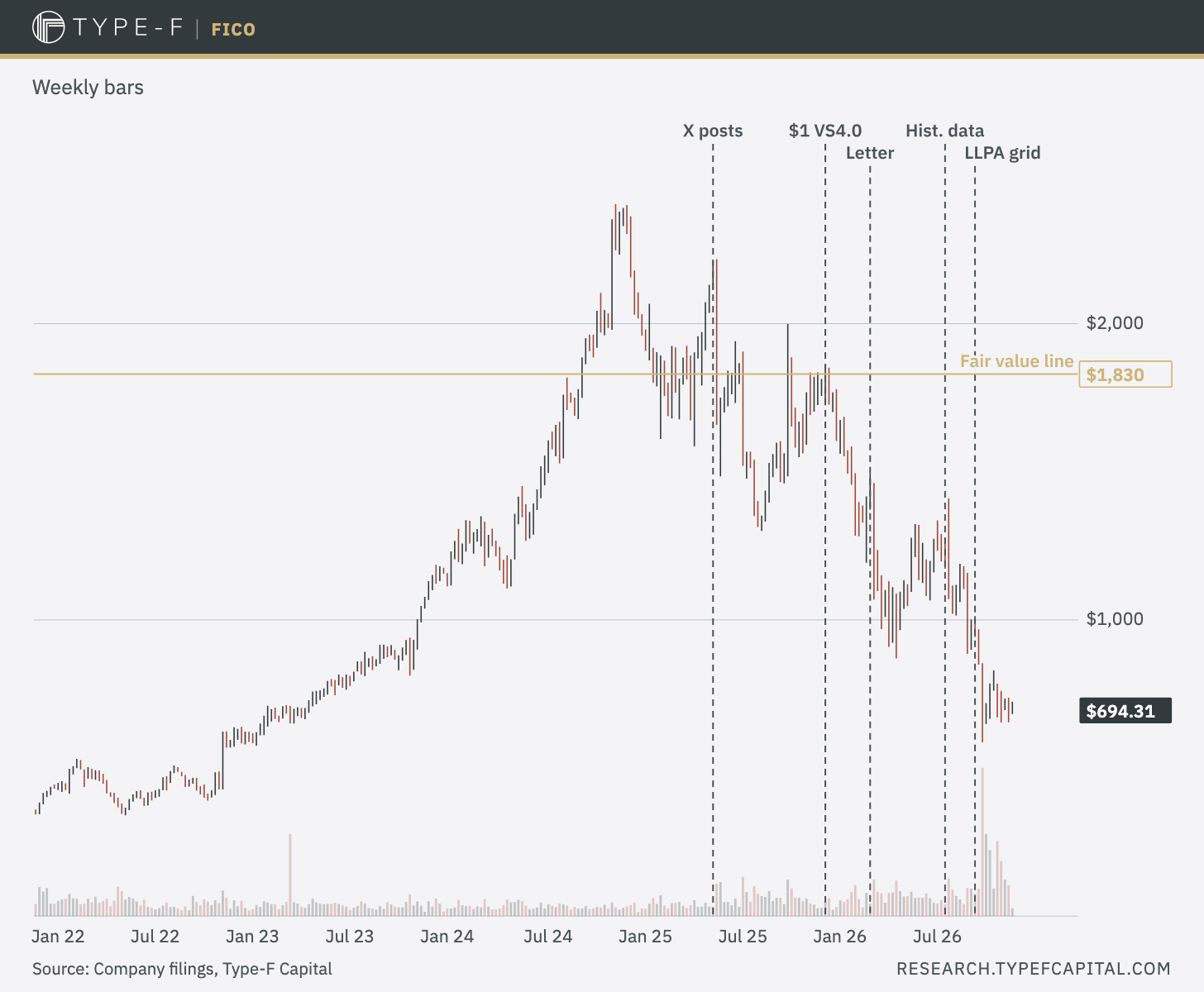
The question for investors can be divided into three parts:
Is FICO’s monopoly as the gold standard at risk, and are they losing market share?
Are the days of FICO’s pricing power gone?
Will there be more political intervention, affecting questions 1 and 2?
Company profile
November 23, 2026 Follow-up coverage
Direction: Buy
Previous fair intrinsic value: $2269, as of August 25, 2026
Symbol: FICO, Exchange: NYSE
Sector: Technology, Industry: Software - Application
Theme: High quality
Fair intrinsic value: $1849 (166%), as of November 23, 2026
Market capitalization: $15 957 million
Pricing data: P/S 6.3x, P/E 19.1x
Previous recent coverage:


TYPEFCAPITAL.COM
Consider following me on X and YouTube.
This article is for informational purposes only and does not constitute investment advice or an offer to buy or sell securities.
Outperforming despite headwinds
It is easy to get caught up in the moment when pessimistic news headlines are dropping left and right, causing the stock to drop. Despite the insistent headlines, FICO kept reporting what I felt were great earnings results each quarter, and all the data points I looked at pointed in a direction that said that FICO was not losing market share. In fact, the opposite was happening; FICO was increasing its share of revenue in the mortgage market.
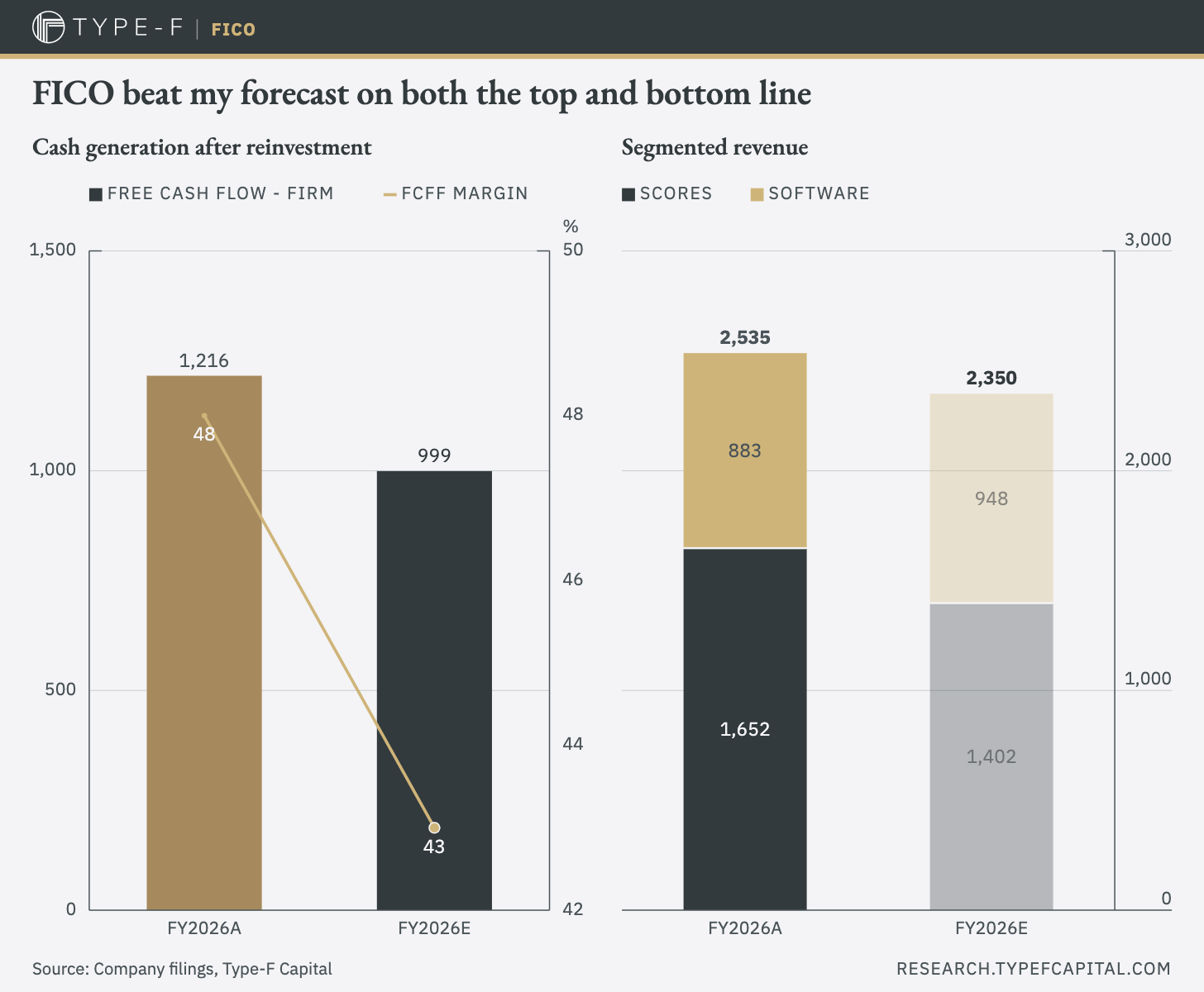
I zoomed out back to the start of 2026, when FICO reported its FY2025 results. I took my then forecast for FY2026, made when FICO was still trading at around $1,600-$1,800 per share and many of the bad headlines had not yet started hitting. Meaning, the most pessimistic implications for the years had not yet made it into my forecast. I extracted the revenue and free cash flow to the firm estimates, and the actual FY2026 results are quite interesting:
Actual revenue came in 8% higher than my forecast
FCFF came in 22% higher than my forecast
FICO, in a year when they were supposedly losing market share to VS4.0, with their gold standard at risk, completely blew past my forecast before most of those headlines materialized. FCFF margins were 48% against my 43% forecast, and Scores revenue came in at $1,652 million against my forecast of $1,402 million (18% higher).
You can double-check my forecast in my model here:

Did FICO lose sales to VantageScore with the GSEs?
Throughout the year, we have gotten numerous comments from FICO executives noting that they are not seeing any loss of volume, and they were not showing up in the results either.
Q1
CEO Lansing:
“it's very, very hard to just substitute one score for another, a VantageScore for a FICO Score.”
Q2
CFO Weber:
"we do not anticipate share loss to competition in any vertical."
CEO Lansing:
"We anticipate no loss of volume to Vantage in this fiscal year."
"As near as we can tell, nobody's paying for Vantage scores."
On VS substitutability and share: “If I had to ballpark, I would call it 2%."
"I think it's trivial, is what I would say."
"the lenders use FICO Classic and they use FICO 10T, and they don't use Vantage."
"If we were losing market share, you'd see it in our numbers, and you don't see any of that."
"There's not a good reason for them to take any share at all."
"there may be opportunities for Vantage based on the gaming."
“something like 20 mortgages have been securitized with Vantage scored paper.”
"Again, I don't see volume loss for FICO."
Q3
CEO Lansing:
"are we seeing volume loss? No, we are not, which suggests that they're pulling both scores."
"the VantageScore is additive to the market, makes the market bigger."
"Vantage is such a small part of the market, it's not clear that any of it is really providing real signal."
"We think there's a limit to how big gaming can get."
Q4
CFO Weber:
"In the quarter, we saw no meaningful loss of volume to competition."
CEO Lansing:
If VS entry affected share in non-conforming mortgage, auto, or card: "We have not seen any, no."
From the quotes, one comment is particularly important: the one on gaming. For example, Rocket Mortgage chose to default to VS4.0 for all eligible GSE loans, not because it is cheaper than FICO. Instead, VS4.0 often gives a higher number on the grid, which means lower fees. The FHFA forced a unified grid to create a competitor to FICO among GSEs, but that system introduces significant risk.
VS4.0 places about 20 points higher on the unified LLPA grid than FICO Classic for the same borrower, often resulting in a cheaper price cell since the LLPA matrix is in increments of 20. This incentivizes gaming because formulas could be construed to qualify more people at higher grid brackets, introducing risk to the system where credit losses are not immediately apparent. If defaults start escalating, taxpayers become the backstop. It has nothing to do with a FICO score costing more or less than a VantageScore; the most optimistic score is set to win, rather than the most accurate one.
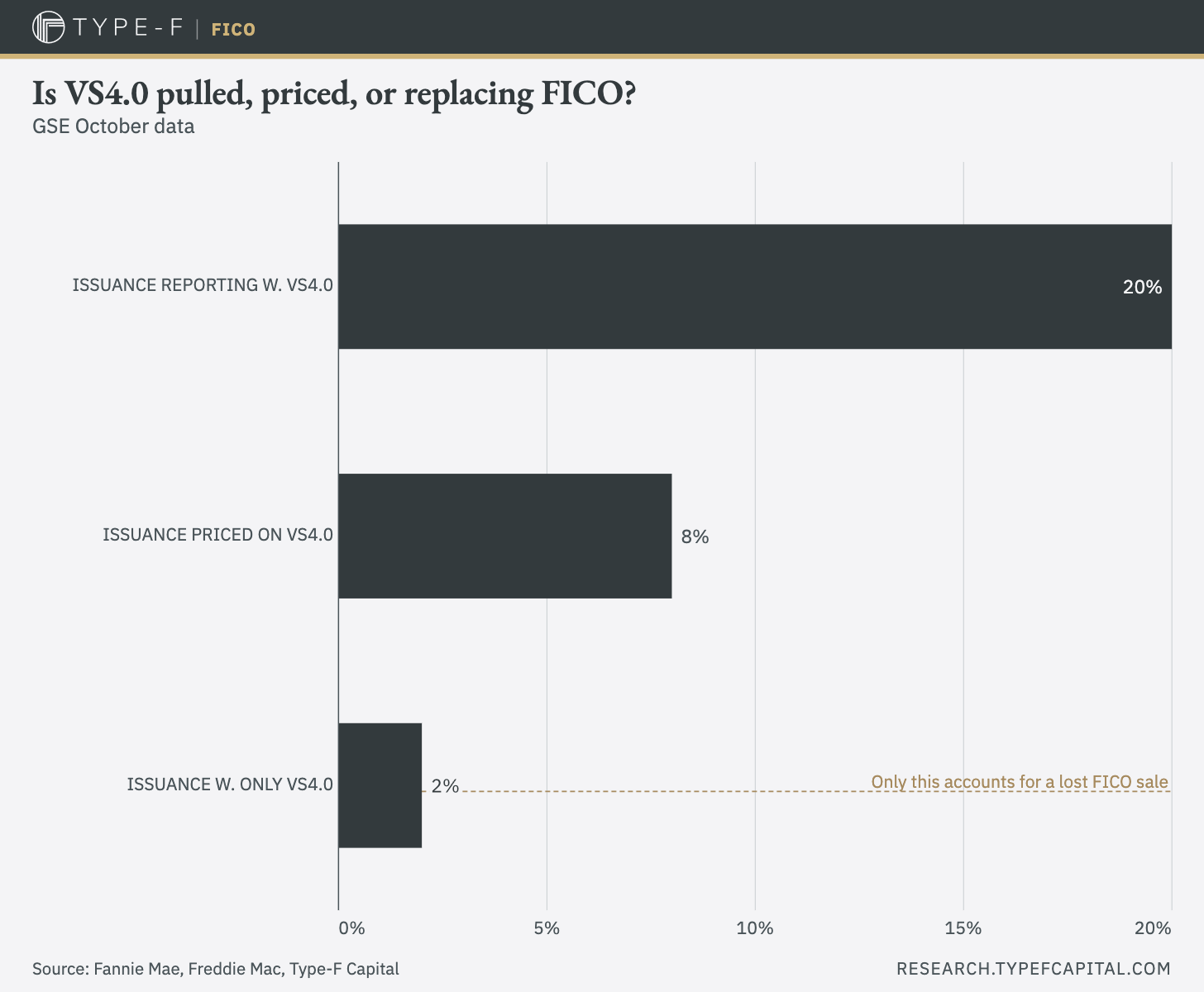
However, even if VantageScore 4.0 is used as the pricing score, that does not mean that FICO loses sales. Loan-level counts from KBW show VS4.0 as the pricing score on 0.7% of new GSE loans in June, 4.4% in July, and 5.6% in August, before dropping to 5.5% in September. Adoption is fairly narrow, with Rocket Mortgage and United Wholesale Mortgage delivering 99% of VS4 loans in August and 95% in September and October. By November, 173 sellers were pulling VS4.0 scores, but only 37 were pricing with them, and among those lenders (except Rocket and UWM), only 1% of production was priced on VS4.0.
Why is that important? Because despite adoption in sheer percentage terms, it does not materially matter for FICO’s results. In October, only 2% of issuance carried a VS4.0 score with no FICO score, and only those 2% mean sales loss for FICO. Of the loans priced on VS4.0, 3/4 also carried a FICO score in the file. Because of the gaming, it makes sense to pull both scores and then price based on the most optimistic one.
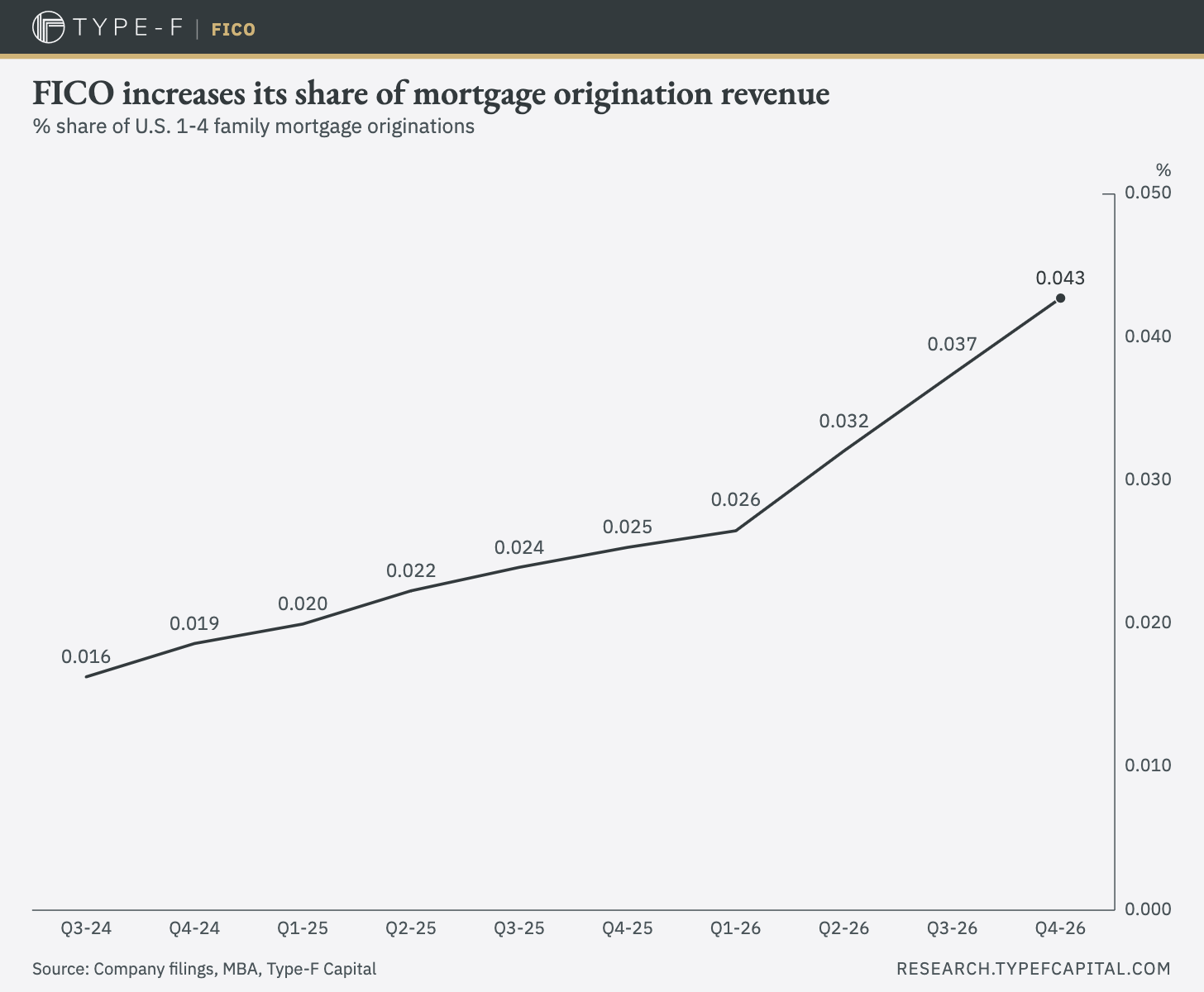
Based on reported financial results from the public credit bureaus, an increasingly large share of mortgage-related revenue growth is attributed to FICO. As quarters passed and VantageScore 4.0 adoption increased, FICO made up a larger share of total mortgage revenue growth each quarter at both bureaus. Equifax USIS mortgage revenue grew 28% in Q3 2026, but only ~2% was excluding FICO, in a quarter that saw peak VantageScore 4.0 adoption at the GSEs.
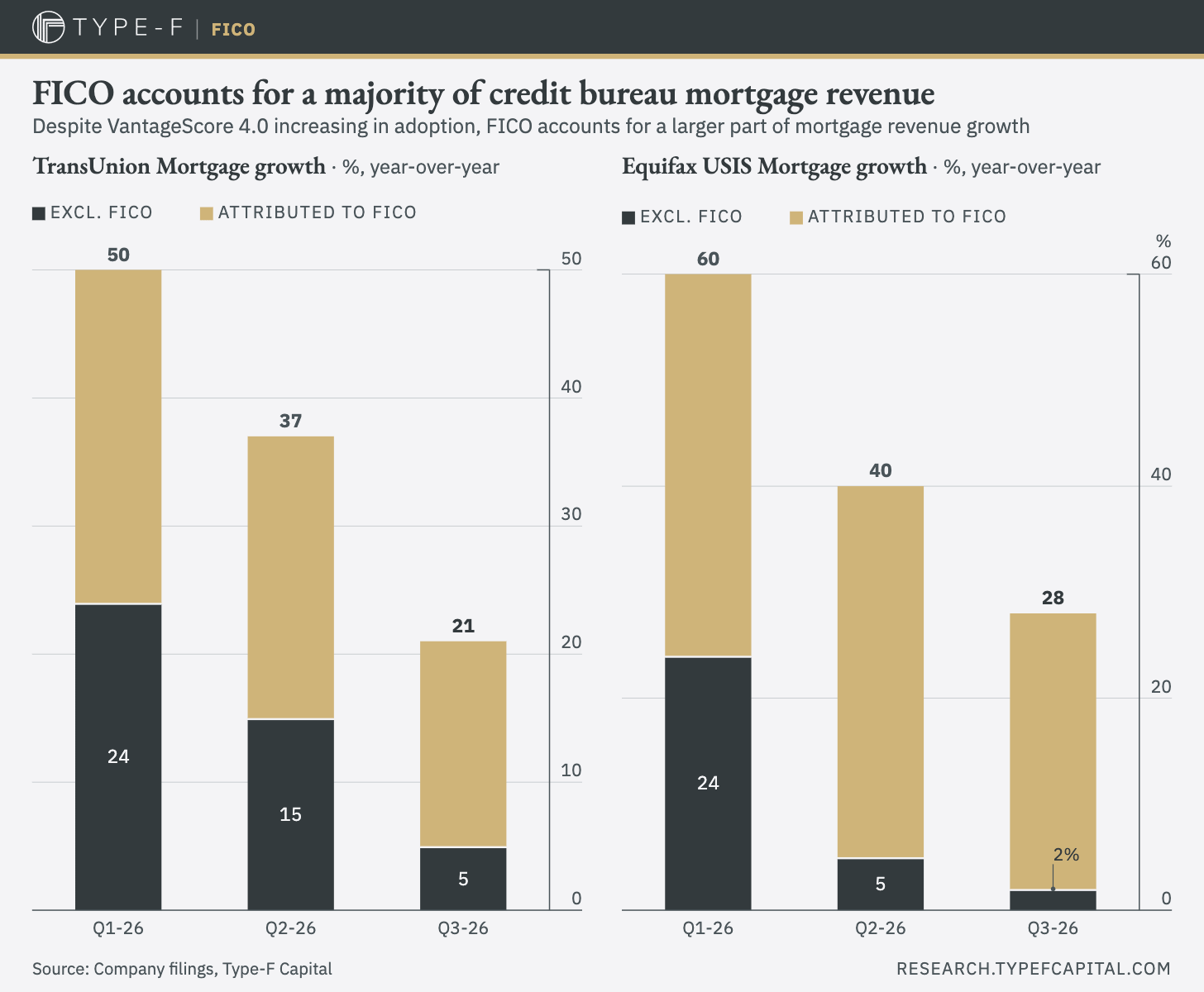
The credit bureaus benefit from larger FICO volumes and price increases, and would lose significant revenue if they actually outcompeted FICO (which they are not). While credit bureaus are struggling to grow their revenue on their own, FICO has increased its share of mortgage origination dollars as VS4.0 adoption has grown.
Card loans, auto loans, and personal loans were never protected by regulation, and as such, nothing has materially changed in 2026 on that end. FICO remains the industry standard.